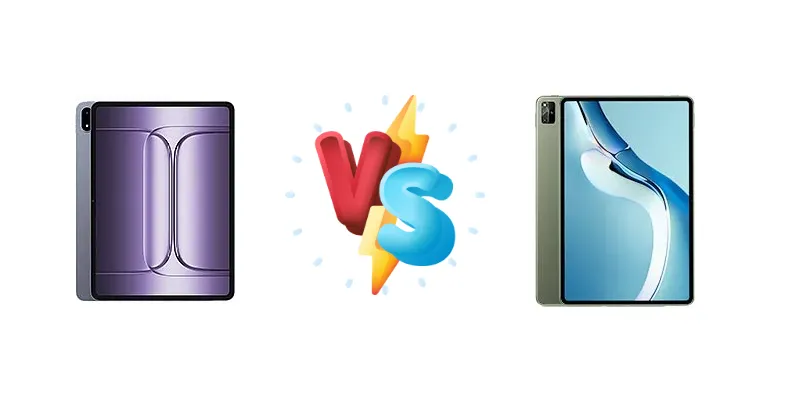
The tablet market is heating up, with the OnePlus Pad 3 entering the fray as a performance-focused contender against the established Huawei MatePad Pro 12.6 (2021). While the Huawei device benefits from a mature software experience and versatile charging options, the OnePlus Pad 3 aims to disrupt with the latest Qualcomm Snapdragon 8 Elite chipset. This comparison dissects the key differences to help you determine which tablet best suits your needs.
🏆 Quick Verdict
For users prioritizing raw performance and future-proofing, the OnePlus Pad 3 is the clear winner. Its Snapdragon 8 Elite chipset and 80W charging significantly outperform the Kirin 9000E and 40W charging of the Huawei MatePad Pro 12.6 (2021). However, the Huawei tablet remains a strong choice for those deeply embedded in the Huawei ecosystem and valuing wireless charging convenience.
| Network |
|---|
| 2G bands | N/A | GSM 850 / 900 / 1800 / 1900 |
| 3G bands | N/A | HSDPA 800 / 850 / 900 / 1700(AWS) / 1900 / 2100 |
| 4G bands | N/A | 1, 2, 3, 4, 5, 7, 8, 9, 12, 17, 18, 19, 20, 26, 28, 32, 34, 38, 39, 40, 41, 42, 66 |
| 5G bands | - | 1, 3, 5, 7, 8, 28, 38, 40, 41, 66, 77, 78, 79, 80, 84 SA/NSA |
| EDGE | No | - |
| GPRS | No | - |
| Speed | - | HSPA, LTE, 5G - cellular model only |
| Technology | No cellular connectivity | GSM / HSPA / LTE / 5G |
| Launch |
|---|
| Announced | 2025, June 05 | 2021, June 02 |
| Status | Available. Released 2025, June 19 | Available. Released 2021, June 25 |
| Body |
|---|
| Build | Glass front, aluminum frame, aluminum back | - |
| Dimensions | 289.6 x 209.7 x 6 mm (11.40 x 8.26 x 0.24 in) | 286.5 x 184.7 x 6.7 mm (11.28 x 7.27 x 0.26 in) |
| SIM | No | Nano-SIM (cellular model only) |
| Weight | 675 g (1.49 lb) | 609 g (1.34 lb) |
| Display |
|---|
| Resolution | 2400 x 3392 pixels (~315 ppi density) | 2560 x 1600 pixels, 16:10 ratio (~240 ppi density) |
| Size | 13.2 inches, 530.0 cm2 (~87.3% screen-to-body ratio) | 12.6 inches, 460.3 cm2 (~87.0% screen-to-body ratio) |
| Type | IPS LCD, 68B colors, Dolby Vision, 144Hz, 900 nits (HBM) | OLED |
| Platform |
|---|
| CPU | Octa-core (2x4.32 GHz Oryon V2 Phoenix L + 6x3.53 GHz Oryon V2 Phoenix M) | Octa-core (1x3.13 GHz Cortex-A77 & 3x2.54 GHz Cortex-A77 & 4x2.05 GHz Cortex-A55) |
| Chipset | Qualcomm SM8750-AB Snapdragon 8 Elite (3 nm) | Kirin 9000E 5G (5 nm) - Wi-Fi modelKirin 9000 5G (5 nm) - 5G model |
| GPU | Adreno 830 | Mali-G78 MP22 - Wi-Fi modelMali-G78 MP24 - 5G model |
| OS | Android 15, ColorOS 15 | HarmonyOS 2.0 |
| Memory |
|---|
| Card slot | No | Nano Memory (dedicated slot) |
| Internal | 256GB 12GB RAM, 512GB 16GB RAM | 128GB 8GB RAM, 256GB 4GB RAM, 256GB 8GB RAM, 256GB 12GB RAM, 512GB 12GB RAM |
| Main Camera |
|---|
| Dual | - | 13 MP, f/1.8, (wide), PDAF
8 MP, f/2.4, (ultrawide)
TOF 3D |
| Features | Color spectrum sensor, LED flash | LED flash, HDR, panorama |
| Single | 13 MP | - |
| Video | 4K@30fps, 1080p@30ps, gyro-EIS | 4K@30fps, 1080p@30fps |
| Selfie camera |
|---|
| Single | 8 MP | 8 MP, f/2.0 |
| Video | 1080p@30fps | 1080p@30fps |
| Sound |
|---|
| 3.5mm jack | - | No |
| 35mm jack | No | No |
| Loudspeaker | Yes, with stereo speakers (8 speakers) | Yes, with stereo speakers (8 speakers) |
| Comms |
|---|
| Bluetooth | 5.4, A2DP, LE, aptX HD | 5.2, A2DP, LE |
| NFC | No | No |
| Positioning | No | GPS, GLONASS, BDS, GALILEO, QZSS - cellular model only |
| Radio | No | No |
| USB | USB Type-C 3.2, OTG, accessory connector | USB Type-C 3.1, OTG |
| WLAN | Wi-Fi 802.11 a/b/g/n/ac/6/7, dual-band | Wi-Fi 802.11 a/b/g/n/ac/6, dual-band, Wi-Fi Direct |
| Features |
|---|
| Sensors | Accelerometer, proximity (accessories only), gyro, compass | Accelerometer, gyro, proximity, compass |
| Battery |
|---|
| Charging | 80W wired | 40W wired
27W wireless
10W wireless reversed
5W reverse wired |
| Type | 12140 mAh | Li-Po 10,050 mAh |
| Misc |
|---|
| Colors | Storm Blue | Matte Gray, Green, Silver |
| Models | OPD2415 | WGR-W09, WGR-W19, WGR-AN19 |
| Price | About 600 EUR | About 800 EUR |
| Tests |
|---|
| Display | - |
Contrast ratio: Infinite (nominal) |
| Loudspeaker | - |
-23.1 LUFS (Very good)
|
OnePlus Pad 3
- Significantly faster Snapdragon 8 Elite processor
- Ultra-fast 80W wired charging
- Potentially longer battery life (10:49h active use)
- Display specifications currently unknown
- Camera details not yet available
Huawei MatePad Pro 12.6 (2021)
- Wireless charging support (27W)
- Reverse wireless and wired charging
- Mature software ecosystem (Huawei)
- Older Kirin 9000E/9000 chipset
- Slower 40W wired charging
- Lower peak display brightness (382 nits)
Display Comparison
The Huawei MatePad Pro 12.6 (2021) features a 12.6-inch display with a measured peak brightness of 382 nits. While adequate for indoor use, this falls short of modern flagship tablets. The OnePlus Pad 3’s display specifications are currently unavailable, but given the device’s positioning, we anticipate a comparable or superior brightness level. The Huawei’s ‘Infinite’ contrast ratio is a nominal specification; real-world contrast performance will depend on the panel technology used. Without knowing the OnePlus Pad 3’s panel type (OLED vs. LCD) or refresh rate, it’s difficult to definitively assess display quality, but the newer device has the potential for improvements in color accuracy and viewing angles.
Camera Comparison
Camera performance is rarely a primary concern for tablet buyers, but it's worth noting. The Huawei MatePad Pro 12.6 (2021) camera specifications are not provided, but typically include a multi-camera setup. The OnePlus Pad 3’s camera details are also missing. Without specific sensor information, it’s difficult to make a meaningful comparison. We anticipate both tablets will offer adequate cameras for video conferencing and casual snapshots, but neither is likely to compete with dedicated smartphone cameras.
Performance
The core differentiator here is the chipset. The OnePlus Pad 3’s Qualcomm SM8750-AB Snapdragon 8 Elite (3nm) represents a significant leap forward in mobile processing. Its octa-core CPU, comprised of 2x4.32 GHz Oryon V2 Phoenix L cores and 6x3.53 GHz Oryon V2 Phoenix M cores, promises substantial performance gains over the Huawei MatePad Pro 12.6’s Kirin 9000E 5G (5nm) or Kirin 9000 5G (5nm). The 3nm fabrication process of the Snapdragon 8 Elite translates to improved thermal efficiency, reducing the likelihood of performance throttling during extended use. The Kirin 9000E’s CPU, with its Cortex-A77 cores, is a generation behind, and the 5nm process, while efficient, cannot match the 3nm node. The OnePlus Pad 3 is poised to deliver a smoother, more responsive experience, particularly in graphically intensive applications and games.
Battery Life
The OnePlus Pad 3 achieves an impressive 10:49 hours of active use, suggesting excellent battery life despite the powerful processor. This is coupled with incredibly fast 80W wired charging, allowing for rapid replenishment. The Huawei MatePad Pro 12.6 (2021) offers 40W wired charging, 27W wireless charging, 10W reversed wireless charging, and 5W reverse wired charging. While the Huawei’s wireless charging is a convenient feature, the significantly slower charging speed compared to the OnePlus Pad 3’s 80W wired charging is a notable disadvantage. The Huawei’s reverse charging capabilities are niche but could be useful for topping up accessories.
Buying Guide
Buy the OnePlus Pad 3 if you need a tablet for demanding tasks like gaming, video editing, or multitasking, and value the fastest possible charging speeds. Buy the Huawei MatePad Pro 12.6 (2021) if you prioritize a refined software experience, wireless charging capabilities, and seamless integration with other Huawei devices, and are less concerned with having the absolute latest processor.
Frequently Asked Questions
❓ Does the Kirin 9000E chip in the Huawei MatePad Pro 12.6 (2021) suffer from significant thermal throttling during prolonged gaming sessions?
The Kirin 9000E, while a capable chip, is based on a 5nm process and lacks the advanced thermal management of newer chipsets. Users have reported some degree of throttling during extended gaming, leading to reduced frame rates over time. The OnePlus Pad 3’s Snapdragon 8 Elite, with its 3nm process, is expected to handle heat more efficiently and maintain higher sustained performance.
❓ How does the 80W charging on the OnePlus Pad 3 compare to the 40W charging on the Huawei MatePad Pro 12.6 (2021) in real-world usage?
The 80W charging on the OnePlus Pad 3 will dramatically reduce charging times. Expect a full charge in well under an hour, potentially around 30-45 minutes. The Huawei MatePad Pro 12.6 (2021) will take significantly longer, likely exceeding 90 minutes for a full charge. This difference is particularly noticeable for users who frequently need to quickly top up their tablet.
❓ Is the Huawei MatePad Pro 12.6 (2021)'s reverse wireless charging feature practical for everyday use?
While convenient in theory, the 10W reverse wireless charging on the Huawei MatePad Pro 12.6 (2021) is relatively slow. It's best suited for emergency charging of small accessories like earbuds or smartwatches, rather than significantly charging a smartphone. It's not a replacement for a dedicated power bank.