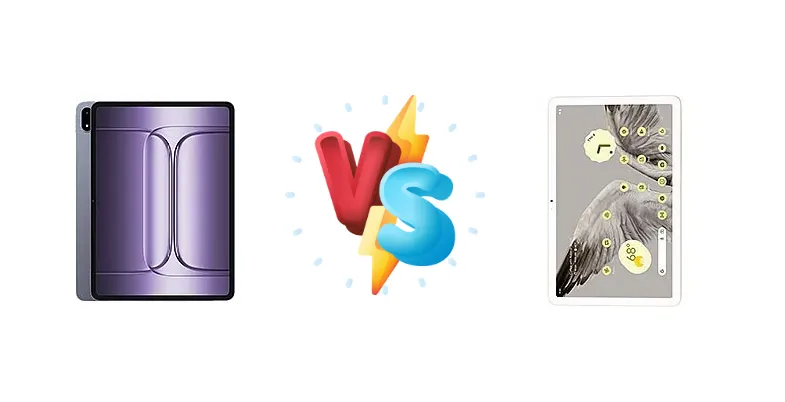
The Android tablet market is heating up, with the OnePlus Pad 3 entering the fray as a performance-focused contender against Google's established Pixel Tablet. While the Pixel Tablet emphasizes seamless Google ecosystem integration, the Pad 3 aims to deliver flagship-level power with Qualcomm’s latest Snapdragon 8 Elite chipset. This comparison dissects the key differences to determine which tablet best suits your needs.
🏆 Quick Verdict
For users prioritizing raw performance and fast charging, the OnePlus Pad 3 is the clear winner. Its Snapdragon 8 Elite chipset and 80W charging significantly outperform the Pixel Tablet’s Tensor G2 and 15W charging. However, the Pixel Tablet remains a strong choice for those deeply invested in the Google ecosystem and prioritizing software experience.
| Network |
|---|
| 2G bands | N/A | N/A |
| 3G bands | N/A | N/A |
| 4G bands | N/A | N/A |
| EDGE | No | No |
| GPRS | No | No |
| Technology | No cellular connectivity | No cellular connectivity |
| Launch |
|---|
| Announced | 2025, June 05 | 2023, May 10 |
| Status | Available. Released 2025, June 19 | Available. Released 2023, June 20 |
| Body |
|---|
| Build | Glass front, aluminum frame, aluminum back | Glass front, aluminum frame, aluminum back |
| Dimensions | 289.6 x 209.7 x 6 mm (11.40 x 8.26 x 0.24 in) | 258 x 169 x 8.1 mm (10.16 x 6.65 x 0.32 in) |
| SIM | No | No |
| Weight | 675 g (1.49 lb) | 493 g (1.09 lb) |
| | - | Stylus support |
| Display |
|---|
| Resolution | 2400 x 3392 pixels (~315 ppi density) | 1600 x 2560 pixels, 16:10 ratio (~276 ppi density) |
| Size | 13.2 inches, 530.0 cm2 (~87.3% screen-to-body ratio) | 10.95 inches, 347.7 cm2 (~79.7% screen-to-body ratio) |
| Type | IPS LCD, 68B colors, Dolby Vision, 144Hz, 900 nits (HBM) | IPS LCD |
| Platform |
|---|
| CPU | Octa-core (2x4.32 GHz Oryon V2 Phoenix L + 6x3.53 GHz Oryon V2 Phoenix M) | Octa-core (2x2.85 GHz Cortex-X1 & 2x2.35 GHz Cortex-A78 & 4x1.80 GHz Cortex-A55) |
| Chipset | Qualcomm SM8750-AB Snapdragon 8 Elite (3 nm) | Google Tensor G2 (5 nm) |
| GPU | Adreno 830 | Mali-G710 MP7 |
| OS | Android 15, ColorOS 15 | Android 13, upgradable to Android 15 |
| Memory |
|---|
| Card slot | No | No |
| Internal | 256GB 12GB RAM, 512GB 16GB RAM | 128GB 8GB RAM, 256GB 8GB RAM |
| | - | UFS 3.1 |
| Main Camera |
|---|
| Features | Color spectrum sensor, LED flash | HDR, panorama |
| Single | 13 MP | 8 MP, f/2.0, 24mm (wide), 1/4.0", 1.12µm |
| Video | 4K@30fps, 1080p@30ps, gyro-EIS | 1080p@30fps |
| Selfie camera |
|---|
| Features | - | HDR, panorama |
| Single | 8 MP | 8 MP, f/2.0, 24mm (wide), 1/4.0", 1.12µm |
| Video | 1080p@30fps | 1080p@30fps |
| Sound |
|---|
| 3.5mm jack | - | No |
| 35mm jack | No | No |
| Loudspeaker | Yes, with stereo speakers (8 speakers) | Yes, with stereo speakers (4 speakers) |
| Comms |
|---|
| Bluetooth | 5.4, A2DP, LE, aptX HD | 5.2, A2DP, LE |
| NFC | No | No |
| Positioning | No | No |
| Radio | No | No |
| USB | USB Type-C 3.2, OTG, accessory connector | USB Type-C 3.2 (Gen 1), magnetic connector |
| WLAN | Wi-Fi 802.11 a/b/g/n/ac/6/7, dual-band | Wi-Fi 802.11 a/b/g/n/ac/6, dual-band |
| Features |
|---|
| Sensors | Accelerometer, proximity (accessories only), gyro, compass | Accelerometer, gyro, compass, proximity (accessories only) |
| | - | Ultra Wideband (UWB) support |
| Battery |
|---|
| Charging | 80W wired | 15W wired |
| Type | 12140 mAh | Li-Po 7020 mAh (27 Wh) |
| Misc |
|---|
| Colors | Storm Blue | Porcelain, Hazel, Rose |
| Models | OPD2415 | GA06156-EU, GA06157-EU, GA06158-EU |
| Price | About 600 EUR | About 670 EUR |
OnePlus Pad 3
- Significantly faster processor (Snapdragon 8 Elite)
- Ultra-fast 80W charging
- Potentially superior display technology (depending on specs)
- Likely better sustained performance due to 3nm process
- Display specifications currently unknown
- Camera details are missing
Google Pixel Tablet
- Seamless Google ecosystem integration
- Clean and optimized Android software experience
- Good for media consumption and smart home control
- Established brand reputation
- Slower processor (Tensor G2)
- Slow 15W charging
- Less powerful for demanding tasks
- 5nm process less efficient than 3nm
Display Comparison
While display specifications are missing for the OnePlus Pad 3, the Pixel Tablet features a 10.95-inch LCD. The Snapdragon 8 Elite’s superior processing power in the Pad 3 could potentially drive a higher refresh rate display, offering smoother visuals, if implemented. The Pixel Tablet’s LCD is adequate for general use, but likely lacks the vibrancy and contrast of an OLED panel, which the Pad 3 *could* feature. Bezels are a key consideration, and without Pad 3 specs, it's difficult to compare. Color accuracy is also unknown for the Pad 3, but Google typically calibrates its displays well.
Camera Comparison
Camera details are absent for the OnePlus Pad 3. The Pixel Tablet’s camera setup is likely focused on video conferencing rather than photography. Without knowing the sensor size or aperture of the Pad 3’s cameras, a direct comparison is impossible. However, given the Pad 3’s focus on overall performance, it’s reasonable to expect a more capable camera system than the Pixel Tablet, potentially including features like 4K video recording. The Pixel Tablet’s camera is sufficient for basic video calls, but not a primary reason to purchase the device.
Performance
The core difference lies in the chipsets. The OnePlus Pad 3’s Qualcomm SM8750-AB Snapdragon 8 Elite (3nm) with its octa-core CPU (2x4.32 GHz Oryon V2 Phoenix L + 6x3.53 GHz Oryon V2 Phoenix M) represents a significant leap in performance over the Google Pixel Tablet’s Google Tensor G2 (5nm). The Snapdragon 8 Elite’s Oryon cores are designed for high single-core and multi-core performance, crucial for demanding applications. The 3nm process node further enhances efficiency and reduces thermal throttling compared to the Tensor G2’s 5nm node. This translates to sustained performance during extended gaming sessions or resource-intensive tasks. The Pixel Tablet’s Tensor G2 excels in AI and machine learning tasks, but falls behind in raw CPU and GPU power.
Battery Life
The OnePlus Pad 3 boasts an active use battery life of 10:49h, a strong showing. However, the real differentiator is its 80W wired charging, which will dramatically reduce recharge times. The Google Pixel Tablet, with its 15W wired charging, will take significantly longer to fully charge. While battery capacity isn’t specified for either device, the faster charging of the Pad 3 mitigates any potential capacity disadvantage. The Snapdragon 8 Elite’s 3nm process also contributes to improved power efficiency, potentially extending battery life during demanding tasks.
Buying Guide
Buy the OnePlus Pad 3 if you need a tablet for demanding tasks like gaming, video editing, or multitasking, and value rapid charging. Its Snapdragon 8 Elite processor provides a substantial performance advantage. Buy the Google Pixel Tablet if you prioritize seamless integration with Google services, a clean software experience, and a tablet designed for media consumption and smart home control. The Pixel Tablet’s strength lies in its software and ecosystem benefits, not raw horsepower.
Frequently Asked Questions
❓ Does the Google Tensor G2 chip in the Pixel Tablet overheat during prolonged gaming sessions?
The Tensor G2 is known to throttle under sustained load, meaning performance will decrease over time during extended gaming. While adequate for casual gaming, it won't maintain peak performance like the Snapdragon 8 Elite in the OnePlus Pad 3.
❓ How long does it realistically take to fully charge the Google Pixel Tablet from 0% to 100%?
With 15W charging, the Google Pixel Tablet will take approximately 3-4 hours to fully charge from 0% to 100%. This is significantly slower than the OnePlus Pad 3’s 80W charging, which can likely achieve a full charge in under an hour.
❓ Is the Snapdragon 8 Elite in the OnePlus Pad 3 powerful enough to run demanding games at high settings?
Yes, the Snapdragon 8 Elite is a flagship-level chipset capable of running virtually any Android game at maximum settings with smooth frame rates. Its Oryon cores and 3nm process provide ample power and efficiency for a premium gaming experience.
❓ How does the software experience differ between the OnePlus Pad 3 and the Google Pixel Tablet?
The Google Pixel Tablet offers a clean, stock Android experience with guaranteed software updates directly from Google. The OnePlus Pad 3 likely features OxygenOS, which offers customization options but may have a slightly less streamlined update schedule. The Pixel Tablet also benefits from tighter integration with Google Assistant and other Google services.