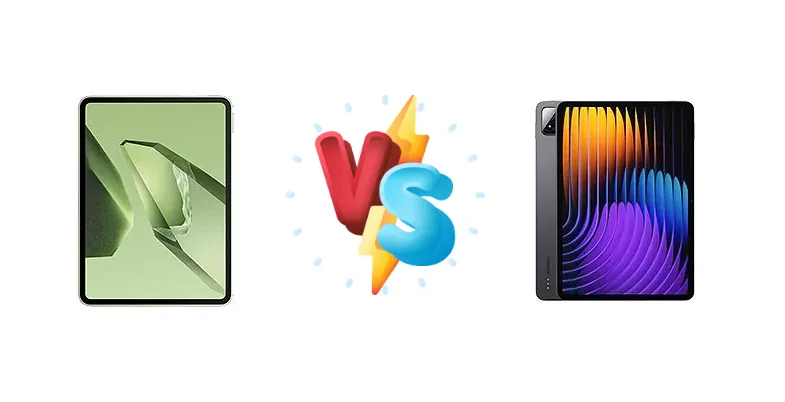
The Android tablet market is heating up, with both OnePlus and Xiaomi offering compelling options. The OnePlus Pad 3 (China) aims to deliver strong performance with its MediaTek Dimensity 8350, while the Xiaomi Pad 7 Pro counters with the Qualcomm Snapdragon 8s Gen 3. This comparison dissects the key differences to determine which tablet best suits your needs.
🏆 Quick Verdict
For most users, the Xiaomi Pad 7 Pro emerges as the superior choice. Its Snapdragon 8s Gen 3 chipset provides a noticeable performance edge, and the reported 10:12 hour active use battery life offers greater longevity. While both tablets feature 67W charging, the Xiaomi's overall efficiency and performance make it the winner.
| Network |
|---|
| 2G bands | N/A | N/A |
| 3G bands | N/A | N/A |
| 4G bands | N/A | - |
| EDGE | No | N/A |
| GPRS | No | N/A |
| Technology | No cellular connectivity | No cellular connectivity |
| Launch |
|---|
| Announced | 2024, December 26 | 2024, October 29 |
| Status | Available. Released 2024, December 26 | Available. Released 2024, October 29 |
| Body |
|---|
| Build | - | Glass front, aluminum frame, aluminum back |
| Dimensions | 257.8 x 189.1 x 6.3 mm (10.15 x 7.44 x 0.25 in) | 251.2 x 173.4 x 6.2 mm (9.89 x 6.83 x 0.24 in) |
| SIM | No | No |
| Weight | 533 g (1.18 lb) | 500 g (1.10 lb) |
| Display |
|---|
| Resolution | 2000 x 2800 pixels (~296 ppi density) | 2136 x 3200 pixels, 3:2 ratio (~345 ppi density) |
| Size | 11.61 inches, 411.3 cm2 (~84.4% screen-to-body ratio) | 11.2 inches, 371.5 cm2 (~85.3% screen-to-body ratio) |
| Type | IPS LCD, 1B colors, 144Hz, 500 nits (typ), 700 nits (HBM) | IPS LCD, 68B colors, 144Hz, HDR10, Dolby Vision, 800 nits (peak) |
| Platform |
|---|
| CPU | Octa-core (1x3.35 GHz Cortex-A715 & 3x3.20 GHz Cortex-A715 & 4x2.20 GHz Cortex-A510) | Octa-core (1x3.0 GHz Cortex-X4 & 4x2.8 GHz Cortex-A720 & 3x2.0 GHz Cortex-A520) |
| Chipset | Mediatek Dimensity 8350 (4 nm) | Qualcomm SM8635 Snapdragon 8s Gen 3 (4 nm) |
| GPU | Mali G615-MC6 | Adreno 735 |
| OS | Android 15, ColorOS 15 | Android 15, HyperOS 2 |
| Memory |
|---|
| Card slot | No | No |
| Internal | 128GB 8GB RAM, 256GB 8GB RAM, 256GB 12GB RAM, 512GB 12GB RAM | 128GB 8GB RAM, 256GB 8GB RAM, 256GB 12GB RAM, 512GB 12GB RAM |
| Main Camera |
|---|
| Dual | - | 50 MP, f/1.8, (wide), 1/2.76", 0.64µm, PDAF
Auxiliary lens |
| Features | LED flash | LED flash, HDR, panorama |
| Single | 8 MP | - |
| Video | 4K@30fps, 1080p@30ps, gyro-EIS | 4K@30/60fps, 1080p@30/60fps |
| Selfie camera |
|---|
| Features | - | HDR |
| Single | 8 MP | 32 MP, f/2.2, 19mm (ultrawide), 1/3.6", 0.61µm |
| Video | 1080p@30fps | 1080p@30fps |
| Sound |
|---|
| 35mm jack | No | No |
| Loudspeaker | Yes, with stereo speakers (4 speakers) | Yes, with stereo speakers (4 speakers) |
| Comms |
|---|
| Bluetooth | 5.4, A2DP, LE | 5.4, A2DP, LE, LHDC 5 |
| Infrared port | - | Yes |
| NFC | Yes (accessories only) | No |
| Positioning | No | No |
| Radio | No | No |
| USB | USB Type-C 3.2, OTG, accessory connector | USB Type-C 3.2, accessory connector |
| WLAN | Wi-Fi 802.11 a/b/g/n/ac/6, dual-band | Wi-Fi 802.11 a/b/g/n/ac/6e/7, dual-band, Wi-Fi Direct |
| Features |
|---|
| Sensors | Accelerometer, proximity (accessories only), gyro, compass | Fingerprint (side-mounted), accelerometer, gyro, proximity, compass |
| Battery |
|---|
| Charging | 67W wired, PD, QC, UFCS | 67W wired, PD3.0, QC3+, 40% in 20 min |
| Type | 9520 mAh | 8850 mAh |
| Misc |
|---|
| Colors | Green, Gray | Gray, Blue, Green |
| Models | OPD2407 | 24091RPADG |
| Price | About 280 EUR | About 500 EUR |
| SAR EU | - | 0.99 W/kg (body) |
OnePlus Pad 3 (China)
- Potentially lower price point
- MediaTek Dimensity 8350 offers good performance for everyday tasks
- 67W fast charging with multiple protocols
- Snapdragon 8s Gen 3 is a more powerful chipset
- Likely shorter battery life compared to Xiaomi Pad 7 Pro
- MediaTek's software optimization may not be as refined as Qualcomm's
Xiaomi Pad 7 Pro
- Superior performance with Snapdragon 8s Gen 3
- Longer battery life (10:12h active use)
- Qualcomm's optimized software and ISP
- Potentially higher price
- May run slightly warmer under sustained load
- Software bloatware is a potential concern with Xiaomi
Display Comparison
Both tablets are expected to feature high-quality displays, though specific details like panel type (IPS vs OLED) and resolution are missing. However, the focus here is on performance, so display differences are less critical. The absence of LTPO technology in either device suggests both will rely on adaptive refresh rates managed by the chipset, impacting battery life during variable workloads. Bezels are likely comparable given the competitive landscape.
Camera Comparison
Given the tablet form factor, camera performance isn't a primary concern. However, the Xiaomi Pad 7 Pro is likely to have a more sophisticated camera system, leveraging Qualcomm's image signal processor (ISP). While specific sensor details are unavailable, Qualcomm's ISPs generally offer better dynamic range and low-light performance. The OnePlus Pad 3's camera will likely be adequate for casual snapshots and video calls, but won't compete with dedicated camera phones.
Performance
The core battleground is the chipset. The Xiaomi Pad 7 Pro’s Qualcomm Snapdragon 8s Gen 3 (4nm) boasts a Cortex-X4 prime core clocked at 3.0 GHz, designed for peak performance, alongside four Cortex-A720 cores at 2.8 GHz and three Cortex-A520 cores at 2.0 GHz. This contrasts with the OnePlus Pad 3’s MediaTek Dimensity 8350 (4nm) which utilizes a 1x3.35 GHz Cortex-A715, 3x3.20 GHz Cortex-A715, and 4x2.20 GHz Cortex-A510 configuration. While the Dimensity 8350 has a higher clock speed on some cores, the Snapdragon 8s Gen 3’s newer architecture, particularly the Cortex-X4, generally translates to superior single-core and multi-core performance. The Snapdragon's Adreno GPU is also expected to outperform the Mali-G720 MC10 in the Dimensity 8350, making the Xiaomi a better choice for graphically intensive games. Both utilize LPDDR5x RAM, but the Snapdragon's overall system-on-chip efficiency will likely result in better thermal management and sustained performance.
Battery Life
The Xiaomi Pad 7 Pro’s reported 10:12 hours of active use is a significant advantage. While both tablets feature 67W wired charging with support for PD3.0, QC3+, and UFCS (OnePlus), the Snapdragon 8s Gen 3’s improved power efficiency means the Xiaomi can deliver longer runtimes on a single charge. The Xiaomi also claims a 40% charge in 20 minutes, suggesting optimized charging algorithms. The OnePlus Pad 3’s battery capacity is unknown, but to achieve comparable battery life, it would likely require a larger capacity, potentially impacting weight and thickness.
Buying Guide
Buy the OnePlus Pad 3 (China) if you prioritize a potentially lower price point and are comfortable with the MediaTek ecosystem. It's a solid performer for everyday tasks and media consumption. Buy the Xiaomi Pad 7 Pro if you demand the best possible performance for gaming, demanding applications, and extended use, and value the longer battery life and Qualcomm's optimized software.
Frequently Asked Questions
❓ Will the Snapdragon 8s Gen 3 in the Xiaomi Pad 7 Pro experience thermal throttling during extended gaming sessions?
While the Snapdragon 8s Gen 3 is a powerful chip, thermal throttling is always a possibility. However, Qualcomm's thermal management technologies and the tablet's larger form factor should mitigate this issue, allowing for sustained performance for longer periods compared to phones with the same chipset. The Xiaomi Pad 7 Pro is expected to handle demanding games at high settings with minimal throttling.
❓ Does the MediaTek Dimensity 8350 in the OnePlus Pad 3 support ray tracing or other advanced graphical features?
The MediaTek Dimensity 8350 does not natively support hardware-accelerated ray tracing. While it can handle some graphical effects, it won't deliver the same visual fidelity as devices with dedicated ray tracing hardware, like those powered by the Snapdragon 8s Gen 3. This difference will be most noticeable in graphically demanding games.
❓ How does the 67W charging on both tablets compare in real-world usage?
Both tablets support 67W charging, but the Xiaomi Pad 7 Pro's optimized charging algorithms and potentially more efficient power management system likely result in slightly faster overall charging times. The Xiaomi claims 40% charge in 20 minutes, while the OnePlus Pad 3's charging speed will depend on its battery capacity and charging curve.