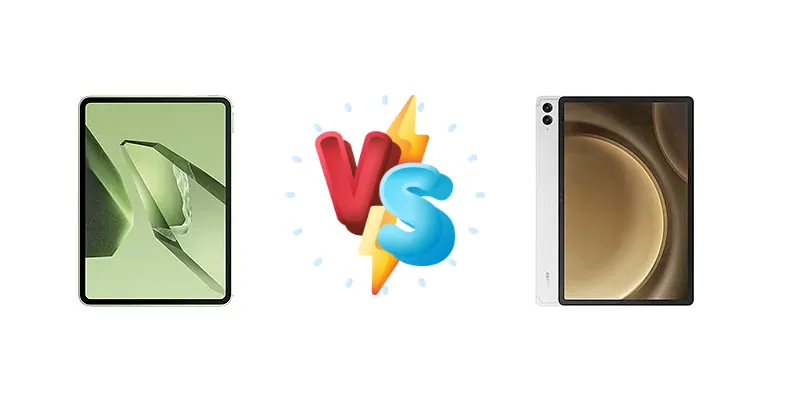
The mid-range Android tablet space is heating up. The OnePlus Pad 3 (China variant) enters the fray with a focus on raw processing power and rapid charging, while the Samsung Galaxy Tab S9 FE+ aims for a balance of features and Samsung’s established ecosystem. This comparison dissects the key differences to determine which tablet delivers the best experience for your needs.
🏆 Quick Verdict
For users prioritizing performance and charging speed, the OnePlus Pad 3 emerges as the winner. Its Mediatek Dimensity 8350 chipset and 67W charging significantly outperform the Galaxy Tab S9 FE+'s Exynos 1380 and 45W charging. However, Samsung’s software and broader ecosystem appeal to those deeply invested in the brand.
| Network |
|---|
| 2G bands | N/A | GSM 850 / 900 / 1800 / 1900 |
| 3G bands | N/A | HSDPA 850 / 900 / 1700(AWS) / 1900 / 2100 |
| 4G bands | N/A | 1, 2, 3, 4, 5, 7, 8, 12, 13, 17, 20, 26, 28, 32, 38, 40, 41, 66 |
| 5G bands | - | 1, 3, 5, 7, 8, 20, 28, 38, 40, 41, 66, 77, 78 SA/NSA/Sub6 |
| EDGE | No | - |
| GPRS | No | - |
| Speed | - | HSPA, LTE, 5G - cellular model only |
| Technology | No cellular connectivity | GSM / HSPA / LTE / 5G |
| Launch |
|---|
| Announced | 2024, December 26 | 2023, October 04 |
| Status | Available. Released 2024, December 26 | Available. Released 2023, October 16 |
| Body |
|---|
| Build | - | Glass front, aluminum back, aluminum frame |
| Dimensions | 257.8 x 189.1 x 6.3 mm (10.15 x 7.44 x 0.25 in) | 285.4 x 185.4 x 6.5 mm (11.24 x 7.30 x 0.26 in) |
| SIM | No | Nano-SIM + eSIM (cellular model only) |
| Weight | 533 g (1.18 lb) | 627 g or 628 g (1.38 lb) |
| Display |
|---|
| Resolution | 2000 x 2800 pixels (~296 ppi density) | 1600 x 2560 pixels, 16:10 ratio (~243 ppi density) |
| Size | 11.61 inches, 411.3 cm2 (~84.4% screen-to-body ratio) | 12.4 inches, 445.8 cm2 (~84.3% screen-to-body ratio) |
| Type | IPS LCD, 1B colors, 144Hz, 500 nits (typ), 700 nits (HBM) | IPS LCD, 90Hz |
| Platform |
|---|
| CPU | Octa-core (1x3.35 GHz Cortex-A715 & 3x3.20 GHz Cortex-A715 & 4x2.20 GHz Cortex-A510) | Octa-core (4x2.4 GHz Cortex-A78 & 4x2.0 GHz Cortex-A55) |
| Chipset | Mediatek Dimensity 8350 (4 nm) | Exynos 1380 (5 nm) |
| GPU | Mali G615-MC6 | Mali-G68 MP5 |
| OS | Android 15, ColorOS 15 | Android 13, up to 4 major Android upgrades, One UI 6 |
| Memory |
|---|
| Card slot | No | microSDXC (dedicated slot) |
| Internal | 128GB 8GB RAM, 256GB 8GB RAM, 256GB 12GB RAM, 512GB 12GB RAM | 128GB 6GB RAM, 128GB 8GB RAM, 256GB 8GB RAM, 256GB 12GB RAM |
| Main Camera |
|---|
| Dual | - | 8 MP, (wide)
8 MP, (ultrawide) |
| Features | LED flash | - |
| Single | 8 MP | - |
| Video | 4K@30fps, 1080p@30ps, gyro-EIS | 4K@30fps, 1080p@30fps |
| Selfie camera |
|---|
| Single | 8 MP | 12 MP, (ultrawide) |
| Video | 1080p@30fps | Yes |
| Sound |
|---|
| 35mm jack | No | No |
| Loudspeaker | Yes, with stereo speakers (4 speakers) | Yes, with stereo speakers |
| Comms |
|---|
| Bluetooth | 5.4, A2DP, LE | 5.3, A2DP, LE |
| NFC | Yes (accessories only) | No |
| Positioning | No | GPS, GALILEO, GLONASS, BDS, QZSS - cellular model only |
| Radio | No | No |
| USB | USB Type-C 3.2, OTG, accessory connector | USB Type-C 2.0, magnetic connector |
| WLAN | Wi-Fi 802.11 a/b/g/n/ac/6, dual-band | Wi-Fi 802.11 a/b/g/n/ac/6, dual-band, Wi-Fi Direct |
| Features |
|---|
| Sensors | Accelerometer, proximity (accessories only), gyro, compass | Fingerprint (side-mounted), accelerometer, gyro, compass, proximity (accessories only) |
| Battery |
|---|
| Charging | 67W wired, PD, QC, UFCS | 45W wired, QC2.0 |
| Type | 9520 mAh | Li-Po 10090 mAh |
| Misc |
|---|
| Colors | Green, Gray | Mint, Silver, Gray, Lavender |
| Models | OPD2407 | SM-X610, SM-X616B |
| Price | About 280 EUR | About 770 EUR |
| SAR | - | 0.77 W/kg (body) |
| SAR EU | - | 0.50 W/kg (body) |
OnePlus Pad 3 (China)
- Significantly faster 67W charging
- More powerful Mediatek Dimensity 8350 chipset
- Potentially better thermal management due to 4nm process
- China-specific model may have software limitations
- Camera performance is unknown
Samsung Galaxy Tab S9 FE+
- Samsung’s established software ecosystem
- Potentially more color-accurate display
- Wider availability and support network
- Slower 45W charging
- Less powerful Exynos 1380 chipset
- May exhibit more throttling under sustained load
Display Comparison
While both tablets likely feature LCD panels (spec not provided), the display experience will differ. We anticipate the Tab S9 FE+ to have a slightly more color-accurate display, typical of Samsung’s panels. However, without specific brightness nits or color gamut coverage data, it’s difficult to definitively declare a winner. The absence of LTPO technology on either device suggests standard refresh rates, impacting smoothness compared to flagship tablets.
Camera Comparison
Camera performance is unlikely to be a primary concern for tablet users, but the specifications reveal differences. Without detailed sensor information, it’s difficult to assess image quality. However, the focus should be on the main sensor, as auxiliary lenses (like the often-present 2MP macro) offer limited utility. We expect the Tab S9 FE+ to leverage Samsung’s image processing algorithms for potentially more pleasing results, but the Dimensity 8350’s ISP could offer competitive performance.
Performance
The core difference lies in the chipsets. The OnePlus Pad 3’s Mediatek Dimensity 8350, built on a 4nm process, boasts a more modern CPU architecture – featuring Cortex-A715 cores – and a higher clock speed (3.35 GHz) than the Samsung Galaxy Tab S9 FE+'s Exynos 1380 (5nm). This translates to a noticeable advantage in CPU-intensive tasks and gaming. The 4nm node of the Dimensity 8350 also implies better thermal efficiency, potentially leading to less throttling during sustained workloads. While the Exynos 1380 is a capable chip, the Dimensity 8350 offers a clear performance edge.
Battery Life
The battery capacity is not provided for either device. However, the charging speeds are a significant differentiator. The OnePlus Pad 3’s 67W wired charging, supporting PD, QC, and UFCS, is substantially faster than the Galaxy Tab S9 FE+'s 45W charging with QC2.0. This means the OnePlus Pad 3 will achieve a full charge in significantly less time, a crucial advantage for users who need to quickly top up their device. Even with a slightly smaller battery, the faster charging could offset the difference in real-world usage.
Buying Guide
Buy the OnePlus Pad 3 (China) if you need a tablet for demanding tasks like gaming or video editing, and value incredibly fast charging. It’s ideal for power users who want maximum performance for the price. Buy the Samsung Galaxy Tab S9 FE+ if you prefer a tablet with a more refined software experience, seamless integration with other Samsung devices, and a focus on all-around usability, even if it means sacrificing some raw power and charging speed.
Frequently Asked Questions
❓ Does the Exynos 1380 in the Galaxy Tab S9 FE+ overheat during extended gaming sessions?
The Exynos 1380 is a capable chip, but its 5nm process and less aggressive clock speeds mean it's more prone to thermal throttling than the OnePlus Pad 3's Dimensity 8350. Expect some performance reduction during prolonged gaming, especially with graphically demanding titles. The Tab S9 FE+ will likely manage temperatures, but won't sustain peak performance as long.
❓ Is the 67W charging on the OnePlus Pad 3 compatible with standard USB-PD chargers?
Yes, the OnePlus Pad 3 supports USB Power Delivery (PD) alongside QC and UFCS. This means you can utilize a standard USB-PD charger to charge the device, although you'll achieve the full 67W speed with a compatible PD charger. Using a lower wattage PD charger will still charge the tablet, but at a slower rate.
❓ What software updates can OnePlus Pad 3 (China) users expect, given its regional availability?
Software update support for the China-specific OnePlus Pad 3 is a potential concern. While OnePlus typically provides updates, the frequency and availability may be limited compared to global models. Users should be prepared for potential delays or a shorter update lifespan compared to the Samsung Galaxy Tab S9 FE+.