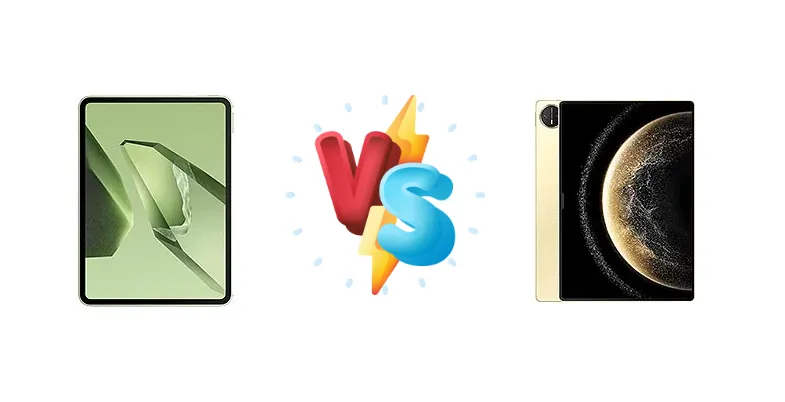
The Android tablet market is heating up, with both OnePlus and Huawei vying for dominance. The OnePlus Pad 3, currently available in China, brings a proven Mediatek Dimensity 8350 chipset to the table, while Huawei’s MatePad Pro 13.2 (2025) introduces the new Kirin T92. This comparison dissects these two contenders, focusing on performance, charging capabilities, and the overall user experience to determine which tablet offers the best value.
🏆 Quick Verdict
For the average user prioritizing rapid charging and potentially optimized software integration, the Huawei MatePad Pro 13.2 (2025) emerges as the winner. Its 100W charging significantly outperforms the OnePlus Pad 3’s 67W, and the Kirin T92 is expected to offer competitive performance. However, the OnePlus Pad 3 remains a strong contender, particularly for those already invested in the OnePlus ecosystem.
| Network |
|---|
| 2G bands | N/A | GSM 850 / 900 / 1800 / 1900 |
| 3G bands | N/A | HSDPA 850 / 900 / 1900 / 2100 |
| 4G bands | N/A | LTE |
| EDGE | No | - |
| GPRS | No | - |
| Speed | - | HSPA, LTE - cellular model only |
| Technology | No cellular connectivity | GSM / HSPA / LTE |
| Launch |
|---|
| Announced | 2024, December 26 | 2024, November 26 |
| Status | Available. Released 2024, December 26 | Available. Released 2024, December 12 |
| Body |
|---|
| Build | - | Glass front, nylon fiber back, magnesium alloy frame |
| Dimensions | 257.8 x 189.1 x 6.3 mm (10.15 x 7.44 x 0.25 in) | 289.1 x 196.1 x 5.5 mm (11.38 x 7.72 x 0.22 in) |
| SIM | No | Nano-SIM (cellular model only) |
| Weight | 533 g (1.18 lb) | 580 g (Wi-FI) or 590 g (LTE) (1.28 lb) |
| Display |
|---|
| Resolution | 2000 x 2800 pixels (~296 ppi density) | 2880 x 1920 pixels, 3:2 ratio (~262 ppi density) |
| Size | 11.61 inches, 411.3 cm2 (~84.4% screen-to-body ratio) | 13.2 inches, 518.8 cm2 (~91.5% screen-to-body ratio) |
| Type | IPS LCD, 1B colors, 144Hz, 500 nits (typ), 700 nits (HBM) | OLED, 1B colors, 144Hz, HDR Vivid, 1000 nits (peak) |
| Platform |
|---|
| CPU | Octa-core (1x3.35 GHz Cortex-A715 & 3x3.20 GHz Cortex-A715 & 4x2.20 GHz Cortex-A510) | Octa-core |
| Chipset | Mediatek Dimensity 8350 (4 nm) | Kirin T92 |
| GPU | Mali G615-MC6 | - |
| OS | Android 15, ColorOS 15 | Harmony OS 4.3 |
| Memory |
|---|
| Card slot | No | No |
| Internal | 128GB 8GB RAM, 256GB 8GB RAM, 256GB 12GB RAM, 512GB 12GB RAM | 256GB 12GB RAM, 512GB 12GB RAM, 1TB 16GB RAM |
| Main Camera |
|---|
| Dual | - | 50 MP, f/1.8, (wide), PDAF
8 MP, f/2.2, (ultrawide) |
| Features | LED flash | LED flash |
| Single | 8 MP | - |
| Video | 4K@30fps, 1080p@30ps, gyro-EIS | 4K@30fps, 1080p@30fps |
| Selfie camera |
|---|
| Single | 8 MP | 16 MP, f/2.2 |
| Video | 1080p@30fps | 1080p@30fps |
| Sound |
|---|
| 35mm jack | No | No |
| Loudspeaker | Yes, with stereo speakers (4 speakers) | Yes, with stereo speakers (6 speakers) |
| Comms |
|---|
| Bluetooth | 5.4, A2DP, LE | 5.2, A2DP, LE, L2HC |
| NFC | Yes (accessories only) | No |
| Positioning | No | GPS, GALILEO, GLONASS, BDS |
| Radio | No | No |
| USB | USB Type-C 3.2, OTG, accessory connector | USB Type-C 3.1, OTG, DisplayPort 1.2, accessory connector pins |
| WLAN | Wi-Fi 802.11 a/b/g/n/ac/6, dual-band | Wi-Fi 802.11 a/b/g/n/ac/6, dual-band |
| Features |
|---|
| Sensors | Accelerometer, proximity (accessories only), gyro, compass | Fingerprint (side-mounted), accelerometer, gyro, compass, proximity (accessories only) |
| Battery |
|---|
| Charging | 67W wired, PD, QC, UFCS | 100W wired
7.5W reverse wired |
| Type | 9520 mAh | Li-Po 10100 mAh |
| Misc |
|---|
| Colors | Green, Gray | Black, White, Gold |
| Models | OPD2407 | WEB-W00, PCE-W29 |
| Price | About 280 EUR | About 680 EUR |
OnePlus Pad 3 (China)
- Proven Mediatek Dimensity 8350 performance
- Efficient 4nm process node
- Supports multiple charging standards (PD, QC, UFCS)
- Slower 67W charging compared to Huawei
- Currently only available in China
Huawei MatePad Pro 13.2 (2025)
- Ultra-fast 100W wired charging
- New Kirin T92 chipset (potential for optimization)
- Reverse wired charging for accessories
- Kirin T92 performance is unproven
- Potential software limitations due to Huawei's ecosystem
Display Comparison
While specific display details are missing for both devices, the 13.2-inch screen size of the Huawei MatePad Pro suggests a focus on immersive content consumption. The OnePlus Pad 3’s display size is not specified, but given its positioning, it’s likely to be around 11-12 inches. The absence of LTPO information for either tablet means we can’t assess adaptive refresh rate capabilities. Color accuracy and peak brightness will be crucial differentiators, but require further testing. Bezels will also play a role in the overall viewing experience.
Camera Comparison
Given the tablet form factor, camera performance isn’t a primary concern for most users. However, the quality of the front-facing camera for video conferencing is important. Details on camera sensors are unavailable for both devices. We anticipate both tablets will feature multiple cameras, but the focus will likely be on basic functionality rather than high-end photography capabilities. The absence of information prevents a meaningful comparison.
Performance
The core of the performance difference lies in the chipsets. The OnePlus Pad 3 utilizes the Mediatek Dimensity 8350 (4nm), an octa-core processor with a mix of Cortex-A715 and A510 cores. This chipset is known for its strong multi-core performance and efficiency. The Huawei MatePad Pro 13.2 (2025) features the Kirin T92, also an octa-core processor, but details on its core configuration are limited. The 4nm process node of the Dimensity 8350 suggests good thermal efficiency, while the Kirin T92’s architecture will dictate its performance characteristics. RAM speed (likely LPDDR5x on both) will also impact responsiveness. The real-world performance gap will depend on Huawei’s software optimization of the Kirin T92.
Battery Life
The Huawei MatePad Pro 13.2 (2025) takes a clear lead in charging speed with its 100W wired charging capability. This will significantly reduce charging times compared to the OnePlus Pad 3’s 67W wired charging, supporting PD, QC, and UFCS. While battery capacity isn’t specified for either device, the faster charging of the Huawei tablet mitigates the impact of a potentially smaller battery. The 7.5W reverse wired charging on the Huawei MatePad Pro is a useful feature for topping up smaller devices like earbuds or smartwatches.
Buying Guide
Buy the OnePlus Pad 3 (China) if you need a reliable performer with a well-established chipset and are comfortable importing a device. It’s ideal for users who prioritize a balanced experience and are familiar with the Mediatek Dimensity platform. Buy the Huawei MatePad Pro 13.2 (2025) if you prefer blazing-fast charging, potentially superior software optimization within the Huawei ecosystem, and are willing to pay a premium for the latest Kirin chipset.
Frequently Asked Questions
❓ Will the OnePlus Pad 3 receive software updates consistently, given its China-only release?
Software update consistency for the OnePlus Pad 3 outside of China is a significant concern. While OnePlus generally provides updates, the China-specific model may receive them later or with limited features compared to global releases. Users should be prepared for potential delays or inconsistencies.
❓ How does Huawei’s Kirin T92 chipset handle sustained performance under heavy load, like prolonged gaming?
The Kirin T92’s thermal management capabilities are currently unknown. Huawei has historically focused on optimizing its chipsets for efficiency, but sustained performance under heavy load will depend on the tablet’s cooling system and software throttling algorithms. Independent testing will be crucial to determine its gaming performance.
❓ Does the Huawei MatePad Pro 13.2 (2025) support the Huawei Pencil and keyboard accessories?
Yes, the Huawei MatePad Pro 13.2 (2025) is designed to work seamlessly with Huawei’s M-Pencil (2nd Generation) and Smart Magnetic Keyboard. These accessories enhance productivity and provide a more versatile tablet experience, offering features like pressure sensitivity and a comfortable typing experience.