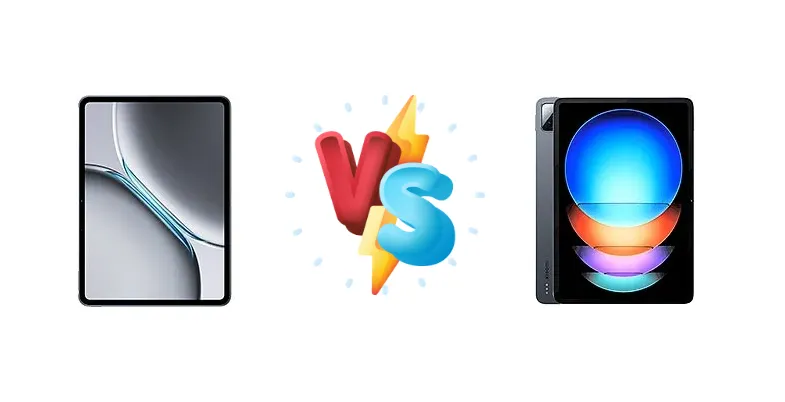
The Android tablet market is heating up, with the OnePlus Pad 2 and Xiaomi Pad 6S Pro 12.4 representing the latest contenders. The Pad 2 arrives with the cutting-edge Snapdragon 8 Gen 3, while the 6S Pro 12.4 leverages the still-potent Snapdragon 8 Gen 2 and a significantly faster charging solution. This comparison dives deep into the specifics to determine which tablet delivers the best overall experience.
🏆 Quick Verdict
For users prioritizing raw processing power and future-proofing, the OnePlus Pad 2 takes a slight edge thanks to its Snapdragon 8 Gen 3. However, the Xiaomi Pad 6S Pro 12.4 counters with a superior display contrast ratio and a blazing-fast 120W charging system, making it the better choice for media consumption and users who value convenience.
| Network |
|---|
| 2G bands | N/A | N/A |
| 3G bands | N/A | N/A |
| 4G bands | N/A | - |
| EDGE | No | N/A |
| GPRS | No | N/A |
| Technology | No cellular connectivity | No cellular connectivity |
| Launch |
|---|
| Announced | 2024, July 16 | 2024, February 22 |
| Status | Available. Released 2024, August 01 | Available. Released 2024, February 22 |
| Body |
|---|
| Build | Glass front, aluminum back, aluminum frame | Glass front (Gorilla Glass 5), aluminum frame, aluminum back |
| Dimensions | 268.7 x 195.1 x 6.5 mm (10.58 x 7.68 x 0.26 in) | 278.7 x 191.6 x 6.3 mm (10.97 x 7.54 x 0.25 in) |
| SIM | No | No |
| Weight | 584 g (1.29 lb) | 590 g (1.30 lb) |
| Display |
|---|
| Protection | - | Corning Gorilla Glass 5 |
| Resolution | 2120 x 3000 pixels (~304 ppi density) | 2032 x 3048 pixels, 3:2 ratio (~295 ppi density) |
| Size | 12.1 inches, 445.2 cm2 (~84.9% screen-to-body ratio) | 12.4 inches, 457.8 cm2 (~85.7% screen-to-body ratio) |
| Type | IPS LCD, 1B colors, Dolby Vision, HDR10+, 144Hz, 600 nits (typ), 900 nits (peak) | IPS LCD, 68B colors, 144Hz, HDR10, Dolby Vision, 900 nits (peak) |
| Platform |
|---|
| CPU | Octa-core (1x3.3 GHz Cortex-X4 & 3x3.2 GHz Cortex-A720 & 2x3.0 GHz Cortex-A720 & 2x2.3 GHz Cortex-A520) | Octa-core (1x3.2 GHz Cortex-X3 & 2x2.8 GHz Cortex-A715 & 2x2.8 GHz Cortex-A710 & 3x2.0 GHz Cortex-A510) |
| Chipset | Qualcomm SM8650-AB Snapdragon 8 Gen 3 (4 nm) | Qualcomm SM8550-AB Snapdragon 8 Gen 2 (4 nm) |
| GPU | Adreno 750 | Adreno 740 |
| OS | Android 14, upgradable to Android 15, OxygenOS 15 | Android 14, up to 3 major Android upgrades, HyperOS |
| Memory |
|---|
| Card slot | No | No |
| Internal | 128GB 8GB RAM, 256GB 12GB RAM | 256GB 8GB RAM, 256GB 12GB RAM, 512GB 12GB RAM, 1TB 16GB RAM |
| Main Camera |
|---|
| Dual | - | 50 MP, f/1.8, (wide), 1/2.76", 0.64µm, PDAF
Auxiliary lens |
| Features | LED flash | LED flash, HDR, panorama |
| Single | 13 MP, f/2.2, 23mm (wide) | - |
| Video | 4K@30fps, 1080p@30ps, gyro-EIS | 4K@30/60fps, 1080p@30/60fps |
| Selfie camera |
|---|
| Single | 8 MP, f/2.3, (wide), 1/4.0", 1.12µm | 32 MP, f/2.2, (wide), 1/3.6", 0.61µm |
| Video | 1080p@30fps, gyro-EIS | 1080p@30fps |
| Sound |
|---|
| 35mm jack | No | No |
| Loudspeaker | Yes, with stereo speakers (6 speakers) | Yes, with stereo speakers (6 speakers) |
| Comms |
|---|
| Bluetooth | 5.4, A2DP, LE, aptX HD, LHDC | 5.3, A2DP, LE, LHDC |
| NFC | NFC (data sharing only) | Yes (file transfer only) |
| Positioning | No | No |
| Radio | No | No |
| USB | USB Type-C 3.2, OTG, accessory connector | USB Type-C 3.2, accessory connector |
| WLAN | Wi-Fi 802.11 a/b/g/n/ac/6/7, dual-band | Wi-Fi 802.11 a/b/g/n/a/6/7, dual-band, Wi-Fi Direct |
| Features |
|---|
| Sensors | Accelerometer, gyro, proximity (accessories only), compass | Fingerprint (side-mounted), accelerometer, gyro, proximity (accessories only), compass |
| Battery |
|---|
| Charging | 67W wired, 64% in 30 min, 100% in 81 min | 120W wired, PD3.0, QC4, 45% in 10 min, 100% in 35 min |
| Type | Li-Po 9510 mAh | 10000 mAh |
| Misc |
|---|
| Colors | Nimbus Gray | Black, Blue, Green |
| Models | - | 24018RPACG |
| Price | About 550 EUR | About 700 EUR |
| SAR EU | - | 0.99 W/kg (body) |
OnePlus Pad 2
- Superior processing power with Snapdragon 8 Gen 3
- Slightly longer active use battery life
- Latest generation chipset for future-proofing
- Slower charging speed compared to Xiaomi
- Lower display contrast ratio
Xiaomi Pad 6S Pro 12.4
- Blazing-fast 120W charging
- Higher display contrast ratio for vibrant visuals
- Longer active use battery life
- Older generation Snapdragon 8 Gen 2 chipset
- Potentially lower peak performance in demanding tasks
Display Comparison
The Xiaomi Pad 6S Pro 12.4 boasts a superior 1378:1 contrast ratio compared to the OnePlus Pad 2’s 864:1, resulting in deeper blacks and a more vibrant image. While both tablets achieve high brightness levels – 848 nits for the Xiaomi and 793 nits for the OnePlus – the contrast difference is immediately noticeable. Neither specification details refresh rate or panel technology (LTPO), but both are likely to offer smooth visuals. The larger screen size of the Xiaomi Pad 6S Pro 12.4 also contributes to a more immersive viewing experience.
Camera Comparison
Neither tablet is positioned as a photography powerhouse, and the provided data doesn't offer detailed camera specifications. However, given the focus on performance and display, it's reasonable to assume both will offer adequate cameras for video conferencing and casual snapshots. Without sensor size or aperture information, a definitive comparison is impossible. The absence of details suggests camera quality isn't a primary differentiator.
Performance
The OnePlus Pad 2’s Snapdragon 8 Gen 3 (4nm) represents a significant leap in performance over the Xiaomi Pad 6S Pro 12.4’s Snapdragon 8 Gen 2 (4nm). The Gen 3 features a new CPU architecture with a Cortex-X4 prime core clocked at 3.3 GHz, compared to the Gen 2’s Cortex-X3 at 3.2 GHz. This translates to faster single-core performance and improved efficiency. The Pad 2’s CPU configuration (1+3+2+2) also differs from the 6S Pro’s (1+2+2+3), potentially impacting multi-core performance. While both utilize 4nm fabrication, the architectural improvements in the Gen 3 chipset give the OnePlus Pad 2 a clear advantage in demanding applications.
Battery Life
The Xiaomi Pad 6S Pro 12.4’s 120W charging is a game-changer, achieving 45% charge in just 10 minutes and a full charge in 35 minutes. This is significantly faster than the OnePlus Pad 2’s 67W charging, which takes 30 minutes to reach 64% and 81 minutes for a full charge. Despite the OnePlus Pad 2 having a slightly longer active use score (10:51h vs 11:14h for the Xiaomi), the convenience of the Xiaomi’s rapid charging is a major advantage. The longer active use time of the Xiaomi suggests better power efficiency despite the faster charging.
Buying Guide
Buy the OnePlus Pad 2 if you need the absolute best performance for demanding tasks like video editing, high-end gaming, or multitasking with numerous apps. Buy the Xiaomi Pad 6S Pro 12.4 if you prioritize a stunning display with excellent contrast, incredibly fast charging, and a more immersive media experience. The 6S Pro is also ideal for users who frequently travel and need quick top-ups.
Frequently Asked Questions
❓ Does the Snapdragon 8 Gen 3 in the OnePlus Pad 2 get noticeably hotter than the Snapdragon 8 Gen 2 in the Xiaomi Pad 6S Pro 12.4 during extended gaming sessions?
While the Snapdragon 8 Gen 3 is more powerful, it also generates more heat. Both tablets will likely experience some thermal throttling during prolonged gaming. However, the 4nm process node on both chips helps mitigate this, and the larger chassis of a tablet provides more surface area for heat dissipation. The OnePlus Pad 2's thermal management will be crucial to maintaining sustained performance.
❓ How does the 120W charging of the Xiaomi Pad 6S Pro 12.4 affect battery health over the long term?
While extremely fast charging is convenient, there's a common concern about its impact on battery longevity. However, modern charging algorithms and battery management systems are designed to mitigate this. The Xiaomi Pad 6S Pro 12.4 utilizes PD3.0 and QC4 standards, which incorporate features to protect the battery during rapid charging. It's unlikely to cause significant degradation within the typical lifespan of the tablet.
❓ Is the difference in display contrast between the two tablets noticeable in everyday use, or is it only apparent in controlled testing environments?
The difference in contrast ratio is definitely noticeable in everyday use, particularly when viewing content with deep blacks, such as movies or dark-themed apps. The Xiaomi Pad 6S Pro 12.4’s higher contrast ratio results in a more immersive and visually appealing experience, making it a better choice for media consumption.