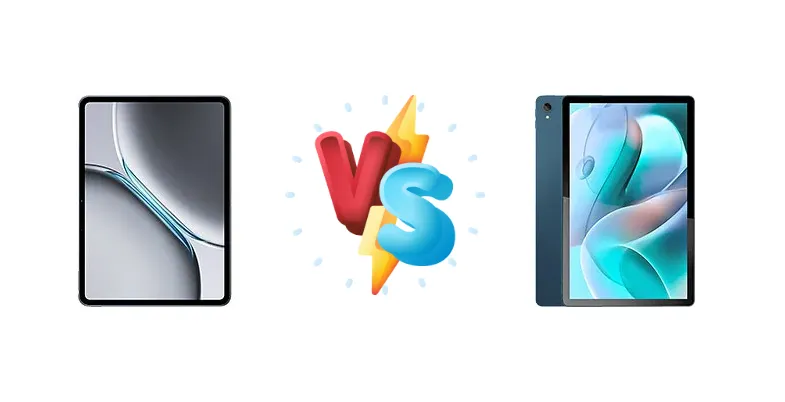
The Android tablet market is heating up, with options ranging from budget-friendly media consumption devices to high-performance powerhouses. We pit the newly released OnePlus Pad 2, boasting a flagship Snapdragon 8 Gen 3 chipset, against the more affordable Motorola Moto Tab G70, powered by a MediaTek Helio G90T, to determine which tablet delivers the best value and experience.
🏆 Quick Verdict
For users prioritizing performance and a premium experience, the OnePlus Pad 2 is the clear winner. Its Snapdragon 8 Gen 3 chipset and brighter display justify the higher price. However, the Motorola Moto Tab G70 remains a compelling option for budget-conscious buyers seeking a capable tablet for everyday tasks.
| Network |
|---|
| 2G bands | N/A | GSM 850 / 900 / 1800 / 1900 |
| 3G bands | N/A | HSDPA 850 / 900 / 1900 / 2100 |
| 4G bands | N/A | 1, 2, 4, 7, 8, 20, 28, 38, 40, 41 |
| EDGE | No | - |
| GPRS | No | - |
| Speed | - | HSPA 42.2/5.76 Mbps, LTE Cat4 150/50 Mbps - cellular model only |
| Technology | No cellular connectivity | GSM / HSPA / LTE |
| Launch |
|---|
| Announced | 2024, July 16 | 2022, January 12 |
| Status | Available. Released 2024, August 01 | Available. Released 2022, January 13 |
| Body |
|---|
| Build | Glass front, aluminum back, aluminum frame | Glass front, aluminum back, aluminum frame |
| Dimensions | 268.7 x 195.1 x 6.5 mm (10.58 x 7.68 x 0.26 in) | 258.4 x 163 x 7.5 mm (10.17 x 6.42 x 0.30 in) |
| SIM | No | Nano-SIM (cellular model only) |
| Weight | 584 g (1.29 lb) | 500 g (1.10 lb) |
| | - | Water repellent design |
| Display |
|---|
| Resolution | 2120 x 3000 pixels (~304 ppi density) | 1200 x 2000 pixels, 5:3 ratio (~212 ppi density) |
| Size | 12.1 inches, 445.2 cm2 (~84.9% screen-to-body ratio) | 11.0 inches, 344.4 cm2 (~81.8% screen-to-body ratio) |
| Type | IPS LCD, 1B colors, Dolby Vision, HDR10+, 144Hz, 600 nits (typ), 900 nits (peak) | IPS LCD, 400 nits (typ) |
| Platform |
|---|
| CPU | Octa-core (1x3.3 GHz Cortex-X4 & 3x3.2 GHz Cortex-A720 & 2x3.0 GHz Cortex-A720 & 2x2.3 GHz Cortex-A520) | Octa-core (2x2.05 GHz Cortex-A76 & 6x2.0 GHz Cortex-A55) |
| Chipset | Qualcomm SM8650-AB Snapdragon 8 Gen 3 (4 nm) | Mediatek MT6785 Helio G90T (12 nm) |
| GPU | Adreno 750 | Mali-G76 MC4 |
| OS | Android 14, upgradable to Android 15, OxygenOS 15 | Android 11 |
| Memory |
|---|
| Card slot | No | microSDXC (dedicated slot) |
| Internal | 128GB 8GB RAM, 256GB 12GB RAM | 64GB 4GB RAM, 128GB 6GB RAM |
| | - | eMMC 5.1 |
| Main Camera |
|---|
| Features | LED flash | LED flash |
| Single | 13 MP, f/2.2, 23mm (wide) | 13 MP, f/2.2, 26mm (wide), AF |
| Video | 4K@30fps, 1080p@30ps, gyro-EIS | 1080p@30fps |
| Selfie camera |
|---|
| Single | 8 MP, f/2.3, (wide), 1/4.0", 1.12µm | 8 MP, f/2.0, 26mm (wide) |
| Video | 1080p@30fps, gyro-EIS | 1080p@30fps |
| Sound |
|---|
| 3.5mm jack | - | Yes |
| 35mm jack | No | Yes |
| Loudspeaker | Yes, with stereo speakers (6 speakers) | Yes, with stereo speakers (4 speakers) |
| Comms |
|---|
| Bluetooth | 5.4, A2DP, LE, aptX HD, LHDC | 5.2, A2DP, LE |
| NFC | NFC (data sharing only) | No |
| Positioning | No | GPS, GLONASS - cellular model only |
| Radio | No | No |
| USB | USB Type-C 3.2, OTG, accessory connector | USB Type-C 2.0, OTG |
| WLAN | Wi-Fi 802.11 a/b/g/n/ac/6/7, dual-band | Wi-Fi 802.11 a/b/g/n/ac, dual-band, Wi-Fi Direct |
| Features |
|---|
| Sensors | Accelerometer, gyro, proximity (accessories only), compass | Accelerometer, gyro, proximity |
| Battery |
|---|
| Charging | 67W wired, 64% in 30 min, 100% in 81 min | 20W wired |
| Type | Li-Po 9510 mAh | Li-Po 7700 mAh |
| Misc |
|---|
| Colors | Nimbus Gray | Modernist Teal, Blue |
| Price | About 550 EUR | About 380 EUR |
OnePlus Pad 2
- Exceptional performance with Snapdragon 8 Gen 3
- Bright and vibrant display with 793 nits
- Fast 67W charging for quick power-ups
- Higher price point compared to the Moto Tab G70
- May be overkill for basic tablet tasks
Motorola Moto Tab G70
- Affordable price point
- Large display suitable for media consumption
- Decent performance for everyday tasks
- Slower performance compared to the OnePlus Pad 2
- Slower 20W charging
Display Comparison
The OnePlus Pad 2 boasts a significantly brighter display, reaching a measured 793 nits, compared to the Moto Tab G70 (brightness data unavailable, but expected to be lower based on price point). This higher brightness translates to better visibility outdoors and a more immersive viewing experience. While contrast ratios are strong on the OnePlus Pad 2 at 864:1, the Moto Tab G70’s panel specifications are less detailed, suggesting a potentially lower contrast ratio. The OnePlus Pad 2 likely benefits from a more advanced panel technology, potentially including features like LTPO for variable refresh rates, contributing to improved power efficiency and smoother visuals, features absent in the Moto Tab G70.
Camera Comparison
Camera performance isn't a primary focus for tablets, but the OnePlus Pad 2 likely has an advantage due to its more powerful ISP (Image Signal Processor) integrated within the Snapdragon 8 Gen 3. While specific camera specs are unavailable for both devices, the processing power of the Snapdragon chipset will result in better image quality and faster processing times. The Moto Tab G70’s Helio G90T lacks the advanced image processing capabilities of the Snapdragon, resulting in potentially lower-quality photos and videos.
Performance
The performance gap between these tablets is substantial. The OnePlus Pad 2’s Qualcomm Snapdragon 8 Gen 3 (4nm) is a flagship-level chipset, featuring an octa-core CPU with a prime Cortex-X4 core clocked at 3.3 GHz. This architecture is designed for peak performance and efficiency. In contrast, the Moto Tab G70 utilizes the MediaTek Helio G90T (12nm), an older chipset with a less sophisticated CPU configuration (2x2.05 GHz Cortex-A76 & 6x2.0 GHz Cortex-A55). The 4nm process node of the Snapdragon 8 Gen 3 offers significantly better thermal efficiency, meaning the OnePlus Pad 2 will sustain peak performance for longer periods without throttling, crucial for gaming and demanding applications. The Moto Tab G70 will likely experience performance throttling under sustained load.
Battery Life
The OnePlus Pad 2 achieves an impressive 10:51h of active use, demonstrating excellent battery life despite its powerful processor. The Moto Tab G70’s battery life is not specified, but given its less efficient chipset, it’s likely to be lower. The OnePlus Pad 2 also features significantly faster charging at 67W, reaching 64% charge in 30 minutes and 100% in 81 minutes. The Moto Tab G70’s 20W charging is considerably slower, requiring significantly more time to fully charge, impacting usability for users who need quick top-ups.
Buying Guide
Buy the OnePlus Pad 2 if you need a tablet for demanding tasks like gaming, video editing, or multitasking, and appreciate a vibrant, high-brightness display. Buy the Motorola Moto Tab G70 if you prioritize affordability and a large screen for media consumption, casual gaming, and basic productivity – it’s a solid choice for those on a tighter budget.
Frequently Asked Questions
❓ Will the Moto Tab G70 struggle with graphically intensive games like Genshin Impact?
Yes, the MediaTek Helio G90T in the Moto Tab G70 will likely struggle with demanding games like Genshin Impact. You'll likely need to lower graphics settings significantly to achieve playable frame rates, and even then, expect some stuttering. The OnePlus Pad 2’s Snapdragon 8 Gen 3 is designed for these types of games and will provide a much smoother experience.
❓ How much faster is the 67W charging on the OnePlus Pad 2 compared to the 20W charging on the Moto Tab G70 in real-world use?
The 67W charging on the OnePlus Pad 2 is significantly faster. It can reach 64% charge in just 30 minutes, while the Moto Tab G70’s 20W charging will take considerably longer – likely over 90 minutes to reach the same charge level. This makes the OnePlus Pad 2 much more convenient for users who need to quickly top up their battery.
❓ Is the difference in chipset performance noticeable for everyday tasks like browsing and video streaming?
For basic tasks like browsing and video streaming, the difference in chipset performance may not be immediately noticeable. However, the OnePlus Pad 2 will handle multitasking and app switching much more smoothly, and will remain responsive for longer periods of use. The Moto Tab G70 may exhibit some lag when running multiple apps simultaneously.