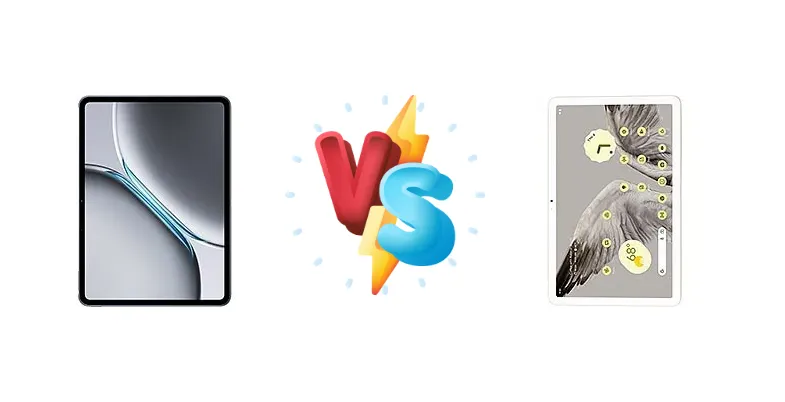
The Android tablet market is heating up, with the OnePlus Pad 2 challenging Google’s own Pixel Tablet. While both aim to deliver a premium experience, they take drastically different approaches to performance and value. The Pixel Tablet focuses on smart home integration and a streamlined software experience, while the OnePlus Pad 2 prioritizes raw processing power and rapid charging. This comparison will dissect the key differences to help you determine which tablet best suits your needs.
🏆 Quick Verdict
For users prioritizing performance and fast charging, the OnePlus Pad 2 is the clear winner. Its Snapdragon 8 Gen 3 chipset delivers significantly more processing power than the Google Pixel Tablet’s Tensor G2, and the 67W charging is a game-changer. However, the Pixel Tablet remains a compelling option for those deeply invested in the Google ecosystem.
| Network |
|---|
| 2G bands | N/A | N/A |
| 3G bands | N/A | N/A |
| 4G bands | N/A | N/A |
| EDGE | No | No |
| GPRS | No | No |
| Technology | No cellular connectivity | No cellular connectivity |
| Launch |
|---|
| Announced | 2024, July 16 | 2023, May 10 |
| Status | Available. Released 2024, August 01 | Available. Released 2023, June 20 |
| Body |
|---|
| Build | Glass front, aluminum back, aluminum frame | Glass front, aluminum frame, aluminum back |
| Dimensions | 268.7 x 195.1 x 6.5 mm (10.58 x 7.68 x 0.26 in) | 258 x 169 x 8.1 mm (10.16 x 6.65 x 0.32 in) |
| SIM | No | No |
| Weight | 584 g (1.29 lb) | 493 g (1.09 lb) |
| | - | Stylus support |
| Display |
|---|
| Resolution | 2120 x 3000 pixels (~304 ppi density) | 1600 x 2560 pixels, 16:10 ratio (~276 ppi density) |
| Size | 12.1 inches, 445.2 cm2 (~84.9% screen-to-body ratio) | 10.95 inches, 347.7 cm2 (~79.7% screen-to-body ratio) |
| Type | IPS LCD, 1B colors, Dolby Vision, HDR10+, 144Hz, 600 nits (typ), 900 nits (peak) | IPS LCD |
| Platform |
|---|
| CPU | Octa-core (1x3.3 GHz Cortex-X4 & 3x3.2 GHz Cortex-A720 & 2x3.0 GHz Cortex-A720 & 2x2.3 GHz Cortex-A520) | Octa-core (2x2.85 GHz Cortex-X1 & 2x2.35 GHz Cortex-A78 & 4x1.80 GHz Cortex-A55) |
| Chipset | Qualcomm SM8650-AB Snapdragon 8 Gen 3 (4 nm) | Google Tensor G2 (5 nm) |
| GPU | Adreno 750 | Mali-G710 MP7 |
| OS | Android 14, upgradable to Android 15, OxygenOS 15 | Android 13, upgradable to Android 15 |
| Memory |
|---|
| Card slot | No | No |
| Internal | 128GB 8GB RAM, 256GB 12GB RAM | 128GB 8GB RAM, 256GB 8GB RAM |
| | - | UFS 3.1 |
| Main Camera |
|---|
| Features | LED flash | HDR, panorama |
| Single | 13 MP, f/2.2, 23mm (wide) | 8 MP, f/2.0, 24mm (wide), 1/4.0", 1.12µm |
| Video | 4K@30fps, 1080p@30ps, gyro-EIS | 1080p@30fps |
| Selfie camera |
|---|
| Features | - | HDR, panorama |
| Single | 8 MP, f/2.3, (wide), 1/4.0", 1.12µm | 8 MP, f/2.0, 24mm (wide), 1/4.0", 1.12µm |
| Video | 1080p@30fps, gyro-EIS | 1080p@30fps |
| Sound |
|---|
| 3.5mm jack | - | No |
| 35mm jack | No | No |
| Loudspeaker | Yes, with stereo speakers (6 speakers) | Yes, with stereo speakers (4 speakers) |
| Comms |
|---|
| Bluetooth | 5.4, A2DP, LE, aptX HD, LHDC | 5.2, A2DP, LE |
| NFC | NFC (data sharing only) | No |
| Positioning | No | No |
| Radio | No | No |
| USB | USB Type-C 3.2, OTG, accessory connector | USB Type-C 3.2 (Gen 1), magnetic connector |
| WLAN | Wi-Fi 802.11 a/b/g/n/ac/6/7, dual-band | Wi-Fi 802.11 a/b/g/n/ac/6, dual-band |
| Features |
|---|
| Sensors | Accelerometer, gyro, proximity (accessories only), compass | Accelerometer, gyro, compass, proximity (accessories only) |
| | - | Ultra Wideband (UWB) support |
| Battery |
|---|
| Charging | 67W wired, 64% in 30 min, 100% in 81 min | 15W wired |
| Type | Li-Po 9510 mAh | Li-Po 7020 mAh (27 Wh) |
| Misc |
|---|
| Colors | Nimbus Gray | Porcelain, Hazel, Rose |
| Models | - | GA06156-EU, GA06157-EU, GA06158-EU |
| Price | About 550 EUR | About 670 EUR |
OnePlus Pad 2
- Significantly faster processor with Snapdragon 8 Gen 3
- Ultra-fast 67W charging
- High display brightness (793 nits)
- Camera specifications are unknown
- Software experience may not be as streamlined as Pixel Tablet
Google Pixel Tablet
- Seamless Google ecosystem integration
- Clean and intuitive software experience
- Potential for strong image processing
- Slower Tensor G2 processor
- Slow 15W charging
- Performance may struggle with demanding tasks
Display Comparison
The OnePlus Pad 2 boasts a measured peak brightness of 793 nits and a contrast ratio of 864:1, suggesting a vibrant and punchy display. While the Pixel Tablet’s display specifications aren’t provided, Google typically prioritizes color accuracy. The OnePlus Pad 2’s higher brightness will be particularly beneficial for outdoor use or in brightly lit environments. The contrast ratio indicates deeper blacks and more vivid colors, enhancing the viewing experience for multimedia content. Without comparable data for the Pixel Tablet, it’s difficult to definitively declare a winner, but the OnePlus Pad 2’s measured specs give it an initial edge.
Camera Comparison
Neither tablet is positioned as a photography powerhouse, but the absence of detailed camera specifications for both devices limits a meaningful comparison. Given the Pixel Tablet’s history with computational photography, it’s likely to offer superior image processing, even with a potentially less impressive sensor. However, without knowing the sensor sizes or lens apertures, it’s impossible to definitively assess camera quality. We can assume both tablets will be adequate for video calls and casual snapshots, but not for serious photography.
Performance
The performance gap between these tablets is substantial. The OnePlus Pad 2’s Qualcomm Snapdragon 8 Gen 3 (4nm) is a flagship-level chipset, featuring an octa-core CPU with a prime Cortex-X4 core clocked at 3.3 GHz. This architecture is designed for peak performance and efficiency. In contrast, the Google Pixel Tablet utilizes the Google Tensor G2 (5nm). While the Tensor G2 is capable, its CPU configuration – with two Cortex-X1 cores at 2.85 GHz – is less focused on raw speed and more on AI and machine learning tasks. The 4nm process node of the Snapdragon 8 Gen 3 also offers better thermal efficiency, potentially leading to less throttling during sustained workloads. This translates to a smoother experience for gamers and power users on the OnePlus Pad 2.
Battery Life
The OnePlus Pad 2 delivers a compelling battery and charging package. It achieved an active use score of 10:51h, demonstrating solid endurance. More impressively, its 67W wired charging can replenish 64% of the battery in just 30 minutes and achieve a full charge in 81 minutes. The Google Pixel Tablet, with its 15W wired charging, is significantly slower. While battery capacity isn’t specified for either device, the OnePlus Pad 2’s faster charging mitigates any potential capacity disadvantage. For users who frequently need to top up their tablet quickly, the OnePlus Pad 2 is the clear winner.
Buying Guide
Buy the OnePlus Pad 2 if you need a tablet for demanding tasks like gaming, video editing, or multitasking, and value incredibly fast charging. Its superior chipset ensures a smoother, more responsive experience. Buy the Google Pixel Tablet if you prioritize seamless integration with Google’s smart home ecosystem, a clean software experience, and a tablet designed as a hub for your connected devices. It’s ideal for casual use, media consumption, and controlling smart home features.
Frequently Asked Questions
❓ Does the Snapdragon 8 Gen 3 in the OnePlus Pad 2 generate excessive heat during prolonged gaming sessions?
The Snapdragon 8 Gen 3’s 4nm process node is designed for improved thermal efficiency. While some heat generation is inevitable during intensive gaming, the OnePlus Pad 2 is expected to manage temperatures effectively, minimizing throttling and maintaining consistent performance. However, sustained peak loads will still result in some warming.
❓ How does the Google Tensor G2 handle multitasking compared to the Snapdragon 8 Gen 3?
The Google Tensor G2 is optimized for AI and machine learning tasks, but it falls behind the Snapdragon 8 Gen 3 in raw processing power. While the Tensor G2 can handle moderate multitasking, the OnePlus Pad 2’s Snapdragon 8 Gen 3 will provide a noticeably smoother and more responsive experience when running multiple demanding applications simultaneously.
❓ Is the 15W charging on the Google Pixel Tablet sufficient for daily use, or will I find myself frequently needing to charge it?
15W charging is relatively slow by modern tablet standards. While it will charge the device overnight, users who frequently use their tablet throughout the day may find themselves needing to top it up more often than with the OnePlus Pad 2’s 67W charging. This is a significant trade-off for Pixel Tablet owners.