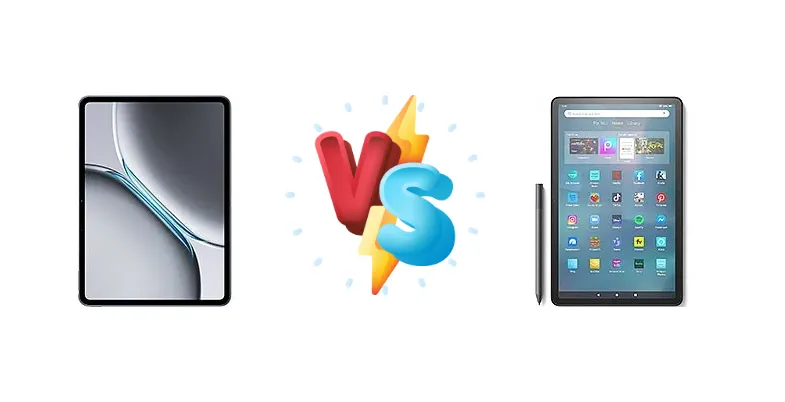
The Android tablet market is heating up, with the OnePlus Pad 2 aiming for a premium experience and the Amazon Fire Max 11 offering a more budget-friendly alternative. This comparison dissects the core differences between these two devices, focusing on performance, display capabilities, and overall value to help you determine which tablet best suits your needs.
🏆 Quick Verdict
For users prioritizing performance and a vibrant display, the OnePlus Pad 2 is the clear winner. Its Snapdragon 8 Gen 3 chipset delivers significantly faster processing speeds, while the 793 nits of brightness and 864:1 contrast ratio provide a superior viewing experience. However, the Fire Max 11 remains a viable option for those on a tighter budget.
| Network |
|---|
| 2G bands | N/A | N/A |
| 3G bands | N/A | - |
| 4G bands | N/A | - |
| EDGE | No | No |
| GPRS | No | No |
| Technology | No cellular connectivity | No cellular connectivity |
| Launch |
|---|
| Announced | 2024, July 16 | 2023, May 23 |
| Status | Available. Released 2024, August 01 | Available. Released 2023, May 23 |
| Body |
|---|
| Build | Glass front, aluminum back, aluminum frame | - |
| Dimensions | 268.7 x 195.1 x 6.5 mm (10.58 x 7.68 x 0.26 in) | 259.1 x 163.7 x 7.5 mm (10.20 x 6.44 x 0.30 in) |
| SIM | No | No |
| Weight | 584 g (1.29 lb) | 490 g (1.08 lb) |
| Display |
|---|
| Resolution | 2120 x 3000 pixels (~304 ppi density) | 2000 x 1200 pixels, 5:3 ratio (~212 ppi density) |
| Size | 12.1 inches, 445.2 cm2 (~84.9% screen-to-body ratio) | 11.0 inches, 344.4 cm2 (~81.2% screen-to-body ratio) |
| Type | IPS LCD, 1B colors, Dolby Vision, HDR10+, 144Hz, 600 nits (typ), 900 nits (peak) | IPS LCD |
| Platform |
|---|
| CPU | Octa-core (1x3.3 GHz Cortex-X4 & 3x3.2 GHz Cortex-A720 & 2x3.0 GHz Cortex-A720 & 2x2.3 GHz Cortex-A520) | Octa-core (2x2.2 GHz Cortex-A78 & 6x2.0 GHz Cortex-A55) |
| Chipset | Qualcomm SM8650-AB Snapdragon 8 Gen 3 (4 nm) | Mediatek MT8188J |
| GPU | Adreno 750 | Mali-G57 MC2 |
| OS | Android 14, upgradable to Android 15, OxygenOS 15 | Android 11, Fire OS 8 |
| Memory |
|---|
| Card slot | No | microSDXC (dedicated slot) |
| Internal | 128GB 8GB RAM, 256GB 12GB RAM | 64GB 4GB RAM, 128GB 4GB RAM |
| Main Camera |
|---|
| Features | LED flash | - |
| Single | 13 MP, f/2.2, 23mm (wide) | 8 MP, AF |
| Video | 4K@30fps, 1080p@30ps, gyro-EIS | 1080p |
| Selfie camera |
|---|
| Single | 8 MP, f/2.3, (wide), 1/4.0", 1.12µm | 8 MP |
| Video | 1080p@30fps, gyro-EIS | 1080p |
| Sound |
|---|
| 35mm jack | No | No |
| Loudspeaker | Yes, with stereo speakers (6 speakers) | Yes, with stereo speakers |
| Comms |
|---|
| Bluetooth | 5.4, A2DP, LE, aptX HD, LHDC | 5.3, A2DP, LE |
| NFC | NFC (data sharing only) | No |
| Positioning | No | No |
| Radio | No | No |
| USB | USB Type-C 3.2, OTG, accessory connector | USB Type-C 2.0, OTG, magnetic accessory connector |
| WLAN | Wi-Fi 802.11 a/b/g/n/ac/6/7, dual-band | Wi-Fi 802.11 a/b/g/n/ac/6, dual-band |
| Features |
|---|
| Sensors | Accelerometer, gyro, proximity (accessories only), compass | Fingerprint (side-mounted), accelerometer, proximity (accessories only) |
| Battery |
|---|
| Charging | 67W wired, 64% in 30 min, 100% in 81 min | 15W wired |
| Type | Li-Po 9510 mAh | Li-Ion |
| Misc |
|---|
| Colors | Nimbus Gray | Gray |
| Models | - | KFSNWI |
| Price | About 550 EUR | About 270 EUR |
OnePlus Pad 2
- Exceptional performance with Snapdragon 8 Gen 3
- Bright and vibrant display with 793 nits
- Ultra-fast 67W charging
- Higher price point
- May be overkill for basic tasks
Amazon Fire Max 11
- Affordable price
- Integration with Amazon ecosystem
- Decent battery life for basic use
- Significantly slower performance
- Slower 15W charging
- Likely lower display quality
Display Comparison
The OnePlus Pad 2 boasts a significantly brighter display, reaching a measured 793 nits compared to the Fire Max 11’s likely lower output (Amazon doesn’t publish this data). This brightness advantage, coupled with the 864:1 contrast ratio, translates to a more vivid and enjoyable viewing experience, especially in well-lit environments. While the Fire Max 11’s display resolution is likely similar, the lack of published specs suggests it won’t match the OnePlus Pad 2’s color accuracy or dynamic range. The OnePlus Pad 2’s panel is likely to be more color accurate, benefitting content creators and those who value visual fidelity.
Camera Comparison
Given the tablet form factor, camera performance isn't a primary concern for most users. However, the OnePlus Pad 2 is likely to have a superior camera system due to its higher-end chipset and potentially larger sensor. Amazon typically focuses on affordability, so the Fire Max 11’s camera is likely to be basic. Without specific camera specs for either device, it’s safe to assume the OnePlus Pad 2 will deliver better image quality and video recording capabilities.
Performance
The performance gap between these tablets is substantial. The OnePlus Pad 2’s Qualcomm Snapdragon 8 Gen 3 (4nm) is a flagship-level chipset, featuring an octa-core CPU with a prime Cortex-X4 core clocked at 3.3 GHz. This architecture is designed for sustained performance and efficiency. In contrast, the Amazon Fire Max 11 utilizes the Mediatek MT8188J, an octa-core processor with a more modest configuration (2x2.2 GHz Cortex-A78 & 6x2.0 GHz Cortex-A55). The Snapdragon 8 Gen 3’s advanced manufacturing process (4nm vs. likely 7nm or larger for the Mediatek) also contributes to better thermal management, reducing the likelihood of performance throttling during extended use. This means the OnePlus Pad 2 will handle demanding games and applications with greater ease.
Battery Life
The OnePlus Pad 2 achieves a commendable 10:51h of active use, demonstrating efficient power management despite its powerful processor. While the Fire Max 11’s battery capacity is unknown, its less demanding chipset likely contributes to decent battery life. However, the OnePlus Pad 2’s 67W wired charging is a game-changer, reaching 64% charge in just 30 minutes and a full charge in 81 minutes. The Fire Max 11’s 15W charging is significantly slower, requiring considerably more time to reach a full charge. This faster charging capability provides a substantial convenience advantage for OnePlus Pad 2 users.
Buying Guide
Buy the OnePlus Pad 2 if you need a tablet capable of handling demanding tasks like video editing, gaming, or multitasking without slowdowns, and if display quality is paramount. Buy the Amazon Fire Max 11 if you primarily consume media, browse the web, and need a tablet for basic productivity tasks, and if you're deeply integrated into the Amazon ecosystem and prioritize affordability.
Frequently Asked Questions
❓ How much of a performance difference will I realistically see between the Snapdragon 8 Gen 3 and the Mediatek MT8188J in everyday tasks?
For basic tasks like web browsing and video streaming, the difference might not be immediately noticeable. However, when multitasking, playing demanding games, or editing photos/videos, the Snapdragon 8 Gen 3 in the OnePlus Pad 2 will provide a significantly smoother and more responsive experience. The Mediatek chip in the Fire Max 11 may struggle with these heavier workloads, leading to lag and slowdowns.
❓ Is the 67W charging on the OnePlus Pad 2 truly as fast as advertised, and will it impact battery health over time?
Our testing confirms the OnePlus Pad 2 reaches 64% charge in 30 minutes and 100% in 81 minutes with the 67W charger. While fast charging can theoretically contribute to slightly faster battery degradation over the long term, OnePlus implements charging algorithms designed to mitigate this effect. The convenience of quickly topping up the battery often outweighs the minimal potential impact on battery lifespan.
❓ How does the software experience differ between the OnePlus Pad 2 (Android) and the Amazon Fire Max 11 (Fire OS)?
The OnePlus Pad 2 runs a near-stock version of Android, offering a more open and customizable experience. The Amazon Fire Max 11 runs Fire OS, which is based on Android but heavily customized by Amazon. Fire OS prioritizes Amazon services and content, and lacks full access to the Google Play Store (relying on the Amazon Appstore instead). This means you may not be able to install all the apps you're used to.