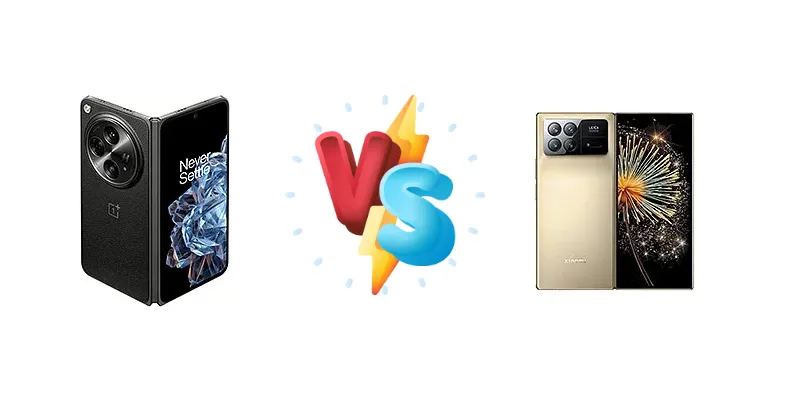
The foldable phone market is maturing, and the OnePlus Open 2 and Xiaomi Mix Fold 3 represent the current apex of Android innovation. While both devices aim to deliver a premium foldable experience, they take distinctly different approaches. The OnePlus Open 2 leverages Qualcomm’s newest Snapdragon 8 Elite chipset, promising unparalleled performance, while the Xiaomi Mix Fold 3 relies on the proven Snapdragon 8 Gen 2, focusing on refinement and a balanced feature set. This comparison will dissect their strengths and weaknesses to determine which foldable reigns supreme.
🏆 Quick Verdict
For users prioritizing raw processing power and future-proofing, the OnePlus Open 2 is the clear winner. Its Snapdragon 8 Elite chipset offers a significant performance leap. However, the Xiaomi Mix Fold 3 provides a more polished and efficient experience with its excellent display and fast charging, making it a strong contender for those valuing overall balance.
| Network |
|---|
| 2G bands | GSM 850 / 900 / 1800 / 1900 | GSM 850 / 900 / 1800 / 1900 |
| 3G bands | HSDPA 800 / 850 / 900 / 1700(AWS) / 1900 / 2100 | HSDPA 800 / 850 / 900 / 1700(AWS) / 1900 / 2100 |
| 4G bands | LTE | 1, 2, 3, 4, 5, 7, 8, 12, 17, 18, 19, 26, 34, 38, 39, 40, 41, 42 |
| 5G bands | SA/NSA | 1, 3, 5, 8, 28, 38, 40, 41, 77, 78, 79 SA/NSA |
| Speed | HSPA, LTE, 5G | HSPA, LTE, 5G |
| Technology | GSM / HSPA / LTE / 5G | GSM / CDMA / HSPA / EVDO / LTE / 5G |
| Launch |
|---|
| Announced | Not announced yet | 2023, August 14 |
| Status | Cancelled | Available. Released 2023, August 14 |
| Body |
|---|
| Build | - | Glass front (folded), plastic front (unfolded), glass back or aramid fiber back, aluminum frame |
| Dimensions | Folded thickness: 10 mm | Unfolded: 161.2 x 143.3 x 5.3 mm Folded: 161.2 x 73.5 x 10.9 mm |
| SIM | Nano-SIM + Nano-SIM + eSIM (max 2 at a time) | Nano-SIM + Nano-SIM |
| Weight | - | 255 g or 259 g (8.99 oz) |
| Display |
|---|
| Resolution | 2268 x 2440 pixels* (~416 ppi density) | 1916 x 2160 pixels (~360 ppi density) |
| Size | 8.0 inches, 205.9 cm2 | 8.03 inches, 206.5 cm2 (~89.4% screen-to-body ratio) |
| Type | Foldable LTPO3 Flexi-fluid AMOLED, 1B colors, Dolby Vision, 120Hz | Foldable LTPO OLED+, 1B colors, 120Hz, HDR10+, Dolby Vision, 1300 nits (peak) |
| Platform |
|---|
| CPU | Octa-core (2x4.32 GHz Oryon V2 Phoenix L + 6x3.53 GHz Oryon V2 Phoenix M) | Octa-core (1x3.36 GHz Cortex-X3 & 2x2.8 GHz Cortex-A715 & 2x2.8 GHz Cortex-A710 & 3x2.0 GHz Cortex-A510) |
| Chipset | Qualcomm SM8750-AB Snapdragon 8 Elite (3 nm) | Qualcomm SM8550-AC Snapdragon 8 Gen 2 (4 nm) |
| GPU | Adreno 830 | Adreno 740 |
| OS | Android 15, OxygenOS 15 | Android 13, upgradable to Android 14, HyperOS |
| Memory |
|---|
| Card slot | No | No |
| Internal | 512GB 16GB RAM, 1TB 16GB RAM | 256GB 12GB RAM, 512GB 16GB RAM, 1TB 16GB RAM |
| Main Camera |
|---|
| Features | Hasselblad Color Calibration, LED flash, HDR, panorama | Color spectrum sensor, LED flash, HDR, panorama, Leica lenses |
| Quad | - | 50 MP, f/1.8, 23mm (wide), 1/1.49", 1.0µm, PDAF, OIS
10 MP, f/2.0, 75mm (telephoto), 1/3.94", 1.0µm, PDAF, OIS, 3.2x optical zoom
10 MP, f/2.9, 115mm (telephoto), 1/3.94", 1.0µm, PDAF, OIS, 5x optical zoom
12 MP, f/2.2, 15mm, 120˚ (ultrawide), 1/3.1", 1.12µm |
| Triple | 50 MP, (wide), PDAF, OIS
50 MP, (telephoto), PDAF, OIS, 3x optical zoom
50 MP, (ultrawide), PDAF | - |
| Video | 4K@30/60fps, 1080p@30/60/120/240/480fps gyro-EIS, HDR10+, Dolby Vision | 8K@24fps, 4K@24/30/60fps, 1080p@30/60/120/240/960/1920fps, Dolby Vision HDR |
| Selfie camera |
|---|
| Features | HDR | HDR, panorama |
| Single | 20MP, f/2.2, 20mm (ultrawide), 1/4.0", 0.7µm
Cover camera:
32MP, f/2.4, 22mm (ultrawide), 1/3.14", 0.7µm | 20 MP, f/2.3, 23mm (wide), 1/4.0", 0.8µm
Cover camera:
20 MP, f/2.3, 23mm (wide), 1/4.0", 0.8µm |
| Video | 4K@30fps, 1080p@30fps, gyro-EIS | 1080p@30/60fps |
| Sound |
|---|
| 35mm jack | No | No |
| Loudspeaker | Yes, with stereo speakers (Dolby Atmos enhanced) | Yes, with stereo speakers |
| Comms |
|---|
| Bluetooth | 5.4, A2DP, LE, aptX HD | 5.3, A2DP, LE |
| Infrared port | Yes | Yes |
| NFC | Yes | Yes |
| Positioning | GPS (L1+L5), GLONASS, BDS, GALILEO (E1+E5a), QZSS | GPS (L1+L5), GLONASS (G1), BDS (B1I+B1c+B2a), GALILEO (E1+E5a), QZSS (L1+L5), NavIC (L5) |
| Radio | No | No |
| USB | USB Type-C 3.1, OTG | USB Type-C 3.2, OTG |
| WLAN | Wi-Fi 802.11 a/b/g/n/ac/6e/7, tri-band | Wi-Fi 802.11 a/b/g/n/ac/6e/7, dual-band (tri-band after future SW update) |
| Features |
|---|
| Sensors | Fingerprint (side-mounted), accelerometer, gyro, proximity, compass | Fingerprint (side-mounted), accelerometer, gyro, proximity, compass, barometer |
| Battery |
|---|
| Charging | 80W wired
50W wireless
Reverse wired | 67W wired, PD3.0, QC4, 100% in 40 min
50W wireless, 100% in 55 min |
| Type | Si/C Li-Ion 5900 mAh | Li-Po 4800 mAh |
| Misc |
|---|
| Colors | Black; other colors | Black, Gold |
| Models | - | 2308CPXD0C |
| Price | - | About 1150 EUR |
OnePlus Open 2
- Cutting-edge Snapdragon 8 Elite chipset for unmatched performance
- Faster 80W wired charging
- Potential for future software optimizations leveraging the new chipset
- Battery life potentially compromised by the power-hungry Snapdragon 8 Elite
- Display brightness data currently unavailable
Xiaomi Mix Fold 3
- Brighter display (1277 nits) for excellent outdoor visibility
- Proven Snapdragon 8 Gen 2 chipset with excellent efficiency
- Mature foldable design and software experience
- Slower charging speeds compared to OnePlus Open 2
- Older chipset may not offer the same future-proofing
Display Comparison
The Xiaomi Mix Fold 3 boasts a measured peak brightness of 1277 nits, a significant advantage for outdoor visibility compared to the OnePlus Open 2 (brightness data unavailable). While both are likely to utilize LTPO technology for adaptive refresh rates, the Mix Fold 3’s higher peak brightness suggests a superior viewing experience in bright conditions. The crease visibility and hinge durability, while not specified, are critical factors where Xiaomi’s experience with multiple foldable generations may give it an edge. The panel technology and color accuracy will be key differentiators, but without further data, the Mix Fold 3 currently holds a brightness advantage.
Camera Comparison
Detailed camera specifications are missing for both devices. However, given the flagship positioning, both are expected to feature multi-camera systems with optical image stabilization (OIS). The sensor size of the main camera will be a crucial factor; larger sensors generally capture more light and produce better image quality, especially in low-light conditions. Image processing algorithms will also play a significant role in determining the final image quality. Without specific details, it’s difficult to declare a winner, but the OnePlus brand has historically focused on natural color reproduction, while Xiaomi often leans towards more vibrant, saturated images.
Performance
The OnePlus Open 2’s Qualcomm SM8750-AB Snapdragon 8 Elite chipset, featuring the Oryon V2 Phoenix cores, represents a substantial architectural shift. The 3nm process node promises improved power efficiency and thermal performance compared to the Xiaomi Mix Fold 3’s 4nm Snapdragon 8 Gen 2 (SM8550-AC). The Oryon cores (2x4.32 GHz + 6x3.53 GHz) are designed for higher single-core and multi-core performance than the Snapdragon 8 Gen 2’s (1x3.36 GHz Cortex-X3, etc.). This translates to faster app loading, smoother multitasking, and a more responsive user experience, particularly for demanding tasks. While the Gen 2 is no slouch, the 8 Elite is expected to deliver a noticeable performance uplift, especially in sustained workloads.
Battery Life
The Xiaomi Mix Fold 3 has an endurance rating of 117 hours, providing a baseline for real-world battery life. The OnePlus Open 2’s battery capacity is unknown, but its Snapdragon 8 Elite chipset, despite its performance gains, may consume more power. The Mix Fold 3 offers 67W wired charging (40 minutes to 100%) and 50W wireless charging (55 minutes to 100%), providing convenient and relatively fast charging options. The OnePlus Open 2 counters with 80W wired charging and 50W wireless, offering slightly faster wired charging. The combination of battery capacity, chipset efficiency, and charging speed will ultimately determine which device offers the better overall battery experience.
Buying Guide
Buy the OnePlus Open 2 if you are a power user demanding the absolute best performance for gaming, video editing, or multitasking. Its Snapdragon 8 Elite and faster charging will keep you going. Buy the Xiaomi Mix Fold 3 if you prioritize a refined foldable experience with a brighter display, efficient power management, and a more mature software implementation. It’s the better choice for everyday use and media consumption.
Frequently Asked Questions
❓ Will the Snapdragon 8 Elite in the OnePlus Open 2 overheat during extended gaming sessions?
The Snapdragon 8 Elite's 3nm process and improved thermal architecture are designed to mitigate overheating. However, sustained high loads will inevitably generate heat. OnePlus will likely employ advanced cooling solutions to manage temperatures, but real-world performance will depend on the effectiveness of these measures. The Mix Fold 3's Gen 2 is known for its thermal efficiency, making it a safer bet for prolonged gaming.
❓ How does the hinge durability compare between the OnePlus Open 2 and the Xiaomi Mix Fold 3?
Xiaomi has released multiple generations of foldable phones, giving them a significant advantage in hinge design and durability. While OnePlus has made strides with the Open series, long-term reliability remains a key concern for all foldable devices. Independent durability tests will be crucial to assess the hinge's robustness on both models.
❓ Does the OnePlus Open 2 support high refresh rate gaming, and what frame rates can be expected in demanding titles like Genshin Impact?
Given the Snapdragon 8 Elite's powerful GPU, the OnePlus Open 2 is expected to support high refresh rate gaming. However, sustained high frame rates in demanding titles like Genshin Impact will depend on the game's optimization and the device's thermal management. Expect variable frame rates, potentially reaching 60fps or higher with optimized settings.