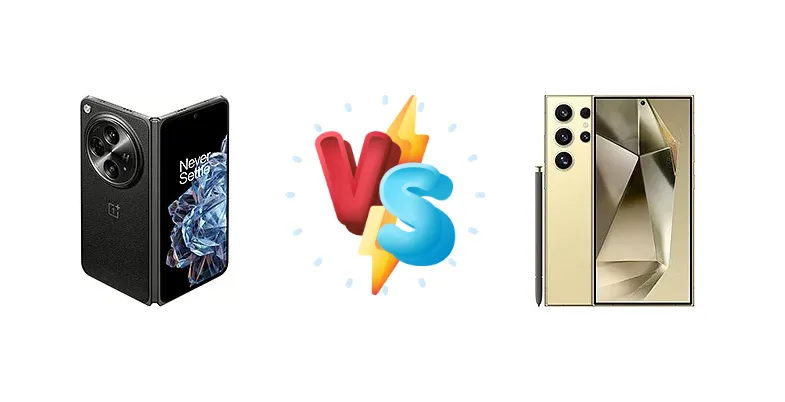
The OnePlus Open 2 arrives as a direct challenger to Samsung’s established dominance in the ultra-premium smartphone space, specifically targeting the Galaxy S24 Ultra. This comparison isn’t just about specs; it’s about contrasting Qualcomm’s newest Snapdragon 8 Elite with the Gen 3, and a foldable form factor against Samsung’s refined Ultra design. We’ll dissect performance, camera capabilities, battery life, and charging speeds to determine which device reigns supreme.
🏆 Quick Verdict
For the power user prioritizing raw performance and a unique foldable experience, the OnePlus Open 2 edges out the Samsung Galaxy S24 Ultra. The Snapdragon 8 Elite’s Oryon cores deliver a noticeable performance uplift, while 80W charging is significantly faster. However, the S24 Ultra’s superior battery life and established software ecosystem make it a strong contender.
| Network |
|---|
| 2G bands | GSM 850 / 900 / 1800 / 1900 | GSM 850 / 900 / 1800 / 1900 |
| 3G bands | HSDPA 800 / 850 / 900 / 1700(AWS) / 1900 / 2100 | HSDPA 850 / 900 / 1700(AWS) / 1900 / 2100 |
| 4G bands | LTE | 1, 2, 3, 4, 5, 7, 8, 12, 13, 17, 18, 19, 20, 25, 26, 28, 32, 38, 39, 40, 41, 66 - International |
| 5G bands | SA/NSA | 1, 2, 3, 5, 7, 8, 12, 20, 25, 26, 28, 38, 40, 41, 66, 75, 77, 78 SA/NSA/Sub6 - International |
| Speed | HSPA, LTE, 5G | HSPA, LTE (up to 7CA), 5G |
| Technology | GSM / HSPA / LTE / 5G | GSM / CDMA / HSPA / EVDO / LTE / 5G |
| Launch |
|---|
| Announced | Not announced yet | 2024, January 17 |
| Status | Cancelled | Available. Released 2024, January 24 |
| Body |
|---|
| Build | - | Glass front (Corning Gorilla Armor), glass back (Corning Gorilla Armor), titanium frame (grade 2) |
| Dimensions | Folded thickness: 10 mm | 162.3 x 79 x 8.6 mm (6.39 x 3.11 x 0.34 in) |
| SIM | Nano-SIM + Nano-SIM + eSIM (max 2 at a time) | · Nano-SIM + Nano-SIM + eSIM + eSIM (max 2 at a time) - INT· Nano-SIM + eSIM + eSIM (max 2 at a time) - USA· Nano-SIM + Nano-SIM - CN |
| Weight | - | 232 g or 233 g (8.18 oz) |
| Display |
|---|
| Protection | - | Corning Gorilla Armor |
| Resolution | 2268 x 2440 pixels* (~416 ppi density) | 1440 x 3120 pixels, 19.5:9 ratio (~505 ppi density) |
| Size | 8.0 inches, 205.9 cm2 | 6.8 inches, 113.5 cm2 (~88.5% screen-to-body ratio) |
| Type | Foldable LTPO3 Flexi-fluid AMOLED, 1B colors, Dolby Vision, 120Hz | Dynamic LTPO AMOLED 2X, 120Hz, HDR10+, 2600 nits (peak) |
| Platform |
|---|
| CPU | Octa-core (2x4.32 GHz Oryon V2 Phoenix L + 6x3.53 GHz Oryon V2 Phoenix M) | 8-core (1x3.39GHz Cortex-X4 & 3x3.1GHz Cortex-A720 & 2x2.9GHz Cortex-A720 & 2x2.2GHz Cortex-A520) |
| Chipset | Qualcomm SM8750-AB Snapdragon 8 Elite (3 nm) | Qualcomm SM8650-AC Snapdragon 8 Gen 3 (4 nm) |
| GPU | Adreno 830 | Adreno 750 (1 GHz) |
| OS | Android 15, OxygenOS 15 | Android 14, up to 7 major Android upgrades, One UI 8.0 |
| Memory |
|---|
| Card slot | No | No |
| Internal | 512GB 16GB RAM, 1TB 16GB RAM | 256GB 12GB RAM, 512GB 12GB RAM, 1TB 12GB RAM |
| Main Camera |
|---|
| Features | Hasselblad Color Calibration, LED flash, HDR, panorama | Laser AF, LED flash, auto-HDR, panorama |
| Quad | - | 200 MP, f/1.7, 24mm (wide), 1/1.3", 0.6µm, multi-directional PDAF, OIS
10 MP, f/2.4, 67mm (telephoto), 1/3.52", 1.12µm, PDAF, OIS, 3x optical zoom
50 MP, f/3.4, 111mm (periscope telephoto), 1/2.52", 0.7µm, PDAF, OIS, 5x optical zoom
12 MP, f/2.2, 13mm, 120˚ (ultrawide), 1/2.55", 1.4µm, dual pixel PDAF, Super Steady video |
| Triple | 50 MP, (wide), PDAF, OIS
50 MP, (telephoto), PDAF, OIS, 3x optical zoom
50 MP, (ultrawide), PDAF | - |
| Video | 4K@30/60fps, 1080p@30/60/120/240/480fps gyro-EIS, HDR10+, Dolby Vision | 8K@24/30fps, 4K@30/60/120fps, 1080p@30/60/120/240fps, HDR10+, stereo sound rec., gyro-EIS |
| Selfie camera |
|---|
| Features | HDR | HDR, HDR10+ |
| Single | 20MP, f/2.2, 20mm (ultrawide), 1/4.0", 0.7µm
Cover camera:
32MP, f/2.4, 22mm (ultrawide), 1/3.14", 0.7µm | 12 MP, f/2.2, 26mm (wide), 1/3.2", 1.12µm, dual pixel PDAF |
| Video | 4K@30fps, 1080p@30fps, gyro-EIS | 4K@30/60fps, 1080p@30fps |
| Sound |
|---|
| 35mm jack | No | No |
| Loudspeaker | Yes, with stereo speakers (Dolby Atmos enhanced) | Yes, with stereo speakers |
| Comms |
|---|
| Bluetooth | 5.4, A2DP, LE, aptX HD | 5.3, A2DP, LE |
| Infrared port | Yes | - |
| NFC | Yes | Yes |
| Positioning | GPS (L1+L5), GLONASS, BDS, GALILEO (E1+E5a), QZSS | GPS, GLONASS, BDS, GALILEO, QZSS |
| Radio | No | No |
| USB | USB Type-C 3.1, OTG | USB Type-C 3.2, DisplayPort 1.2, OTG |
| WLAN | Wi-Fi 802.11 a/b/g/n/ac/6e/7, tri-band | Wi-Fi 802.11 a/b/g/n/ac/6e/7, tri-band, Wi-Fi Direct |
| Features |
|---|
| Sensors | Fingerprint (side-mounted), accelerometer, gyro, proximity, compass | Fingerprint (under display, ultrasonic), accelerometer, gyro, proximity, compass, barometer |
| Battery |
|---|
| Charging | 80W wired
50W wireless
Reverse wired | 45W wired, PD3.0, 65% in 30 min
15W wireless (Qi)
4.5W reverse wireless |
| Type | Si/C Li-Ion 5900 mAh | Li-Ion 5000 mAh |
| Misc |
|---|
| Colors | Black; other colors | Titanium Black, Titanium Gray, Titanium Violet, Titanium Yellow, Titanium Blue, Titanium Green, Titanium Orange |
| Models | - | SM-S928B, SM-S928B/DS, SM-S928U, SM-S928U1, SM-S928W, SM-S928N, SM-S9280, SM-S928E, SM-S928E/DS |
| Price | - | $ 514.94 / C$ 929.99 / £ 630.00 / € 658.53 / ₹ 84,999 |
| SAR | - | 1.26 W/kg (head) 0.62 W/kg (body) |
| SAR EU | - | 1.06 W/kg (head) 1.30 W/kg (body) |
OnePlus Open 2
- Faster 80W wired charging
- Potentially superior CPU performance with Oryon cores
- Unique foldable form factor for enhanced multitasking
- Battery capacity likely lower than S24 Ultra
- Foldable display crease may be distracting
- Camera specs currently unknown
Samsung Galaxy S24 Ultra
- Exceptional 13:49h battery life
- Mature software ecosystem and feature set
- Versatile camera system with excellent zoom capabilities
- Slower 45W wired charging
- Snapdragon 8 Gen 3 may be outperformed by 8 Elite
- Higher price point
Display Comparison
The Samsung Galaxy S24 Ultra boasts a peak brightness of 1447 nits, ensuring excellent visibility even in direct sunlight. While the OnePlus Open 2’s display specs aren’t provided, foldable displays typically prioritize color accuracy and flexibility over peak brightness. Both likely utilize LTPO technology for adaptive refresh rates, conserving battery life. The Open 2’s foldable nature offers a larger screen real estate when unfolded, enhancing multitasking and media consumption, but introduces a crease that some users may find distracting. The S24 Ultra’s flat display minimizes reflections and offers better durability.
Camera Comparison
Detailed camera specs for the OnePlus Open 2 are missing, but given its positioning, it’s expected to feature a high-resolution main sensor. The Samsung Galaxy S24 Ultra’s camera system is well-documented, offering versatile shooting options. The S24 Ultra’s image processing prioritizes natural colors and detail, while OnePlus typically leans towards more vibrant, saturated images. The S24 Ultra’s superior optical zoom capabilities, likely exceeding the Open 2, will be a key advantage for long-distance photography. Without specific sensor details for the Open 2, it’s difficult to definitively assess its camera performance, but the S24 Ultra’s established track record gives it a lead.
Performance
The core difference lies in the chipsets. The OnePlus Open 2 features the Qualcomm SM8750-AB Snapdragon 8 Elite with Oryon V2 Phoenix cores, promising a significant performance leap over the Snapdragon 8 Gen 3 (SM8650-AC) in the S24 Ultra. The 8 Elite’s 3nm process node should deliver improved thermal efficiency, potentially reducing throttling during sustained workloads. The Open 2’s CPU configuration (2x4.32 GHz Oryon V2 Phoenix L + 6x3.53 GHz Oryon V2 Phoenix M) is architecturally distinct from the S24 Ultra’s (1x3.39GHz Cortex-X4 & 3x3.1GHz Cortex-A720 & 2x2.9GHz Cortex-A720 & 2x2.2GHz Cortex-A520), with the Oryon cores designed for higher single-core performance. While the S24 Ultra benefits from Qualcomm’s optimizations, the Open 2’s architecture suggests a potential edge in demanding tasks.
Battery Life
The Samsung Galaxy S24 Ultra achieves an impressive 13:49h of active use, demonstrating excellent battery life. The OnePlus Open 2’s battery capacity is unknown, but foldable phones often have slightly smaller batteries due to space constraints. However, the Open 2 compensates with significantly faster charging: 80W wired versus the S24 Ultra’s 45W. The Open 2 can likely achieve a substantial charge in under 30 minutes, while the S24 Ultra takes approximately 30 minutes to reach 65%. The Open 2 also offers 50W wireless charging, dwarfing the S24 Ultra’s 15W Qi wireless charging. The trade-off is endurance versus speed; the S24 Ultra lasts longer, while the Open 2 charges much faster.
Buying Guide
Buy the OnePlus Open 2 if you demand the absolute fastest Android performance, value the versatility of a foldable display, and prioritize rapid charging. You’ll benefit from the Oryon CPU’s efficiency and the unique multitasking capabilities. Buy the Samsung Galaxy S24 Ultra if you prioritize all-day battery life, a mature and feature-rich software experience, and a robust camera system with extensive zoom capabilities. It’s the safer, more polished choice for mainstream users.
Frequently Asked Questions
❓ Does the Snapdragon 8 Elite in the OnePlus Open 2 generate significantly more heat than the Snapdragon 8 Gen 3 in the S24 Ultra during prolonged gaming sessions?
The Snapdragon 8 Elite’s 3nm process node is designed for improved thermal efficiency. While both chips will generate heat under load, the 8 Elite *should* exhibit less throttling, maintaining higher sustained performance. However, the Open 2’s foldable design may present unique thermal challenges, requiring further testing to confirm real-world results.
❓ How does the 80W charging on the OnePlus Open 2 compare to the 45W charging on the S24 Ultra in terms of actual charging time from 0% to 100%?
The OnePlus Open 2’s 80W charging is substantially faster. While the S24 Ultra reaches 65% in 30 minutes, the Open 2 is expected to fully charge in under an hour. This difference is significant for users who frequently need to quickly top up their battery.
❓ Is the crease on the OnePlus Open 2’s foldable display noticeable during everyday use, and does it affect the viewing experience?
The crease is inherent to foldable display technology. While visibility varies depending on viewing angle and content, it is generally noticeable. Most users adapt to it over time, but it remains a potential drawback for those sensitive to screen imperfections. Samsung has made strides in minimizing the crease in its own foldable devices, but it's still present.