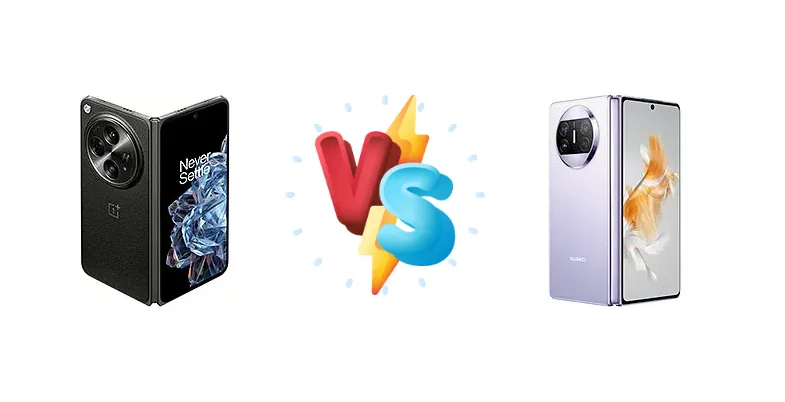
The foldable phone market is maturing, with the OnePlus Open 2 entering as a direct competitor to established players like Huawei. While the Mate X3 has already proven its worth with a robust design and solid performance, the Open 2 arrives with Qualcomm’s latest Snapdragon 8 Elite chipset, promising a significant performance uplift. This comparison dissects the key differences between these two premium foldables, helping you determine which one best suits your needs.
🏆 Quick Verdict
For most users, the OnePlus Open 2 emerges as the superior choice. Its Snapdragon 8 Elite chipset delivers demonstrably faster performance and improved efficiency, while 80W wired charging offers a quicker top-up than the Mate X3’s 66W. Despite the Mate X3’s excellent endurance rating, the Open 2’s raw power and faster charging make it the winner.
| Network |
|---|
| 2G bands | GSM 850 / 900 / 1800 / 1900 | GSM 850 / 900 / 1800 / 1900 |
| 3G bands | HSDPA 800 / 850 / 900 / 1700(AWS) / 1900 / 2100 | HSDPA 800 / 850 / 900 / 1700(AWS) / 1900 / 2100 |
| 4G bands | LTE | 1, 2, 3, 4, 5, 7, 8, 12, 17, 18, 19, 20, 26, 28, 34, 38, 39, 40, 41 |
| 5G bands | SA/NSA | - |
| Speed | HSPA, LTE, 5G | HSPA, LTE |
| Technology | GSM / HSPA / LTE / 5G | GSM / CDMA / HSPA / EVDO / LTE |
| | - | CDMA2000 1xEV-DO |
| Launch |
|---|
| Announced | Not announced yet | 2023, March 23 |
| Status | Cancelled | Available. Released 2023, April 08 |
| Body |
|---|
| Build | - | Glass front, glass back or eco leather back, aluminum frame |
| Dimensions | Folded thickness: 10 mm | Unfolded: 156.9 x 141.5 x 5.3 mmFolded: 156.9 x 72.4 x 11.1 mm |
| SIM | Nano-SIM + Nano-SIM + eSIM (max 2 at a time) | Nano-SIM + Nano-SIM |
| Weight | - | 239 g or 241 g (8.43 oz) |
| | - | IPX8 dust/water resistant (up to 1.5m for 30 min) |
| Display |
|---|
| Protection | - | Kunlun Glass (cover display only) |
| Resolution | 2268 x 2440 pixels* (~416 ppi density) | 2224 x 2496 pixels (~426 ppi density) |
| Size | 8.0 inches, 205.9 cm2 | 7.85 inches, 197.5 cm2 (~88.9% screen-to-body ratio) |
| Type | Foldable LTPO3 Flexi-fluid AMOLED, 1B colors, Dolby Vision, 120Hz | Foldable OLED, 1B colors, 120Hz |
| | - | Cover display:
OLED, 120Hz, 6.4 inches, 1080 x 2504 pixels |
| Platform |
|---|
| CPU | Octa-core (2x4.32 GHz Oryon V2 Phoenix L + 6x3.53 GHz Oryon V2 Phoenix M) | Octa-core (1x3.19 GHz Cortex-X2 & 3x2.75 GHz Cortex-A710 & 4x2.0 GHz Cortex-A510) |
| Chipset | Qualcomm SM8750-AB Snapdragon 8 Elite (3 nm) | Qualcomm SM8475 Snapdragon 8+ Gen 1 4G (4 nm) |
| GPU | Adreno 830 | Adreno 730 |
| OS | Android 15, OxygenOS 15 | HarmonyOS 3.1 (China), EMUI 13.1 (Europe), no Google Play Services |
| Memory |
|---|
| Card slot | No | Nano Memory (uses shared SIM slot) |
| Internal | 512GB 16GB RAM, 1TB 16GB RAM | 256GB 12GB RAM, 512GB 12GB RAM, 1TB 12GB RAM |
| | - | UFS |
| Main Camera |
|---|
| Features | Hasselblad Color Calibration, LED flash, HDR, panorama | Laser AF, color spectrum sensor, LED flash, panorama, HDR |
| Triple | 50 MP, (wide), PDAF, OIS
50 MP, (telephoto), PDAF, OIS, 3x optical zoom
50 MP, (ultrawide), PDAF | 50 MP, f/1.8, 23mm (wide), PDAF, OIS
12 MP, f/3.4, 125mm (periscope telephoto), PDAF, OIS, 5x optical zoom
13 MP, f/2.2, 13mm (ultrawide), AF |
| Video | 4K@30/60fps, 1080p@30/60/120/240/480fps gyro-EIS, HDR10+, Dolby Vision | 4K@30/60fps, 1080p@30/60fps, gyro-EIS |
| Selfie camera |
|---|
| Features | HDR | HDR, panorama |
| Single | 20MP, f/2.2, 20mm (ultrawide), 1/4.0", 0.7µm
Cover camera:
32MP, f/2.4, 22mm (ultrawide), 1/3.14", 0.7µm | 8 MP, f/2.4, (wide)
Cover camera:
8 MP, f/2.4, (wide) |
| Video | 4K@30fps, 1080p@30fps, gyro-EIS | 4K@30fps, 1080p@30fps |
| Sound |
|---|
| 3.5mm jack | - | No |
| 35mm jack | No | No |
| Loudspeaker | Yes, with stereo speakers (Dolby Atmos enhanced) | Yes, with stereo speakers |
| Comms |
|---|
| Bluetooth | 5.4, A2DP, LE, aptX HD | 5.2, A2DP, LE |
| Infrared port | Yes | Yes |
| NFC | Yes | Yes |
| Positioning | GPS (L1+L5), GLONASS, BDS, GALILEO (E1+E5a), QZSS | GPS (L1+L5), GLONASS (B1I+B1c+B2a), BDS (B1I+B1c+B2a), GALILEO (E1+E5a), QZSS (L1+L5), NavIC |
| Radio | No | No |
| USB | USB Type-C 3.1, OTG | USB Type-C 3.1, DisplayPort 1.2, OTG |
| WLAN | Wi-Fi 802.11 a/b/g/n/ac/6e/7, tri-band | Wi-Fi 802.11 a/b/g/n/ac/6, dual-band, Wi-Fi Direct |
| Features |
|---|
| Sensors | Fingerprint (side-mounted), accelerometer, gyro, proximity, compass | Fingerprint (side-mounted), accelerometer, gyro, proximity, compass, barometer, altimeter |
| | - | BDS Satellite Message |
| Battery |
|---|
| Charging | 80W wired
50W wireless
Reverse wired | 66W wired
50W wireless
7.5W reverse wireless |
| Type | Si/C Li-Ion 5900 mAh | Market-dependent versions:· Li-Po 4800 mAh (Global)· Si/C Li-Ion 5060 mAh (China only) |
| Misc |
|---|
| Colors | Black; other colors | Black, White, Violet, Dark Green, Gold |
| Models | - | ALT-AL00, ALT-L29 |
| Price | - | About 1500 EUR |
| Tests |
|---|
| Battery life | - |
Endurance rating 81h
|
| Camera | - |
Photo / Video |
| Display | - |
Contrast ratio: Infinite (nominal) |
| Loudspeaker | - |
-26.3 LUFS (Good)
|
| Performance | - |
AnTuTu: 993592 (v9)
GeekBench: 4283 (v5.5), 4512 (v6)
GFXBench: 41fps (ES 3.1 onscreen) |
OnePlus Open 2
- Significantly faster processor with Snapdragon 8 Elite
- Faster 80W wired charging
- Potential for superior camera performance
- Foldable design durability is unproven
- Specific display specs currently unknown
Huawei Mate X3
- Excellent 81-hour battery endurance
- Proven foldable design and durability
- Competent camera system
- Older Snapdragon 8+ Gen 1 chipset
- Slower 66W wired charging
Display Comparison
The Huawei Mate X3 boasts a 926 nits peak brightness, a respectable figure, but the OnePlus Open 2’s display specifications are currently unavailable. However, given OnePlus’s history with high-quality panels, we anticipate a comparable or superior brightness level. Both devices feature infinite (nominal) contrast ratios, typical of OLED technology. The key difference will likely lie in panel technology – whether the Open 2 utilizes the latest LTPO advancements for variable refresh rates and improved power efficiency. The Mate X3’s foldable design is well-regarded for its minimal crease, and the Open 2 will need to match or exceed this to compete effectively.
Camera Comparison
Both devices are described as having 'Photo / Video' capabilities, lacking specific details. However, the camera experience will likely be a key differentiator. The OnePlus Open 2, given its flagship positioning, is expected to feature a more advanced camera system with larger sensors and improved image processing algorithms. The Mate X3’s camera is competent, but the Open 2 has the potential to deliver superior image quality, particularly in low-light conditions. Without sensor size or aperture information, it’s difficult to make a definitive judgment, but the Open 2’s newer chipset will likely enable more sophisticated computational photography features.
Performance
The OnePlus Open 2’s Qualcomm SM8750-AB Snapdragon 8 Elite chipset, featuring the Oryon V2 Phoenix cores, represents a substantial leap over the Huawei Mate X3’s Snapdragon 8+ Gen 1 (SM8475). The 3nm process node of the Snapdragon 8 Elite offers significantly improved power efficiency and thermal performance compared to the 4nm node of the 8+ Gen 1. The Open 2’s CPU configuration (2x4.32 GHz + 6x3.53 GHz) is also more aggressive, promising faster processing speeds. While the Mate X3’s Cortex-X2 core provides strong single-core performance, the Open 2’s Oryon cores are designed for sustained, multi-threaded workloads, making it ideal for content creators and gamers. The Open 2’s LPDDR5x RAM (spec not provided, but expected) will further enhance performance.
Battery Life
The Huawei Mate X3 achieves an impressive endurance rating of 81 hours, indicating excellent battery life. However, the OnePlus Open 2’s 80W wired charging significantly surpasses the Mate X3’s 66W, allowing for a much faster 0-100% charge. While the Mate X3 offers 50W wireless charging, the Open 2 matches that speed. The Open 2 also includes reverse wired charging, a feature absent on the Mate X3. The Snapdragon 8 Elite’s improved power efficiency could potentially offset any difference in battery capacity (spec not provided), resulting in comparable real-world battery life despite the faster charging speeds.
Buying Guide
Buy the OnePlus Open 2 if you prioritize raw performance for demanding tasks like gaming and video editing, and value the convenience of faster charging. You’ll benefit from the latest processor technology and a more future-proofed experience. Buy the Huawei Mate X3 if you prioritize a proven track record of foldable durability, and are less concerned with having the absolute latest chipset. Its excellent battery endurance and established software ecosystem are strong points for users who value stability over bleeding-edge features.
Frequently Asked Questions
❓ Will the Snapdragon 8 Elite in the OnePlus Open 2 overheat during extended gaming sessions?
The Snapdragon 8 Elite’s 3nm process node and improved thermal architecture are designed to mitigate overheating. While sustained high performance will generate heat, the Open 2 should exhibit less throttling than devices with older chipsets like the Mate X3’s Snapdragon 8+ Gen 1, leading to more consistent frame rates over longer periods.
❓ Does the Huawei Mate X3’s 66W charging feel slow compared to the OnePlus Open 2’s 80W?
While 66W is still considered fast charging, the 80W on the OnePlus Open 2 will noticeably reduce charging times. Expect a roughly 15-20% faster 0-100% charge with the Open 2, which is a significant convenience for users who frequently need to top up their battery.
❓ How does the foldable hinge durability compare between the OnePlus Open 2 and the Huawei Mate X3?
The Huawei Mate X3 has a proven track record for hinge durability, having been on the market for a longer period. The OnePlus Open 2’s hinge durability is currently unknown and will require long-term testing to assess. OnePlus claims to have rigorously tested the hinge, but real-world usage will be the ultimate test.