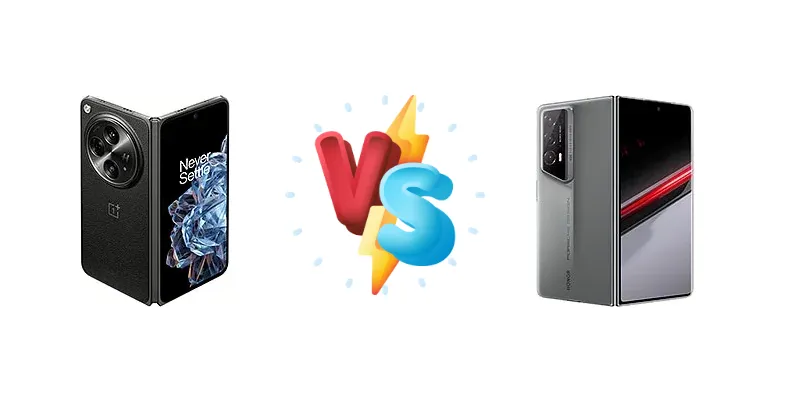
The foldable phone market is heating up, with the OnePlus Open 2 and the Honor Magic V2 RSR Porsche Design representing the pinnacle of Android innovation. While both devices aim for a premium experience, they take distinctly different approaches to achieving it. The Open 2 leverages Qualcomm’s newest Snapdragon 8 Elite, while the Honor opts for the established Snapdragon 8 Gen 2. This comparison dissects the key differences to determine which foldable reigns supreme.
🏆 Quick Verdict
For the power user prioritizing raw performance and future-proofing, the OnePlus Open 2 emerges as the winner. Its Snapdragon 8 Elite chipset, built on a 3nm process, offers a tangible performance advantage. However, the Honor Magic V2 RSR Porsche Design remains a compelling choice for those valuing refined design and a slightly more mature software experience.
| Network |
|---|
| 2G bands | GSM 850 / 900 / 1800 / 1900 | GSM 850 / 900 / 1800 / 1900 |
| 3G bands | HSDPA 800 / 850 / 900 / 1700(AWS) / 1900 / 2100 | HSDPA 800 / 850 / 900 / 1700(AWS) / 1900 / 2100 |
| 4G bands | LTE | 1, 2, 3, 4, 5, 7, 8, 12, 17, 18, 19, 20, 26, 28, 34, 38, 39, 40, 41, 66 |
| 5G bands | SA/NSA | 1, 3, 5, 8, 28, 38, 41, 77, 78 SA/NSA |
| Speed | HSPA, LTE, 5G | HSPA, LTE, 5G |
| Technology | GSM / HSPA / LTE / 5G | GSM / CDMA / HSPA / CDMA2000 / LTE / 5G |
| Launch |
|---|
| Announced | Not announced yet | 2024, January 11 |
| Status | Cancelled | Available. Released 2024, January 12 |
| Body |
|---|
| Build | - | Glass front, glass back, magnesium alloy frame, titanium alloy folding mechanism |
| Dimensions | Folded thickness: 10 mm | Unfolded: 156.7 x 145.4 x 4.7 mm or 4.8 mmFolded: 156.7 x 74 x 9.9 mm or 10.1 mm |
| SIM | Nano-SIM + Nano-SIM + eSIM (max 2 at a time) | · Nano-SIM + eSIM· Nano-SIM + Nano-SIM |
| Weight | - | 234 g (8.25 oz) |
| Display |
|---|
| Resolution | 2268 x 2440 pixels* (~416 ppi density) | 2156 x 2344 pixels (~402 ppi density) |
| Size | 8.0 inches, 205.9 cm2 | 7.92 inches, 201.6 cm2 (~88.5% screen-to-body ratio) |
| Type | Foldable LTPO3 Flexi-fluid AMOLED, 1B colors, Dolby Vision, 120Hz | Foldable LTPO OLED, 1B colors, 120Hz, HDR10+, 1600 nits (peak) |
| Platform |
|---|
| CPU | Octa-core (2x4.32 GHz Oryon V2 Phoenix L + 6x3.53 GHz Oryon V2 Phoenix M) | Octa-core (1x3.36 GHz Cortex-X3 & 2x2.8 GHz Cortex-A715 & 2x2.8 GHz Cortex-A710 & 3x2.0 GHz Cortex-A510) |
| Chipset | Qualcomm SM8750-AB Snapdragon 8 Elite (3 nm) | Qualcomm SM8550-AC Snapdragon 8 Gen 2 (4 nm) |
| GPU | Adreno 830 | Adreno 740 |
| OS | Android 15, OxygenOS 15 | Android 13, upgradable to Android 14, MagicOS 8 |
| Memory |
|---|
| Card slot | No | No |
| Internal | 512GB 16GB RAM, 1TB 16GB RAM | 1TB 16GB RAM |
| Main Camera |
|---|
| Features | Hasselblad Color Calibration, LED flash, HDR, panorama | Multi-zone Laser AF (8x8 dToF), color spectrum sensor, LED flash, HDR, panorama |
| Triple | 50 MP, (wide), PDAF, OIS
50 MP, (telephoto), PDAF, OIS, 3x optical zoom
50 MP, (ultrawide), PDAF | 50 MP, f/1.9, (wide), PDAF, OIS
20 MP, f/2.4, 62mm (telephoto), PDAF, 2.5x optical zoom, OIS
50 MP, f/2.0, 13mm (ultrawide), AF |
| Video | 4K@30/60fps, 1080p@30/60/120/240/480fps gyro-EIS, HDR10+, Dolby Vision | 4K@30/60fps (10-bit), 1080p@30/60fps, gyro-EIS, HDR10+, OIS |
| Selfie camera |
|---|
| Features | HDR | HDR |
| Single | 20MP, f/2.2, 20mm (ultrawide), 1/4.0", 0.7µm
Cover camera:
32MP, f/2.4, 22mm (ultrawide), 1/3.14", 0.7µm | 16 MP, f/2.2, (wide) |
| Video | 4K@30fps, 1080p@30fps, gyro-EIS | 4K@30fps, 1080p@30fps, gyro-EIS |
| Sound |
|---|
| 35mm jack | No | No |
| Loudspeaker | Yes, with stereo speakers (Dolby Atmos enhanced) | Yes, with stereo speakers |
| Comms |
|---|
| Bluetooth | 5.4, A2DP, LE, aptX HD | 5.3, A2DP, LE, aptX HD |
| Infrared port | Yes | Yes |
| NFC | Yes | Yes |
| Positioning | GPS (L1+L5), GLONASS, BDS, GALILEO (E1+E5a), QZSS | GPS (L1+L5), GLONASS (L1), BDS (B1I+B1c+B2a), GALILEO (E1+E5a), QZSS (L1+L5) |
| Radio | No | No |
| USB | USB Type-C 3.1, OTG | USB Type-C 3.1, OTG, Display Port 1.2 |
| WLAN | Wi-Fi 802.11 a/b/g/n/ac/6e/7, tri-band | Wi-Fi 802.11 a/b/g/n/ac/6e/7, dual-band, Wi-Fi Direct |
| Features |
|---|
| Sensors | Fingerprint (side-mounted), accelerometer, gyro, proximity, compass | Fingerprint (side-mounted), accelerometer, gyro, proximity, compass |
| Battery |
|---|
| Charging | 80W wired
50W wireless
Reverse wired | 66W wired
5W reverse wired |
| Type | Si/C Li-Ion 5900 mAh | Si/C Li-Ion 5000 mAh |
| Misc |
|---|
| Colors | Black; other colors | Agate Gray |
| Models | - | VER-AN10 |
| Price | - | About 2700 EUR |
OnePlus Open 2
- Superior processing power with Snapdragon 8 Elite
- Faster wired and wireless charging
- Reverse wired charging capability
- Potentially higher price
- Software may require further refinement
Honor Magic V2 RSR Porsche Design
- Sleek Porsche Design aesthetic
- Established software ecosystem
- Excellent build quality
- Less powerful chipset compared to Snapdragon 8 Elite
- Slower charging speeds
Display Comparison
While both devices feature foldable displays, specifics are missing in the provided data. However, given the price point, both are expected to utilize LTPO technology for adaptive refresh rates, maximizing battery efficiency. The Honor Magic V2 RSR is known for its incredibly thin profile when unfolded, suggesting a focus on minimizing bezel size. The OnePlus Open 2, while likely excellent, will need to match this level of engineering to compete. Color accuracy and peak brightness will be crucial differentiators, but require further testing.
Camera Comparison
Without detailed camera specs, a direct comparison is limited. However, both phones are expected to feature flagship-level camera systems. The OnePlus Open 2, given its focus on overall performance, may prioritize computational photography and advanced image processing capabilities leveraging the Snapdragon 8 Elite’s ISP. The Honor Magic V2 RSR Porsche Design, with its brand association with Porsche, might emphasize image quality and color science. Sensor size and lens apertures will be key factors, but require further investigation. The absence of information on OIS is a notable omission.
Performance
The core difference lies in the chipsets. The OnePlus Open 2’s Snapdragon 8 Elite (3nm) represents a significant leap over the Honor Magic V2 RSR’s Snapdragon 8 Gen 2 (4nm). The 3nm process allows for greater transistor density and improved power efficiency, translating to higher sustained performance and reduced thermal throttling. The Open 2’s Oryon V2 Phoenix CPU cores (2x4.32 GHz + 6x3.53 GHz) are architecturally superior to the Gen 2’s Cortex-X3 and Cortex-A715/A710 configuration, promising faster single-core and multi-core performance. This benefits demanding tasks like video editing, gaming, and complex multitasking. The Honor’s Gen 2 is still incredibly capable, but the Open 2 has a clear advantage.
Battery Life
The OnePlus Open 2’s 80W wired charging and 50W wireless charging significantly outpace the Honor Magic V2 RSR’s 66W wired and 5W wireless charging. This translates to substantially faster charging times for the Open 2. While battery capacity isn’t specified, the faster charging speeds partially offset any potential capacity difference. The Open 2 also includes reverse wired charging, a feature absent on the Honor, adding to its versatility.
Buying Guide
Buy the OnePlus Open 2 if you demand the absolute best in mobile processing power, need faster charging speeds, and are willing to embrace a potentially evolving software experience. Buy the Honor Magic V2 RSR Porsche Design if you prioritize a sleek, Porsche-designed aesthetic, a more established software ecosystem, and are comfortable with a slightly less powerful, yet still very capable, chipset.
Frequently Asked Questions
❓ Will the Snapdragon 8 Elite in the OnePlus Open 2 noticeably improve gaming performance compared to the Snapdragon 8 Gen 2?
Yes, the Snapdragon 8 Elite's Oryon CPU cores and 3nm process provide a significant performance uplift, especially in sustained gaming scenarios. Expect higher frame rates, smoother gameplay, and reduced thermal throttling compared to the Honor Magic V2 RSR.
❓ Does the Honor Magic V2 RSR Porsche Design's software offer more features or a more polished experience out of the box?
Historically, Honor's MagicOS has been praised for its clean interface and useful features. While OnePlus's OxygenOS has improved, the Honor likely offers a more refined software experience initially, with a focus on usability and customization options.
❓ How much faster is the 80W charging on the OnePlus Open 2 compared to the 66W charging on the Honor Magic V2 RSR?
While exact times depend on battery capacity, the 80W charging on the OnePlus Open 2 will likely charge from 0-100% approximately 15-20 minutes faster than the 66W charging on the Honor. This is a substantial difference for users who prioritize quick top-ups.