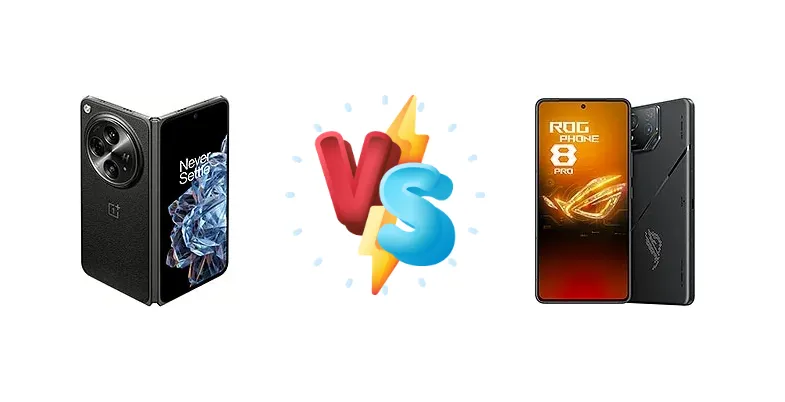
The OnePlus Open 2 arrives with Qualcomm’s newest Snapdragon 8 Elite, promising a leap in mobile performance. It directly challenges the Asus ROG Phone 8 Pro, a device built from the ground up for gaming with the Snapdragon 8 Gen 3. This comparison isn’t just about specs; it’s about understanding which phone best suits your priorities – raw power and a foldable form factor, or a dedicated gaming experience.
🏆 Quick Verdict
For the average user prioritizing peak performance and a unique foldable experience, the OnePlus Open 2 edges out the Asus ROG Phone 8 Pro. The Snapdragon 8 Elite’s Oryon cores offer a demonstrable performance advantage, while the ROG Phone 8 Pro excels in sustained gaming and battery endurance.
| Network |
|---|
| 2G bands | GSM 850 / 900 / 1800 / 1900 | GSM 850 / 900 / 1800 / 1900 |
| 3G bands | HSDPA 800 / 850 / 900 / 1700(AWS) / 1900 / 2100 | HSDPA 850 / 900 / 1700(AWS) / 1800 / 1900 / 2100 - International |
| 4G bands | LTE | 1, 2, 3, 4, 5, 7, 8, 12, 17, 18, 19, 20, 25, 26, 28, 32, 34, 38, 39, 40, 41, 42, 43, 48, 66 - International |
| 5G bands | SA/NSA | 1, 2, 3, 5, 7, 8, 12, 18, 20, 25, 26, 28, 38, 40, 41, 48, 66, 77, 78, 79 SA/NSA/Sub6 - International |
| Speed | HSPA, LTE, 5G | HSPA, LTE (Up to 7CA), 5G |
| Technology | GSM / HSPA / LTE / 5G | GSM / CDMA / HSPA / LTE / 5G |
| Launch |
|---|
| Announced | Not announced yet | 2024, January 08 |
| Status | Cancelled | Available. Released 2024, January 18 |
| Body |
|---|
| Build | - | Glass front (Gorilla Glass Victus 2), glass back (Gorilla Glass), aluminum frame |
| Dimensions | Folded thickness: 10 mm | 163.8 x 76.8 x 8.9 mm (6.45 x 3.02 x 0.35 in) |
| SIM | Nano-SIM + Nano-SIM + eSIM (max 2 at a time) | Nano-SIM + Nano-SIM |
| Weight | - | 225 g (7.94 oz) |
| Display |
|---|
| Protection | - | Corning Gorilla Glass Victus 2 |
| Resolution | 2268 x 2440 pixels* (~416 ppi density) | 1080 x 2400 pixels, 20:9 ratio (~388 ppi density) |
| Size | 8.0 inches, 205.9 cm2 | 6.78 inches, 111.0 cm2 (~88.2% screen-to-body ratio) |
| Type | Foldable LTPO3 Flexi-fluid AMOLED, 1B colors, Dolby Vision, 120Hz | LTPO AMOLED, 1B colors, 165Hz, HDR10, 1600 nits (HBM), 2500 nits (peak) |
| Platform |
|---|
| CPU | Octa-core (2x4.32 GHz Oryon V2 Phoenix L + 6x3.53 GHz Oryon V2 Phoenix M) | Octa-core (1x3.3 GHz Cortex-X4 & 3x3.2 GHz Cortex-A720 & 2x3.0 GHz Cortex-A720 & 2x2.3 GHz Cortex-A520) |
| Chipset | Qualcomm SM8750-AB Snapdragon 8 Elite (3 nm) | Qualcomm SM8650-AB Snapdragon 8 Gen 3 (4 nm) |
| GPU | Adreno 830 | Adreno 750 |
| OS | Android 15, OxygenOS 15 | Android 14, up to 2 major Android upgrades |
| Memory |
|---|
| Card slot | No | No |
| Internal | 512GB 16GB RAM, 1TB 16GB RAM | 512GB 16GB RAM, 1TB 24GB RAM |
| Main Camera |
|---|
| Features | Hasselblad Color Calibration, LED flash, HDR, panorama | LED flash, HDR, panorama |
| Triple | 50 MP, (wide), PDAF, OIS
50 MP, (telephoto), PDAF, OIS, 3x optical zoom
50 MP, (ultrawide), PDAF | 50 MP, f/1.9, 24mm (wide), 1/1.56", 1.0µm, PDAF, gimbal OIS
32 MP, f/2.4, (telephoto), 1/3.2", 0.7µm, PDAF, OIS, 3x optical zoom
13 MP, f/2.2, 13mm, 120˚ (ultrawide) |
| Video | 4K@30/60fps, 1080p@30/60/120/240/480fps gyro-EIS, HDR10+, Dolby Vision | 8K@24fps, 4K@30/60fps, 1080p@30/60/120/240fps, 720p@480fps; gyro-EIS, HDR10+ |
| Selfie camera |
|---|
| Features | HDR | Panorama, HDR |
| Single | 20MP, f/2.2, 20mm (ultrawide), 1/4.0", 0.7µm
Cover camera:
32MP, f/2.4, 22mm (ultrawide), 1/3.14", 0.7µm | 32 MP, f/2.5, 22mm (wide), 1/3.2", 0.7µm |
| Video | 4K@30fps, 1080p@30fps, gyro-EIS | 1080p@30fps |
| Sound |
|---|
| 35mm jack | No | Yes |
| Loudspeaker | Yes, with stereo speakers (Dolby Atmos enhanced) | Yes, with stereo speakers |
| Comms |
|---|
| Bluetooth | 5.4, A2DP, LE, aptX HD | 5.4, A2DP, LE, aptX HD, aptX Adaptive, aptX Lossless |
| Infrared port | Yes | - |
| NFC | Yes | Yes |
| Positioning | GPS (L1+L5), GLONASS, BDS, GALILEO (E1+E5a), QZSS | GPS (L1+L5), BDS (B1I+B1c+B2a), GALILEO (E1+E5a), QZSS (L1+L5), NavIC (L5), GLONASS |
| Radio | No | No |
| USB | USB Type-C 3.1, OTG | USB Type-C (side), DisplayPort 1.4; USB Type-C (bottom), OTG |
| WLAN | Wi-Fi 802.11 a/b/g/n/ac/6e/7, tri-band | Wi-Fi 802.11 a/b/g/n/ac/6e/7, tri-band, Wi-Fi Direct |
| Features |
|---|
| Sensors | Fingerprint (side-mounted), accelerometer, gyro, proximity, compass | Fingerprint (under display, optical), accelerometer, gyro, proximity, compass |
| Battery |
|---|
| Charging | 80W wired
50W wireless
Reverse wired | 65W wired, PD3.0, PPS, QC5, 100% in 39 min - International
30W wired, PD3.0, PPS - India
15W wireless (Qi)
10W reverse wired |
| Type | Si/C Li-Ion 5900 mAh | 5500 mAh |
| Misc |
|---|
| Colors | Black; other colors | Phantom Black |
| Models | - | AI2401, AI2401_A, AI2401_D |
| Price | - | $ 1,157.98 / £ 1,693.75 / € 632.66 |
OnePlus Open 2
- Cutting-edge Snapdragon 8 Elite performance
- Fast 80W wired and 50W wireless charging
- Unique foldable display experience
- Battery life potentially compromised by foldable form factor
- Camera specs currently unknown
Asus ROG Phone 8 Pro
- Exceptional 14:43h battery life
- High 1765 nits peak display brightness
- Gaming-focused features like AirTriggers
- Snapdragon 8 Gen 3 is less powerful than 8 Elite
- Charging speeds are slower than the Open 2
Display Comparison
The Asus ROG Phone 8 Pro boasts a measured peak brightness of 1765 nits, ensuring excellent visibility even in direct sunlight. While the Open 2’s display specs aren’t provided, its foldable nature inherently presents different display challenges. The ROG Phone’s display is likely a standard AMOLED, while the Open 2’s foldable panel requires more complex engineering. The ROG Phone’s higher brightness is a clear advantage for outdoor use, but the Open 2’s foldable form factor offers a unique viewing experience. We anticipate the Open 2 will utilize LTPO technology to dynamically adjust refresh rates for power efficiency, a feature common in high-end foldables.
Camera Comparison
Detailed camera specs for the Open 2 are missing, but given its flagship positioning, we expect a high-quality multi-camera system. The ROG Phone 8 Pro’s camera is described as ‘Photo / Video’ without specifics, suggesting a focus on versatility rather than groundbreaking innovation. The ROG Phone’s image processing likely prioritizes color accuracy and detail, while the Open 2 may lean towards a more vibrant, social media-friendly aesthetic. Without sensor size or aperture information, it’s difficult to definitively declare a winner, but the Open 2’s flagship status suggests a more advanced camera system.
Performance
The core difference lies in the chipsets. The OnePlus Open 2 features the Snapdragon 8 Elite (3nm) with Oryon V2 Phoenix cores – a custom design focused on single-core performance, reaching 4.32 GHz. The Asus ROG Phone 8 Pro uses the Snapdragon 8 Gen 3 (4nm) with a more traditional core configuration peaking at 3.3 GHz. The 3nm process of the 8 Elite should offer better power efficiency and thermal headroom, translating to sustained performance. While the Gen 3 is a powerful chip, the Oryon cores in the 8 Elite are expected to deliver a noticeable boost in CPU-intensive tasks. Both phones utilize LPDDR5x RAM, but the Open 2’s architecture is geared towards maximizing the potential of those cores.
Battery Life
The Asus ROG Phone 8 Pro shines in battery life, achieving an active use score of 14:43h. The OnePlus Open 2’s battery capacity is unknown, but foldable phones often prioritize slimness over battery size. The ROG Phone 8 Pro offers 65W wired charging (international) and 30W (India), alongside 15W wireless charging. The Open 2 counters with 80W wired and 50W wireless, offering significantly faster charging speeds. While the ROG Phone’s battery endurance is superior, the Open 2’s faster charging mitigates this difference, allowing for quicker top-ups.
Buying Guide
Buy the OnePlus Open 2 if you need the absolute fastest Android performance available, a stunning foldable display, and appreciate a more refined, everyday smartphone experience. Buy the Asus ROG Phone 8 Pro if you prioritize long gaming sessions, a robust cooling system, and gaming-specific features like AirTriggers, and value exceptional battery life over bleeding-edge CPU benchmarks.
Frequently Asked Questions
❓ Does the Snapdragon 8 Elite in the OnePlus Open 2 generate excessive heat during prolonged gaming sessions?
The Snapdragon 8 Elite’s 3nm process and optimized Oryon cores are designed for improved thermal efficiency. While demanding games will inevitably generate heat, the Open 2 should manage temperatures better than previous generation flagships. However, the foldable form factor may present unique thermal challenges, and sustained peak performance could lead to some throttling.
❓ How does the charging speed difference (80W vs 65W) translate to real-world usage on the OnePlus Open 2?
The 80W charging on the Open 2 will noticeably reduce charging times compared to the ROG Phone 8 Pro’s 65W. Expect a faster top-up, especially from lower battery percentages. While the difference may not seem massive, it adds up over time and provides more convenience for users who frequently need to quickly recharge.
❓ Is the difference between the Snapdragon 8 Elite and Snapdragon 8 Gen 3 noticeable in everyday tasks?
For basic tasks like browsing, social media, and video playback, the difference will be minimal. However, in demanding applications like video editing, 3D rendering, or heavy multitasking, the Snapdragon 8 Elite’s Oryon cores will provide a tangible performance advantage, resulting in faster processing times.