
OnePlus Open 2 vs. iPhone 15 Pro Max: A Deep Dive into Flagship Performance
| Phones Images | |||||
|---|---|---|---|---|---|
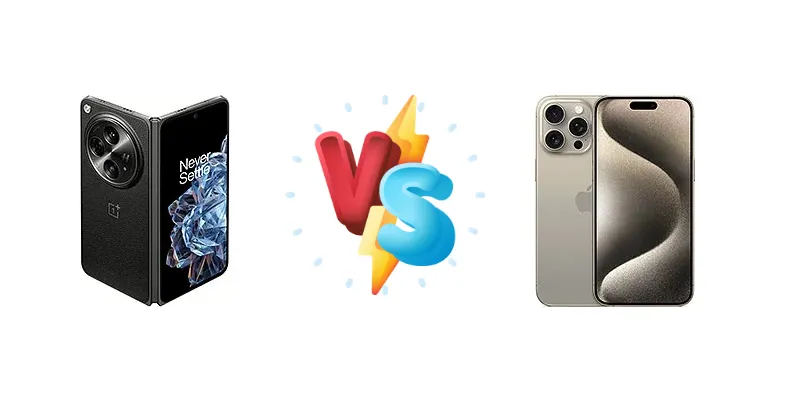
|
🏆 Quick Verdict
For users prioritizing raw processing power and rapid charging, the OnePlus Open 2 offers a compelling package. However, the iPhone 15 Pro Max secures a slight edge for its optimized ecosystem, exceptional battery endurance (16:01h active use), and refined camera processing, making it the better all-around choice for most.
| PHONES | ||
|---|---|---|
| Phone Names | OnePlus Open 2 | Apple iPhone 15 Pro Max |
| Network | ||
|---|---|---|
| 2G bands | GSM 850 / 900 / 1800 / 1900 | GSM 850 / 900 / 1800 / 1900 |
| 3G bands | HSDPA 800 / 850 / 900 / 1700(AWS) / 1900 / 2100 | HSDPA 850 / 900 / 1700(AWS) / 1900 / 2100 |
| 4G bands | LTE | 1, 2, 3, 4, 5, 7, 8, 12, 13, 17, 18, 19, 20, 25, 26, 28, 30, 32, 34, 38, 39, 40, 41, 42, 46, 48, 53, 66 - A3106 |
| 5G bands | SA/NSA | 1, 2, 3, 5, 7, 8, 12, 20, 25, 26, 28, 30, 38, 40, 41, 48, 53, 66, 70, 77, 78, 79 SA/NSA/Sub6 - A3106 |
| Speed | HSPA, LTE, 5G | HSPA, LTE, 5G, EV-DO Rev.A 3.1 Mbps |
| Technology | GSM / HSPA / LTE / 5G | GSM / CDMA / HSPA / EVDO / LTE / 5G |
| Launch | ||
|---|---|---|
| Announced | Not announced yet | 2023, September 12 |
| Status | Cancelled | Available. Released 2023, September 22 |
| Body | ||
|---|---|---|
| Build | - | Glass front, glass back, titanium frame (grade 5) |
| Dimensions | Folded thickness: 10 mm | 159.9 x 76.7 x 8.3 mm (6.30 x 3.02 x 0.33 in) |
| SIM | Nano-SIM + Nano-SIM + eSIM (max 2 at a time) | · Nano-SIM + eSIM + eSIM (max 2 at a time; International)· eSIM + eSIM (8 or more, max 2 at a time; USA)· Nano-SIM + Nano-SIM (China) |
| Weight | - | 221 g (7.80 oz) |
| Display | ||
|---|---|---|
| Protection | - | Ceramic Shield glass |
| Resolution | 2268 x 2440 pixels* (~416 ppi density) | 1290 x 2796 pixels, 19.5:9 ratio (~460 ppi density) |
| Size | 8.0 inches, 205.9 cm2 | 6.7 inches, 110.2 cm2 (~89.8% screen-to-body ratio) |
| Type | Foldable LTPO3 Flexi-fluid AMOLED, 1B colors, Dolby Vision, 120Hz | LTPO Super Retina XDR OLED, 120Hz, HDR10, Dolby Vision, 1000 nits (typ), 2000 nits (HBM) |
| Platform | ||
|---|---|---|
| CPU | Octa-core (2x4.32 GHz Oryon V2 Phoenix L + 6x3.53 GHz Oryon V2 Phoenix M) | Hexa-core (2x3.78 GHz + 4x2.11 GHz) |
| Chipset | Qualcomm SM8750-AB Snapdragon 8 Elite (3 nm) | Apple A17 Pro (3 nm) |
| GPU | Adreno 830 | Apple GPU (6-core graphics) |
| OS | Android 15, OxygenOS 15 | iOS 17, upgradable to iOS 26.1 |
| Memory | ||
|---|---|---|
| Card slot | No | No |
| Internal | 512GB 16GB RAM, 1TB 16GB RAM | 256GB 8GB RAM, 512GB 8GB RAM, 1TB 8GB RAM |
| Main Camera | ||
|---|---|---|
| Features | Hasselblad Color Calibration, LED flash, HDR, panorama | Dual-LED dual-tone flash, HDR (photo/panorama) |
| Triple | 50 MP, (wide), PDAF, OIS 50 MP, (telephoto), PDAF, OIS, 3x optical zoom 50 MP, (ultrawide), PDAF | 48 MP, f/1.8, 24mm (wide), 1/1.28", 1.22µm, dual pixel PDAF, sensor-shift OIS 12 MP, f/2.8, 120mm (periscope telephoto), 1/3.06", 1.12µm, dual pixel PDAF, 3D sensor‑shift OIS, 5x optical zoom 12 MP, f/2.2, 13mm, 120˚ (ultrawide), 1/2.55", 1.4µm, dual pixel PDAF TOF 3D LiDAR scanner (depth) |
| Video | 4K@30/60fps, 1080p@30/60/120/240/480fps gyro-EIS, HDR10+, Dolby Vision | 4K@24/25/30/60fps, 1080p@25/30/60/120/240fps, 10-bit HDR, Dolby Vision HDR (up to 60fps), ProRes, 3D (spatial) video, stereo sound rec. |
| Selfie camera | ||
|---|---|---|
| Features | HDR | HDR, Dolby Vision HDR |
| Single | 20MP, f/2.2, 20mm (ultrawide), 1/4.0", 0.7µm Cover camera: 32MP, f/2.4, 22mm (ultrawide), 1/3.14", 0.7µm | 12 MP, f/1.9, 23mm (wide), 1/3.6", 1.0µm, PDAF, OIS SL 3D, (depth/biometrics sensor) |
| Video | 4K@30fps, 1080p@30fps, gyro-EIS | 4K@24/25/30/60fps, 1080p@25/30/60/120fps, gyro-EIS |
| Sound | ||
|---|---|---|
| 35mm jack | No | No |
| Loudspeaker | Yes, with stereo speakers (Dolby Atmos enhanced) | Yes, with stereo speakers |
| Comms | ||
|---|---|---|
| Bluetooth | 5.4, A2DP, LE, aptX HD | 5.3, A2DP, LE |
| Infrared port | Yes | - |
| NFC | Yes | Yes |
| Positioning | GPS (L1+L5), GLONASS, BDS, GALILEO (E1+E5a), QZSS | GPS (L1+L5), GLONASS, GALILEO, BDS, QZSS, NavIC |
| Radio | No | No |
| USB | USB Type-C 3.1, OTG | USB Type-C 3.2 Gen 2, DisplayPort |
| WLAN | Wi-Fi 802.11 a/b/g/n/ac/6e/7, tri-band | Wi-Fi 802.11 a/b/g/n/ac/6e, tri-band, hotspot |
| Features | ||
|---|---|---|
| Sensors | Fingerprint (side-mounted), accelerometer, gyro, proximity, compass | Face ID, accelerometer, gyro, proximity, compass, barometer |
| Battery | ||
|---|---|---|
| Charging | 80W wired 50W wireless Reverse wired | Wired, PD2.0, 50% in 30 min 15W wireless (MagSafe) 15W wireless (Qi2) - requires iOS 17.2 update 4.5W reverse wired |
| Type | Si/C Li-Ion 5900 mAh | Li-Ion 4441 mAh |
| Misc | ||
|---|---|---|
| Colors | Black; other colors | Black Titanium, White Titanium, Blue Titanium, Natural Titanium |
| Models | - | A2849, A3105, A3106, A3108, iPhone16,2 |
| Price | - | € 758.79 / $ 579.87 / £ 628.29 |
| SAR | - | 1.07 W/kg (head) 1.11 W/kg (body) |
| SAR EU | - | 0.98 W/kg (head) 0.98 W/kg (body) |
OnePlus Open 2
- Significantly faster wired and wireless charging (80W/50W)
- Android's open ecosystem and customization options
- Potentially higher peak CPU performance with Snapdragon 8 Elite
- Software support may be shorter than Apple's
- Camera performance may not match iPhone's consistency
Apple iPhone 15 Pro Max
- Exceptional battery life (16:01h active use)
- Seamless integration with Apple ecosystem
- Industry-leading video recording capabilities
- Slower charging speeds compared to OnePlus Open 2
- Less customization options within iOS
Display Comparison
The iPhone 15 Pro Max boasts a peak brightness of 1787 nits, ensuring excellent visibility even in direct sunlight. While the Open 2’s display specs are not provided, OnePlus typically employs high-quality AMOLED panels. The iPhone’s ProMotion technology (adaptive refresh rate) is a key advantage, though the Open 2 likely features a similar LTPO implementation. The iPhone’s color accuracy is renowned, and the Open 2 will need to match this to compete. Bezels are likely comparable, with both aiming for minimal intrusion.
Camera Comparison
The iPhone 15 Pro Max is known for its exceptional photo and video capabilities, leveraging advanced computational photography. While specific sensor details for the Open 2 are missing, a flagship device at this price point is expected to feature a high-resolution main sensor with optical image stabilization (OIS). The iPhone’s cinematic mode and ProRes video recording are significant advantages for content creators. The Open 2 will need to deliver comparable dynamic range and low-light performance to challenge Apple’s image processing prowess. Ignoring the typical 2MP macro lens found on many phones, the focus should be on the primary and ultrawide sensors.
Performance
The core battleground is the Snapdragon 8 Elite in the Open 2 versus the A17 Pro in the iPhone 15 Pro Max. The Snapdragon 8 Elite utilizes a unique octa-core configuration (2x4.32 GHz Oryon V2 Phoenix L + 6x3.53 GHz Oryon V2 Phoenix M) built on a 3nm process, promising significant performance gains. Apple’s A17 Pro, also 3nm, employs a hexa-core design (2x3.78 GHz + 4x2.11 GHz). While core count differs, Apple’s chip design excels in single-core performance and efficiency. The Open 2’s LPDDR5x RAM will be crucial for multitasking, but Apple’s tight hardware-software integration often yields superior real-world responsiveness. Thermal management will be key; the Snapdragon 8 Elite’s performance will be heavily reliant on OnePlus’ cooling solution.
Battery Life
The iPhone 15 Pro Max demonstrates impressive battery life, achieving 16:01 hours of active use. The Open 2’s battery capacity is not specified, but its 80W wired charging is a substantial advantage over the iPhone’s slower wired charging (50% in 30 min). The Open 2 also offers 50W wireless charging, significantly faster than the iPhone’s 15W MagSafe/Qi2. While the iPhone’s endurance rating of 118 hours is impressive, the Open 2’s faster charging could mitigate any capacity disadvantage, offering quicker top-ups throughout the day. The Open 2 also offers reverse wired charging, a feature absent on the iPhone.
Buying Guide
Buy the OnePlus Open 2 if you need blazing-fast charging (80W wired, 50W wireless) and are deeply embedded in the Android ecosystem, valuing customization and open-source flexibility. Buy the Apple iPhone 15 Pro Max if you prioritize seamless integration with other Apple devices, long-term software support, and a consistently excellent camera experience with a focus on video recording.