
OnePlus Nord vs Samsung Galaxy M52 5G: A Deep Dive into Mid-Range 5G Contenders
| Phones Images | |||||
|---|---|---|---|---|---|
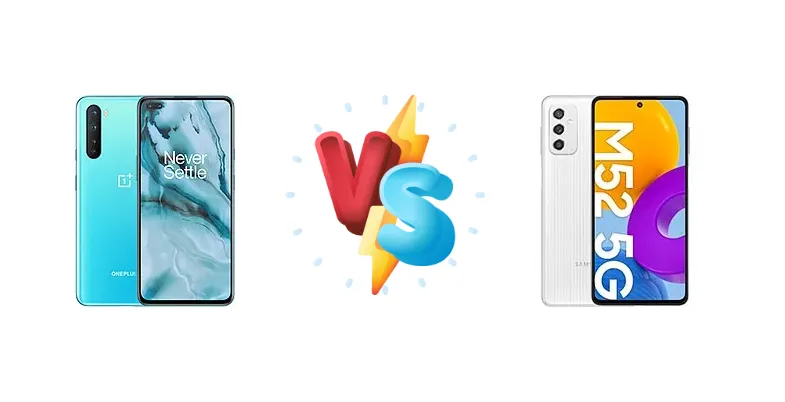
|
🏆 Quick Verdict
For the average user prioritizing all-day battery life and a slightly more powerful processor, the Samsung Galaxy M52 5G is the better choice. Its Snapdragon 778G and 123-hour endurance rating provide a noticeable advantage. However, the OnePlus Nord remains a strong contender, particularly at its lower price points.
| PHONES | ||
|---|---|---|
| Phone Names | OnePlus Nord | Samsung Galaxy M52 5G |
| Network | ||
|---|---|---|
| 2G bands | GSM 850 / 900 / 1800 / 1900 | GSM 850 / 900 / 1800 / 1900 |
| 3G bands | HSDPA 800 / 850 / 900 / 1700(AWS) / 1800 / 1900 / 2100 | HSDPA 850 / 900 / 1700(AWS) / 1900 / 2100 |
| 4G bands | 1, 2, 3, 4, 5, 7, 8, 12, 17, 18, 19, 20, 26, 28, 32, 34, 38, 39, 40, 41, 66 - Europe | 1, 2, 3, 4, 5, 7, 8, 12, 17, 20, 26, 28, 38, 40, 41, 66 |
| 5G bands | 1, 3, 7, 28, 78 SA/NSA - Europe | SA/NSA/Sub6 |
| Speed | HSPA 42.2/5.76 Mbps, LTE Cat18 1200/150 Mbps, 5G | HSPA, LTE, 5G |
| Technology | GSM / HSPA / LTE / 5G | GSM / HSPA / LTE / 5G |
| 78 SA/NSA - India | - | |
| Launch | ||
|---|---|---|
| Announced | 2020, July 21 | 2021, September 24 |
| Status | Available. Released 2020, August 04 | Available. Released 2021, October 03 |
| Body | ||
|---|---|---|
| Build | Glass front (Gorilla Glass 5), glass back (Gorilla Glass 5), plastic frame | Glass front (Gorilla Glass 5), plastic frame, plastic back |
| Dimensions | 158.3 x 73.3 x 8.2 mm (6.23 x 2.89 x 0.32 in) | 164.2 x 76.4 x 7.4 mm (6.46 x 3.01 x 0.29 in) |
| SIM | Nano-SIM + Nano-SIM | Nano-SIM + Nano-SIM |
| Weight | 184 g (6.49 oz) | 173 g (6.10 oz) |
| Display | ||
|---|---|---|
| Protection | Corning Gorilla Glass 5 | Corning Gorilla Glass 5 |
| Resolution | 1080 x 2400 pixels, 20:9 ratio (~408 ppi density) | 1080 x 2400 pixels, 20:9 ratio (~393 ppi density) |
| Size | 6.44 inches, 100.6 cm2 (~86.7% screen-to-body ratio) | 6.7 inches, 108.4 cm2 (~86.4% screen-to-body ratio) |
| Type | Fluid AMOLED, 90Hz, HDR10+ | Super AMOLED Plus, 120Hz |
| Platform | ||
|---|---|---|
| CPU | Octa-core (1x2.4 GHz Kryo 475 Prime & 1x2.2 GHz Kryo 475 Gold & 6x1.8 GHz Kryo 475 Silver) | Octa-core (1x2.4 GHz Cortex-A78 & 3x2.2 GHz Cortex-A78 & 4x1.9 GHz Cortex-A55) |
| Chipset | Qualcomm SM7250 Snapdragon 765G 5G (7 nm) | Qualcomm SM7325 Snapdragon 778G 5G (6 nm) |
| GPU | Adreno 620 | Adreno 642L |
| OS | Android 10, upgradable to Android 12, OxygenOS 12 | Android 11, upgradable to Android 13, One UI 5.1 |
| Memory | ||
|---|---|---|
| Card slot | No | microSDXC (uses shared SIM slot) |
| Internal | 64GB 6GB RAM, 128GB 8GB RAM, 256GB 12GB RAM | 128GB 6GB RAM, 128GB 8GB RAM |
| UFS 2.1 | - | |
| Main Camera | ||
|---|---|---|
| Features | Dual-LED flash, HDR, panorama | LED flash, panorama, HDR |
| Quad | 48 MP, f/1.8, 26mm (wide), 1/2.0", 0.8µm, PDAF, OIS 8 MP, f/2.3, 119˚ (ultrawide) 2 MP (macro) Auxiliary lens | - |
| Single | - | 32 MP, f/2.2, 26mm (wide) |
| Triple | - | 64 MP, f/1.8, 26mm (wide), 1/1.97", 0.7um, PDAF 12 MP, f/2.2, 123˚, (ultrawide), 1/3.06", 1.12µm 5 MP (macro) |
| Video | 4K@30fps, 1080p@30/60/240fps, gyro-EIS | 4K@30fps, 1080p@30/60fps |
| Selfie camera | ||
|---|---|---|
| Dual | 32 MP, f/2.5, (wide), 1/2.8", 0.8µm 8 MP, f/2.5, 105˚ (ultrawide), 1/4.0", 1.12µm | - |
| Features | HDR | - |
| Single | - | 32 MP, f/2.2, 26mm (wide) |
| Video | 4K@30/60fps, 1080p@30/60fps | 4K@30fps, 1080p@30fps |
| Sound | ||
|---|---|---|
| 3.5mm jack | No | No |
| 35mm jack | No | No |
| Loudspeaker | Yes | Yes |
| Comms | ||
|---|---|---|
| Bluetooth | 5.1, A2DP, LE, aptX HD | 5.0, A2DP, LE |
| NFC | Yes | Yes |
| Positioning | GPS (L1+L5), GLONASS (G1), BDS (B1), GALILEO (E1+E5a), NavIC | GPS, GLONASS, GALILEO, BDS, QZSS |
| Radio | No | Unspecified |
| USB | USB Type-C 2.0, OTG | USB Type-C 2.0, OTG |
| WLAN | Wi-Fi 802.11 a/b/g/n/ac, dual-band, Wi-Fi Direct | Wi-Fi 802.11 a/b/g/n/ac/6, dual-band, Wi-Fi Direct |
| Features | ||
|---|---|---|
| Sensors | Fingerprint (under display, optical), accelerometer, gyro, proximity, compass | Fingerprint (side-mounted), accelerometer, gyro, proximity, compass |
| Battery | ||
|---|---|---|
| Charging | 30W wired, 70% in 30 min | 25W wired |
| Type | Li-Po 4115 mAh | Li-Ion 5000 mAh |
| Misc | ||
|---|---|---|
| Colors | Blue Marble, Gray Onyx (Gray Ash) | Icy Blue, Blazing Black, White |
| Models | AC2001, AC2003 | SM-M526BR, SM-M526BR/DS, SM-M526B, SM-M526B/DS |
| Price | € 101.45 / £ 119.99 | About 300 EUR |
| SAR EU | - | 0.79 W/kg (head) 1.40 W/kg (body) |
| Pricing | ||
|---|---|---|
| 128GB 8GB RAM | $ 299.00 | - |
| 256GB 12GB RAM | $ 329.99 | - |
| 64GB 6GB RAM | C$ 865.00 | - |
| RENEWED | £ 172.00 | - |
| Tests | ||
|---|---|---|
| Battery life | Endurance rating 100h | Endurance rating 123h |
| Camera | Photo / Video | Photo / Video |
| Display | Contrast ratio: Infinite (nominal) | Contrast ratio: Infinite (nominal) |
| Loudspeaker | -29.6 LUFS (Average) | -30.0 LUFS (Average) |
| Performance | AnTuTu: 315641 (v8) GeekBench: 7844 (v4.4), 1953 (v5.1) GFXBench: 19fps (ES 3.1 onscreen) | AnTuTu: 504424 (v9) GeekBench: 2796 (v5.1) GFXBench: 28fps (ES 3.1 onscreen) |
OnePlus Nord
- Faster 30W charging
- Potentially lower price (depending on configuration)
- Well-established brand reputation
- Shorter battery life (100h endurance)
- Older Snapdragon 765G chipset
- Slightly dimmer display
Samsung Galaxy M52 5G
- Longer battery life (123h endurance)
- More powerful Snapdragon 778G chipset
- Brighter display (777 nits)
- Slower 25W charging
- Less brand recognition in some markets
- Potentially higher price
Display Comparison
Both the OnePlus Nord and Samsung Galaxy M52 5G feature displays with an 'Infinite' contrast ratio, suggesting deep blacks. However, the M52 5G boasts a higher peak brightness of 777 nits compared to the Nord’s 756 nits. This translates to better visibility in direct sunlight for the M52 5G. While both likely utilize AMOLED panels (implied by the contrast ratio), the M52 5G’s brighter display provides a more vibrant and usable experience outdoors. The lack of refresh rate information for both devices means we can't assess smoothness, but this is a common omission in this price bracket.
Camera Comparison
Both devices are listed as having 'Photo / Video' capabilities, lacking specific details. However, the camera experience will likely differ due to image processing algorithms. Without sensor size or aperture information, it’s difficult to make a definitive judgment. The M52 5G’s newer chipset *could* translate to more advanced image processing capabilities, potentially leading to better low-light performance and dynamic range. The absence of details necessitates caution; relying on megapixel counts alone would be misleading. We can assume both phones will offer a versatile camera system, but the M52 5G has a slight edge due to its processing power.
Performance
The core difference lies in the chipsets: the OnePlus Nord utilizes the Qualcomm Snapdragon 765G (7nm), while the Samsung Galaxy M52 5G features the Snapdragon 778G (6nm). The 778G, built on a smaller 6nm process, offers improved power efficiency and performance. Its CPU configuration – a Cortex-A78 prime core alongside three additional A78 cores – provides a more substantial performance uplift compared to the Nord’s Kryo 475 setup. This is particularly noticeable in sustained workloads and gaming. The M52 5G’s chipset is architecturally superior, promising smoother multitasking and a more responsive experience. Both phones offer ample RAM options, but the chipset difference is the defining factor.
Battery Life
The Samsung Galaxy M52 5G clearly wins in battery endurance, achieving a measured 123 hours compared to the OnePlus Nord’s 100 hours. This 23-hour difference is significant for users who prioritize longevity. While the Nord charges faster at 30W (70% in 30 minutes), the M52 5G’s 25W charging is adequate given its larger battery capacity. The 6nm process of the Snapdragon 778G also contributes to better power efficiency, further extending the M52 5G’s runtime. The M52 5G’s battery life is a key differentiator.
Buying Guide
Buy the OnePlus Nord if you prioritize a well-rounded experience with a recognizable brand and are comfortable with slightly shorter battery life. It's ideal for users who frequently switch between apps and enjoy a fluid user interface. Buy the Samsung Galaxy M52 5G if you need exceptional battery life, a more modern chipset for sustained performance, and don't mind a less established brand in some markets. This phone is perfect for power users, mobile gamers, and those who rely heavily on their phone throughout the day.