
OnePlus Nord vs Motorola Edge 20 Fusion: A Deep Dive into Mid-Range Contenders
| Phones Images | |||||
|---|---|---|---|---|---|
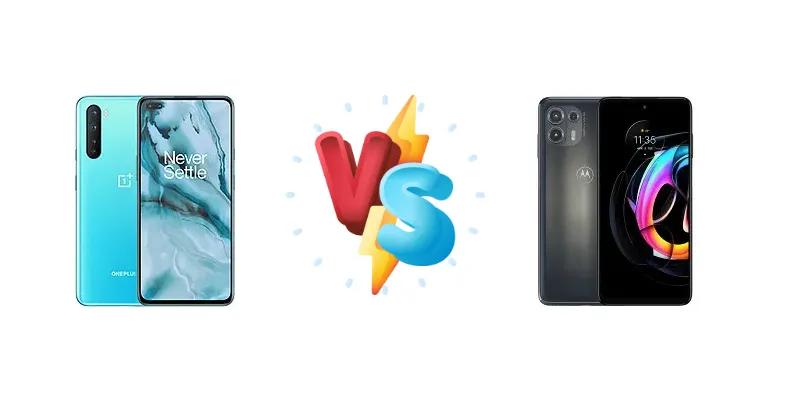
|
🏆 Quick Verdict
For the average user prioritizing consistent performance and a brighter display, the OnePlus Nord emerges as the stronger choice. Its Snapdragon 765G chipset, coupled with the measured 756 nits peak brightness, provides a smoother experience and better visibility in outdoor conditions, despite the Motorola Edge 20 Fusion's competitive pricing.
| PHONES | ||
|---|---|---|
| Phone Names | OnePlus Nord | Motorola Edge 20 Fusion |
| Network | ||
|---|---|---|
| 2G bands | GSM 850 / 900 / 1800 / 1900 | GSM 850 / 900 / 1800 / 1900 |
| 3G bands | HSDPA 800 / 850 / 900 / 1700(AWS) / 1800 / 1900 / 2100 | HSDPA 850 / 900 / 1700(AWS) / 1900 / 2100 |
| 4G bands | 1, 2, 3, 4, 5, 7, 8, 12, 17, 18, 19, 20, 26, 28, 32, 34, 38, 39, 40, 41, 66 - Europe | 1, 2, 3, 4, 5, 7, 8, 12, 13, 17, 18, 19, 20, 26, 28, 32, 34, 38, 39, 40, 41, 42, 43, 66 |
| 5G bands | 1, 3, 7, 28, 78 SA/NSA - Europe | 1, 3, 5, 7, 8, 20, 28, 38, 40, 41, 77, 78, 66 SA/NSA/Sub6 |
| Speed | HSPA 42.2/5.76 Mbps, LTE Cat18 1200/150 Mbps, 5G | HSPA 42.2/5.76 Mbps, LTE Cat18 1200/150 Mbps, 5G |
| Technology | GSM / HSPA / LTE / 5G | GSM / HSPA / LTE / 5G |
| 78 SA/NSA - India | - | |
| Launch | ||
|---|---|---|
| Announced | 2020, July 21 | 2021, August 17 |
| Status | Available. Released 2020, August 04 | Available. Released 2021, August 27 |
| Body | ||
|---|---|---|
| Build | Glass front (Gorilla Glass 5), glass back (Gorilla Glass 5), plastic frame | Glass front |
| Dimensions | 158.3 x 73.3 x 8.2 mm (6.23 x 2.89 x 0.32 in) | 166 x 76 x 8.3 mm (6.54 x 2.99 x 0.33 in) |
| SIM | Nano-SIM + Nano-SIM | Nano-SIM + Nano-SIM |
| Weight | 184 g (6.49 oz) | 185 g (6.53 oz) |
| - | Water-repellent design | |
| Display | ||
|---|---|---|
| Protection | Corning Gorilla Glass 5 | - |
| Resolution | 1080 x 2400 pixels, 20:9 ratio (~408 ppi density) | 1080 x 2400 pixels, 20:9 ratio (~393 ppi density) |
| Size | 6.44 inches, 100.6 cm2 (~86.7% screen-to-body ratio) | 6.7 inches, 108.4 cm2 (~85.9% screen-to-body ratio) |
| Type | Fluid AMOLED, 90Hz, HDR10+ | OLED, 1B colors, 90Hz, HDR10+ |
| Platform | ||
|---|---|---|
| CPU | Octa-core (1x2.4 GHz Kryo 475 Prime & 1x2.2 GHz Kryo 475 Gold & 6x1.8 GHz Kryo 475 Silver) | Octa-core (2x2.4 GHz Cortex-A76 & 6x2.0 GHz Cortex-A55) |
| Chipset | Qualcomm SM7250 Snapdragon 765G 5G (7 nm) | Mediatek Dimensity 800U (7 nm) |
| GPU | Adreno 620 | Mali-G57 MC3 |
| OS | Android 10, upgradable to Android 12, OxygenOS 12 | Android 11 |
| Memory | ||
|---|---|---|
| Card slot | No | microSDXC |
| Internal | 64GB 6GB RAM, 128GB 8GB RAM, 256GB 12GB RAM | 128GB 6GB RAM, 128GB 8GB RAM |
| UFS 2.1 | - | |
| Main Camera | ||
|---|---|---|
| Features | Dual-LED flash, HDR, panorama | LED flash, HDR, panorama |
| Quad | 48 MP, f/1.8, 26mm (wide), 1/2.0", 0.8µm, PDAF, OIS 8 MP, f/2.3, 119˚ (ultrawide) 2 MP (macro) Auxiliary lens | - |
| Triple | - | 108 MP, f/1.9, (wide), 1/1.52", 0.7µm, PDAF 8 MP, f/2.2, 118˚ (ultrawide) Auxiliary lens |
| Video | 4K@30fps, 1080p@30/60/240fps, gyro-EIS | 4K@30fps, 1080p@30/60/120fps, gyro-EIS |
| Selfie camera | ||
|---|---|---|
| Dual | 32 MP, f/2.5, (wide), 1/2.8", 0.8µm 8 MP, f/2.5, 105˚ (ultrawide), 1/4.0", 1.12µm | - |
| Features | HDR | HDR |
| Single | - | 32 MP, f/2.3, (wide), 0.7µm |
| Video | 4K@30/60fps, 1080p@30/60fps | 1080p@30fps |
| Sound | ||
|---|---|---|
| 3.5mm jack | No | Yes |
| 35mm jack | No | Yes |
| Loudspeaker | Yes | Yes |
| Comms | ||
|---|---|---|
| Bluetooth | 5.1, A2DP, LE, aptX HD | 5.0, A2DP, LE |
| NFC | Yes | Yes |
| Positioning | GPS (L1+L5), GLONASS (G1), BDS (B1), GALILEO (E1+E5a), NavIC | GPS, GLONASS, GALILEO |
| Radio | No | FM radio |
| USB | USB Type-C 2.0, OTG | USB Type-C 2.0 |
| WLAN | Wi-Fi 802.11 a/b/g/n/ac, dual-band, Wi-Fi Direct | Wi-Fi 802.11 a/b/g/n/ac, dual-band, Wi-Fi Direct |
| Features | ||
|---|---|---|
| Sensors | Fingerprint (under display, optical), accelerometer, gyro, proximity, compass | Fingerprint (side-mounted), accelerometer, gyro, proximity, compass |
| Battery | ||
|---|---|---|
| Charging | 30W wired, 70% in 30 min | 30W wired |
| Type | Li-Po 4115 mAh | Li-Po 5000 mAh |
| Misc | ||
|---|---|---|
| Colors | Blue Marble, Gray Onyx (Gray Ash) | Electric Graphite, Cyber Teal |
| Models | AC2001, AC2003 | - |
| Price | € 101.45 / £ 119.99 | About 250 EUR |
| Pricing | ||
|---|---|---|
| 128GB 8GB RAM | $ 299.00 | - |
| 256GB 12GB RAM | $ 329.99 | - |
| 64GB 6GB RAM | C$ 865.00 | - |
| RENEWED | £ 172.00 | - |
| Tests | ||
|---|---|---|
| Battery life | Endurance rating 100h | - |
| Camera | Photo / Video | - |
| Display | Contrast ratio: Infinite (nominal) | - |
| Loudspeaker | -29.6 LUFS (Average) | - |
| Performance | AnTuTu: 315641 (v8) GeekBench: 7844 (v4.4), 1953 (v5.1) GFXBench: 19fps (ES 3.1 onscreen) | - |
OnePlus Nord
- Brighter display for better outdoor visibility (756 nits)
- Potentially smoother performance with Snapdragon 765G
- Stronger battery endurance (100h rating)
- Higher price point for some configurations
- Camera specifications are unknown
Motorola Edge 20 Fusion
- Competitive pricing
- MediaTek Dimensity 800U offers 5G connectivity
- Streamlined Android experience (typical of Motorola)
- Likely lower peak display brightness
- Potentially less consistent performance under sustained load
Display Comparison
The OnePlus Nord boasts a measured peak brightness of 756 nits, a significant advantage over the Motorola Edge 20 Fusion (brightness data unavailable). This translates to better outdoor visibility, a crucial factor for many users. While both likely utilize AMOLED panels given the 'Infinite' contrast ratio specification for the Nord, the Nord’s higher brightness suggests a more advanced panel. The lack of refresh rate information for the Edge 20 Fusion means the Nord likely has a smoother experience if it supports a higher refresh rate (not specified in the data).
Camera Comparison
Both phones are listed as having 'Photo / Video' capabilities, but detailed camera specifications are absent. Without sensor size, aperture, or OIS information, a direct comparison is difficult. However, given the market positioning, it’s reasonable to assume both employ similar main sensor resolutions. The absence of detail suggests neither phone is a standout camera performer, focusing instead on providing adequate image quality for social media and casual use. The inclusion of a 2MP macro camera on either device is likely a marketing feature with limited real-world utility.
Performance
The core difference lies in the chipsets: the OnePlus Nord utilizes the Qualcomm Snapdragon 765G, built on a 7nm process, while the Motorola Edge 20 Fusion features the MediaTek Dimensity 800U, also on a 7nm process. The Snapdragon 765G’s CPU configuration – an octa-core setup with a 2.4 GHz Kryo 475 Prime core – suggests a focus on single-core performance, beneficial for app launch speeds and responsiveness. The Dimensity 800U’s Cortex-A76 cores, while capable, are paired with less powerful Cortex-A55 cores for the majority of tasks. This difference in CPU architecture could lead to a more noticeable performance gap in sustained workloads. The Nord’s availability with up to 12GB of RAM further enhances its multitasking capabilities.
Battery Life
The OnePlus Nord claims an endurance rating of 100 hours, a strong indicator of battery life. While the Motorola Edge 20 Fusion’s battery capacity is unknown, both phones share a 30W wired charging capability, allowing for a 70% charge in 30 minutes on the Nord. The Nord’s higher endurance rating suggests more efficient power management, potentially due to the Snapdragon 765G’s optimization or a larger battery capacity (not specified). Without knowing the Edge 20 Fusion’s battery size, it’s difficult to definitively declare a winner, but the Nord’s endurance rating provides a significant advantage.
Buying Guide
Buy the OnePlus Nord if you need a reliably smooth user experience, particularly for multitasking and moderate gaming, and value a brighter, more visible display. The Nord’s wider range of RAM/storage configurations also offers more flexibility. Buy the Motorola Edge 20 Fusion if you prioritize value and are comfortable with potentially slightly less consistent performance in demanding tasks, and are seeking a streamlined Android experience.