
OnePlus Nord N200 5G vs. Xiaomi Redmi Note 12 Pro+: A Deep Dive into Value and Speed
| Phones Images | |||||
|---|---|---|---|---|---|
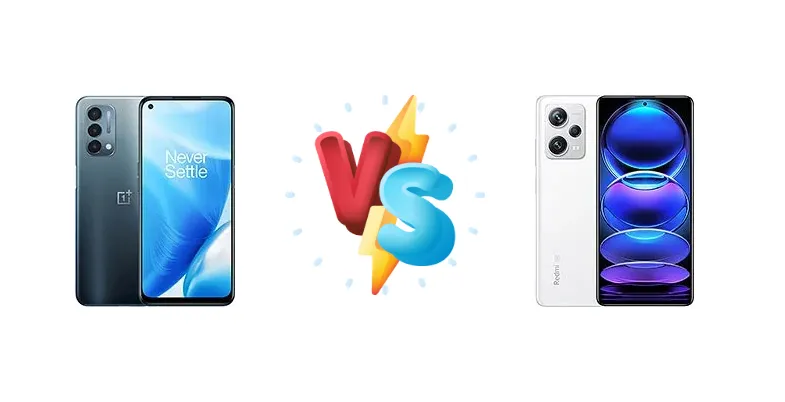
|
🏆 Quick Verdict
For the average user prioritizing rapid charging and a more capable camera system, the Xiaomi Redmi Note 12 Pro+ is the clear winner. However, if budget is the primary concern and 5G access is essential without breaking the bank, the OnePlus Nord N200 5G remains a compelling option.
| PHONES | ||
|---|---|---|
| Phone Names | OnePlus Nord N200 5G | Xiaomi Redmi Note 12 Pro+ |
| Network | ||
|---|---|---|
| 2G bands | GSM 850 / 900 / 1800 / 1900 | GSM 850 / 900 / 1800 / 1900 - SIM 1 & SIM 2 |
| 3G bands | HSDPA 850 / 900 / 1700(AWS) / 1900 / 2100 | HSDPA 800 / 850 / 900 / 1900 / 2100 |
| 4G bands | 1, 2, 3, 4, 5, 7, 8, 12, 13, 17, 20, 25, 26, 28, 66, 71, 38, 39, 40, 41 | 1, 3, 5, 8, 19, 34, 38, 39, 40, 41 - International, China |
| 5G bands | 2, 25, 41, 66, 71 SA/NSA/Sub6 - USA | 1, 3, 5, 8, 28, 38, 40, 41, 77, 78 SA/NSA - International |
| Speed | HSPA 42.2/5.76 Mbps, LTE Cat15 800/150 Mbps, 5G | HSPA, LTE-A (CA), 5G |
| Technology | GSM / HSPA / LTE / 5G | GSM / CDMA / HSPA / EVDO / LTE / 5G |
| 2, 25, 66, 71 SA/NSA/Sub6 - Canada | 1, 3, 5, 8, 28, 38, 41, 77, 78 SA/NSA - China | |
| Launch | ||
|---|---|---|
| Announced | 2021, June 21 | 2022, October 27 |
| Status | Available. Released 2021, June 25 | Available. Released 2022, November 01 |
| Body | ||
|---|---|---|
| Build | - | Glass front (Gorilla Glass 5), glass back |
| Dimensions | 163.1 x 74.9 x 8.3 mm (6.42 x 2.95 x 0.33 in) | 162.9 x 76 x 8.9 mm (6.41 x 2.99 x 0.35 in) |
| SIM | Nano-SIM | Dual SIM (Nano-SIM, dual stand-by) |
| Weight | 189 g (6.67 oz) | 208.4 g (7.34 oz) |
| - | IP53, dust and splash resistant | |
| Display | ||
|---|---|---|
| Protection | - | Corning Gorilla Glass 5 |
| Resolution | 1080 x 2400 pixels, 20:9 ratio (~405 ppi density) | 1080 x 2400 pixels, 20:9 ratio (~395 ppi density) |
| Size | 6.49 inches, 102.2 cm2 (~83.7% screen-to-body ratio) | 6.67 inches, 107.4 cm2 (~86.8% screen-to-body ratio) |
| Type | IPS LCD, 90Hz | OLED, 1B colors, 120Hz, Dolby Vision, HDR10+, 500 nits (typ), 900 nits (HBM) |
| Platform | ||
|---|---|---|
| CPU | Octa-core (2x2.0 GHz Kryo 460 & 6x1.8 GHz Kryo 460) | Octa-core (2x2.6 GHz Cortex-A78 & 6x2.0 GHz Cortex-A55) |
| Chipset | Qualcomm SM4350 Snapdragon 480 5G (8 nm) | Mediatek MT6877V Dimensity 1080 (6 nm) |
| GPU | Adreno 619 | Mali-G68 MC4 |
| OS | Android 11, OxygenOS 11 | Android 12, MIUI 13 |
| Memory | ||
|---|---|---|
| Card slot | microSDXC | No |
| Internal | 64GB 4GB RAM | 256GB 8GB RAM, 256GB 12GB RAM |
| UFS 2.1 | UFS 2.2 | |
| Main Camera | ||
|---|---|---|
| Features | LED flash, HDR, panorama | Dual-LED dual-tone flash, HDR, panorama |
| Single | 16 MP, f/2.1 | - |
| Triple | 13 MP, f/2.2, (wide), PDAF 2 MP (macro) Auxiliary lens | 200 MP, f/1.7, 24mm (wide), 1/1.4", 0.56µm, PDAF, OIS 8 MP, f/2.2, 120˚ (ultrawide), 1/4", 1.12µm 2 MP, f/2.4, (macro) |
| Video | 1080p@30fps, gyro-EIS | 4K@30fps, 1080p@30/60/120fps, 720p@960fps |
| Selfie camera | ||
|---|---|---|
| Features | HDR | HDR |
| Single | 16 MP, f/2.1 | 16 MP, f/2.5, (wide), 1/3.06", 1.0µm |
| Video | 1080p@30fps | 1080p@30/60fps |
| Sound | ||
|---|---|---|
| 3.5mm jack | Yes | Yes |
| 35mm jack | Yes | - |
| Loudspeaker | Yes | Yes, with stereo speakers |
| - | 24-bit/192kHz audio | |
| Comms | ||
|---|---|---|
| Bluetooth | 5.1, A2DP, LE | 5.2, A2DP, LE |
| Infrared port | - | Yes |
| NFC | Yes | Yes (market/region dependent) |
| Positioning | GPS (L1+L5), GLONASS, BDS, GALILEO | GPS (L1), GLONASS (G1), BDS (B1I+B1c), GALILEO (E1), QZSS (L1) |
| Radio | FM radio | No |
| USB | USB Type-C 2.0, OTG | USB Type-C 2.0, OTG |
| WLAN | Wi-Fi 802.11 a/b/g/n/ac, dual-band | Wi-Fi 802.11 a/b/g/n/ac/6, dual-band, Wi-Fi Direct |
| Features | ||
|---|---|---|
| Sensors | Fingerprint (side-mounted), accelerometer, gyro, proximity, compass, barometer | Fingerprint (side-mounted), accelerometer, proximity, gyro, compass |
| Battery | ||
|---|---|---|
| Charging | 18W wired | 120W wired, PD3.0, 100% in 19 min (advertised) |
| Type | Li-Po 5000 mAh | Li-Po 5000 mAh, non-removable |
| Misc | ||
|---|---|---|
| Colors | Blue Quantum | Arctic White, Iceberg Blue, Obsidian Black, Trend edition |
| Models | DE2118, DE2117 | 22101316UCP, 22101316UG |
| Price | About 170 EUR | $ 348.00 / £ 439.00 / € 399.00 / ₹ 29,949 |
| Tests | ||
|---|---|---|
| Battery life | - | Endurance rating 88h |
| Camera | - | Photo / Video |
| Display | - | Contrast ratio: Infinite (nominal) |
| Loudspeaker | - | -26.7 LUFS (Good) |
| Performance | - | AnTuTu: 498710 (v9) GeekBench: 2208 (v5.1), 2372 (v6) GFXBench: 22fps (ES 3.1 onscreen) |
OnePlus Nord N200 5G
- Affordable 5G connectivity
- Lower price point makes it accessible
- Decent performance for everyday tasks
- Slow 18W charging
- Likely inferior camera performance
- Less powerful processor compared to the Redmi
Xiaomi Redmi Note 12 Pro+
- Blazing-fast 120W charging
- More powerful Dimensity 1080 processor
- Potentially superior camera system
- Higher price tag
- May be less energy efficient than the Snapdragon 480
- Software experience can be heavily customized
Display Comparison
The Redmi Note 12 Pro+ boasts an unspecified contrast ratio described as 'Infinite (nominal)', suggesting a high-quality AMOLED panel, likely with excellent blacks. While the Nord N200 5G’s display specifications are absent, its market positioning suggests an LCD panel. The Redmi’s panel is expected to offer superior color accuracy and viewing angles. The lack of display details for the Nord N200 5G makes a direct comparison difficult, but the Redmi Note 12 Pro+ is likely to provide a more visually immersive experience.
Camera Comparison
The Redmi Note 12 Pro+’s camera system is a standout feature, though specific details beyond 'Photo / Video' are missing. However, the 'Pro+' designation and Xiaomi’s recent focus on camera technology suggest a high-resolution primary sensor, potentially exceeding 100MP. The Nord N200 5G’s camera specifications are not provided, but given its price point, it likely features a more modest sensor. The Redmi Note 12 Pro+ is expected to deliver superior image quality, particularly in challenging lighting conditions, and offer more advanced camera features. The absence of details on the Nord N200 5G’s camera makes a precise comparison impossible, but the Redmi is positioned as the clear winner in this category.
Performance
The Xiaomi Redmi Note 12 Pro+ utilizes the Mediatek Dimensity 1080, fabricated on a 6nm process, offering a significant advantage in power efficiency and performance over the OnePlus Nord N200 5G’s Qualcomm Snapdragon 480 5G (8nm). The Dimensity 1080’s octa-core configuration, with 2x2.6 GHz Cortex-A78 cores, provides a noticeable boost in CPU performance compared to the Nord N200 5G’s 2x2.0 GHz Kryo 460 cores. This translates to smoother multitasking, faster app loading times, and improved gaming performance on the Redmi Note 12 Pro+. The 6nm process also implies better thermal management, reducing the likelihood of performance throttling during sustained workloads.
Battery Life
The Redmi Note 12 Pro+’s 120W wired charging is its defining feature, promising a full charge in just 19 minutes (advertised). This is a game-changer for users who prioritize minimal downtime. The Nord N200 5G’s 18W charging is significantly slower, requiring considerably longer to reach a full charge. While the Redmi Note 12 Pro+’s battery capacity is unspecified, its 120W charging capability effectively mitigates any potential disadvantage from a smaller battery size. The Redmi Note 12 Pro+ also boasts an endurance rating of 88h, suggesting excellent battery optimization.
Buying Guide
Buy the OnePlus Nord N200 5G if you need a genuinely affordable 5G smartphone and are willing to compromise on camera quality and charging speed. Buy the Xiaomi Redmi Note 12 Pro+ if you prioritize a high-resolution camera, incredibly fast 120W charging, and a more powerful processor for demanding tasks, even if it means a higher upfront cost.