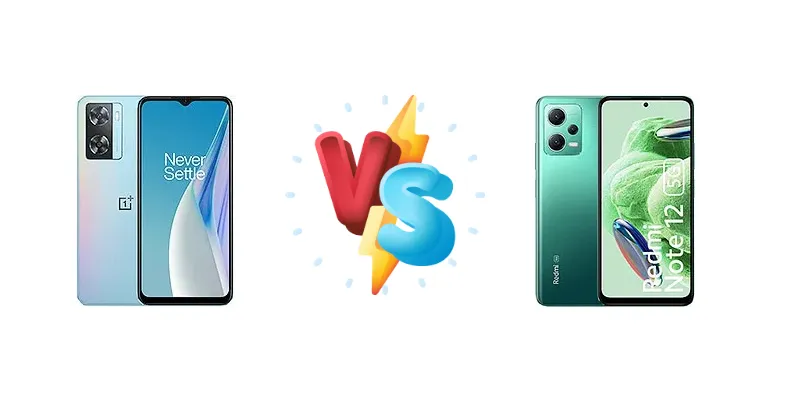
The budget smartphone market is fiercely competitive, offering incredible value for your money. Today, we're pitting two popular contenders against each other: the OnePlus Nord N20 SE and the Xiaomi Redmi Note 12. Let's dive into a detailed comparison to see which phone reigns supreme.
🏆 Quick Verdict
The Xiaomi Redmi Note 12 emerges as the stronger contender thanks to its more efficient chipset, faster charging, and impressive battery life. While the Nord N20 SE offers a decent experience, the Redmi Note 12 provides a more polished and future-proof package for the price.
| Network |
|---|
| 2G bands | GSM 850 / 900 / 1800 / 1900 | GSM 850 / 900 / 1800 / 1900 |
| 3G bands | HSDPA 850 / 900 / 2100 - Global | HSDPA 850 / 900 / 2100 |
| 4G bands | 1, 3, 5, 7, 8, 20, 28, 38, 40, 41 - Global | 1, 3, 5, 8, 40, 41 |
| 5G bands | - | 1, 3, 5, 8, 28, 40, 78 SA/NSA |
| Speed | HSPA, LTE | HSPA, LTE, 5G |
| Technology | GSM / HSPA / LTE | GSM / HSPA / LTE / 5G |
| | 1, 2, 3, 4, 5, 7, 8, 12, 13, 17, 18, 19, 26, 28, 38, 41, 66 - LATAM | - |
| Launch |
|---|
| Announced | 2022, August 05 | 2022, October 27 |
| Status | Available. Released 2022, August 08 | Available. Released 2023, January 11 |
| Body |
|---|
| Build | Glass front, plastic frame, plastic back | - |
| Dimensions | 163.8 x 75 x 8 mm (6.45 x 2.95 x 0.31 in) | 165.9 x 76.2 x 8 mm (6.53 x 3.00 x 0.31 in) |
| SIM | Nano-SIM + Nano-SIM | Nano-SIM + Nano-SIM |
| Weight | 187 g (6.60 oz) | 188 g (6.63 oz) |
| | - | IP53, dust and splash resistant |
| Display |
|---|
| Protection | - | Corning Gorilla Glass 3 |
| Resolution | 720 x 1612 pixels, 20:9 ratio (~269 ppi density) | 1080 x 2400 pixels, 20:9 ratio (~395 ppi density) |
| Size | 6.56 inches, 103.4 cm2 (~84.2% screen-to-body ratio) | 6.67 inches, 107.4 cm2 (~85.0% screen-to-body ratio) |
| Type | IPS LCD, 480 nits (typ), 600 nits (HBM) | AMOLED, 120Hz, 1200 nits (peak) |
| Platform |
|---|
| CPU | Octa-core (4x2.3 GHz Cortex-A53 & 4x1.8 GHz Cortex-A53) | Octa-core (2x2.0 GHz Cortex-A78 & 6x1.8 GHz Cortex-A55) |
| Chipset | Mediatek MT6765G Helio G35 (12 nm) | Qualcomm SM4375 Snapdragon 4 Gen 1 (6 nm) |
| GPU | PowerVR GE8320 | Adreno 619 |
| OS | Android 12, OxygenOS 12.1 | Android 12, MIUI 14 (International), MIUI 13 (India) |
| Memory |
|---|
| Card slot | microSDXC | microSDXC (uses shared SIM slot) |
| Internal | 64GB 4GB RAM, 128GB 4GB RAM | 128GB 4GB RAM, 128GB 6GB RAM, 256GB 8GB RAM |
| | eMMC 5.1 | UFS 2.2 |
| Main Camera |
|---|
| Dual | 50 MP, f/1.8, (wide), 1/2.76", 0.64µm, PDAF
Auxiliary lens | - |
| Features | LED flash, HDR, panorama | Dual-LED dual-tone flash, HDR, panorama |
| Single | 8 MP, f/2.0, 26mm (wide), 1/4", 1.12µm | - |
| Triple | - | 48 MP, f/1.8, (wide), PDAF
8 MP, f/2.2, 120˚ (ultrawide), 1/4.0", 1.12µm
2 MP (macro) |
| Video | 1080p@30fps | 1080p@30fps |
| Selfie camera |
|---|
| Features | - | HDR |
| Single | 8 MP, f/2.0, 26mm (wide), 1/4.0", 1.12µm | 13 MP, f/2.5, (wide), 1/3.0" |
| Video | 1080p@30fps | 1080p@30fps |
| Sound |
|---|
| 3.5mm jack | Yes | Yes |
| 35mm jack | Yes | Yes |
| Loudspeaker | Yes, with dual speakers | Yes |
| | - | 24-bit/192kHz audio |
| Comms |
|---|
| Bluetooth | 5.3, A2DP, LE, aptX HD | 5.1, A2DP, LE |
| Infrared port | - | Yes |
| NFC | No | Yes (market/region dependent) |
| Positioning | GPS, GLONASS, BDS, GALILEO, QZSS | GPS, GLONASS |
| Radio | No | Unspecified |
| USB | USB Type-C 2.0, OTG | USB Type-C 2.0, OTG |
| WLAN | Wi-Fi 802.11 a/b/g/n/ac, dual-band, Wi-Fi Direct | Wi-Fi 802.11 a/b/g/n/ac, dual-band |
| Features |
|---|
| Sensors | Fingerprint (side-mounted), accelerometer, proximity, compass | Fingerprint (side-mounted), accelerometer, gyro, proximity, compass |
| Battery |
|---|
| Charging | 33W wired, 50% in 34 min, 100% in 69 min | 33W wired, 50% in 22 min |
| Type | Li-Po 5000 mAh | Li-Po 5000 mAh |
| Misc |
|---|
| Colors | Blue Oasis, Celestial Black | Frosted Green, Matte Black, Mystique Blue |
| Models | CPH2469 | 22111317I, 22111317G |
| Price | About 190 EUR | € 151.99 / $ 219.99 / ₹ 11,999 |
| SAR | - | 1.09 W/kg (head) 1.05 W/kg (body) |
| SAR EU | - | 0.68 W/kg (head) 0.91 W/kg (body) |
| Tests |
|---|
| Battery life | - |
Endurance rating 101h
|
| Camera | - |
Photo / Video |
| Display | - |
Contrast ratio: Infinite (nominal) |
| Loudspeaker | - |
-28.0 LUFS (Good)
|
| Performance | - |
AnTuTu: 360745 (v9)
GeekBench: 1998 (v5.1), 2017 (v6) |
OnePlus Nord N20 SE
- Clean OxygenOS software
- Slightly more compact design (likely)
- 33W fast charging
- Less powerful chipset
- Likely lower display brightness
- Potentially shorter battery life
Xiaomi Redmi Note 12
- More powerful Snapdragon 4 Gen 1 chipset
- Brighter and higher contrast display
- Exceptional battery life
- Faster charging (based on reported times)
- MIUI software (can be polarizing)
- Design may be less premium (subjective)
Display Comparison
The Redmi Note 12 boasts a significantly brighter display at 706 nits compared to the Nord N20 SE (specs unavailable, assumed lower). Its 'infinite' contrast ratio suggests excellent image quality. While the Nord N20 SE's display is likely adequate, the Redmi Note 12 offers a superior viewing experience.
Camera Comparison
Both phones feature 'Photo / Video' capabilities, but detailed camera specs are missing. Generally, Xiaomi phones offer competitive camera performance in this price range. Without specific details, it's difficult to definitively declare a winner, but the Redmi Note 12 likely has an edge due to its newer chipset's image processing capabilities.
Performance
The Redmi Note 12's Snapdragon 4 Gen 1 (6nm) chipset is a clear winner over the Nord N20 SE's Helio G35 (12nm). The newer architecture and smaller fabrication process translate to better performance and efficiency. Expect smoother multitasking and gaming on the Redmi Note 12.
Battery Life
The Redmi Note 12 shines in battery life, boasting an endurance rating of 101 hours and an active use score of 10:58 hours. The Nord N20 SE's charging speed is comparable (33W), but the Redmi Note 12's significantly longer battery life gives it a substantial advantage.
Buying Guide
The OnePlus Nord N20 SE is a good choice for users prioritizing a clean software experience and a slightly more compact design. The Xiaomi Redmi Note 12 is ideal for those seeking longer battery life, faster charging, and a more powerful processor for smoother performance and future-proofing.
Frequently Asked Questions
❓ Which phone has better performance?
The Xiaomi Redmi Note 12's Snapdragon 4 Gen 1 chipset offers significantly better performance than the OnePlus Nord N20 SE's Helio G35.
❓ Is the Redmi Note 12 worth the extra money?
Yes, the Redmi Note 12's superior performance, display, and battery life generally justify the price difference, especially for users who prioritize those features.