
OnePlus Nord N20 5G vs Nord N300: The Ultimate Showdown
| Phones Images | |||||
|---|---|---|---|---|---|
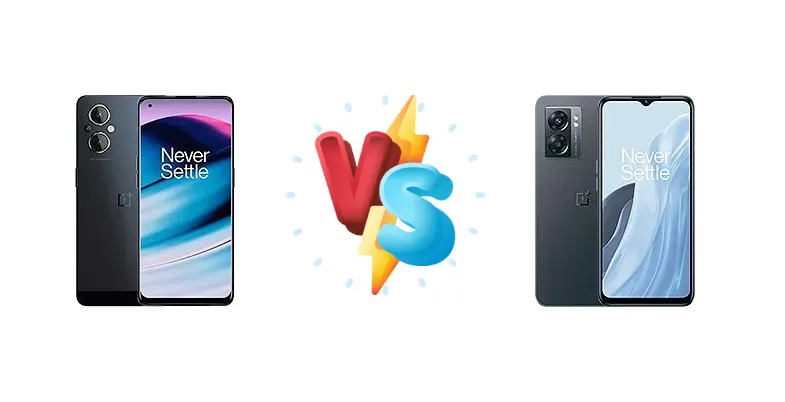
|
🏆 Quick Verdict
The OnePlus Nord N20 5G edges out the N300 thanks to its slightly brighter display and superior endurance rating. While the N300 offers a more modern chipset, the N20 5G's overall package provides a more compelling experience for most users.
| PHONES | ||
|---|---|---|
| Phone Names | OnePlus Nord N20 5G | OnePlus Nord N300 |
| Network | ||
|---|---|---|
| 2G bands | GSM 850 / 900 / 1800 / 1900 | GSM 850 / 900 / 1800 / 1900 |
| 3G bands | HSDPA 850 / 900 / 1700(AWS) / 1900 / 2100 | HSDPA 850 / 900 / 1700(AWS) / 1900 / 2100 |
| 4G bands | 1, 2, 3, 4, 5, 7, 8, 12, 13, 17, 20, 25, 26, 28, 38, 39, 40, 41, 66, 71 | 1, 2, 3, 4, 5, 7, 8, 12, 13, 17, 20, 25, 26, 28, 38, 39, 40, 41, 66, 71 |
| 5G bands | 2, 25, 41, 66, 71 SA/NSA | 2, 25, 41, 66, 71, 77 SA/NSA |
| Speed | HSPA 42.2/5.76 Mbps, LTE Cat15 800/200 Mbps, 5G | HSPA 42.2/5.76 Mbps, LTE Cat13 390/150 Mbps, 5G |
| Technology | GSM / HSPA / LTE / 5G | GSM / HSPA / LTE / 5G |
| Launch | ||
|---|---|---|
| Announced | 2022, April 28 | 2022, October 24 |
| Status | Available. Released 2022, April 28 | Available. Released 2022, November 03 |
| Body | ||
|---|---|---|
| Build | Glass front (Schott Xensation Up), plastic frame, plastic back | Glass front, plastic frame, plastic back |
| Dimensions | 159.9 x 73.2 x 7.5 mm (6.30 x 2.88 x 0.30 in) | 163.8 x 75.1 x 8 mm (6.45 x 2.96 x 0.31 in) |
| SIM | Nano-SIM | Nano-SIM |
| Weight | 173 g (6.10 oz) | 190 g (6.70 oz) |
| Display | ||
|---|---|---|
| Protection | Schott Xensation Up | - |
| Resolution | 1080 x 2400 pixels, 20:9 ratio (~409 ppi density) | 720 x 1612 pixels, 20:9 ratio (~269 ppi density) |
| Size | 6.43 inches, 99.8 cm2 (~85.3% screen-to-body ratio) | 6.56 inches, 103.4 cm2 (~84.0% screen-to-body ratio) |
| Type | AMOLED | IPS LCD, 90Hz |
| Always-on display | - | |
| Platform | ||
|---|---|---|
| CPU | Octa-core (2x2.2 GHz Kryo 660 Gold & 6x1.7 GHz Kryo 660 Silver) | Octa-core (2x2.4 GHz Cortex-A76 & 6x2.0 GHz Cortex-A55) |
| Chipset | Qualcomm SM6375 Snapdragon 695 5G (6 nm) | Mediatek Dimensity 810 (6 nm) |
| GPU | Adreno 619 | Mali-G57 MC2 |
| OS | Android 11, OxygenOS 11 | Android 12, OxygenOS |
| Memory | ||
|---|---|---|
| Card slot | microSDXC (dedicated slot) | microSDXC |
| Internal | 128GB 6GB RAM | 64GB 4GB RAM |
| UFS 2.2 | UFS 2.2 | |
| Main Camera | ||
|---|---|---|
| Dual | - | 48 MP, f/1.8, (wide), PDAF Auxiliary lens |
| Features | LED flash, HDR, panorama | LED flash, HDR, panorama |
| Single | 16 MP, f/2.4, (wide) | 16 MP, f/2.0, (wide) |
| Triple | 64 MP, f/1.8, (wide), PDAF 2 MP (macro) Auxiliary lens | - |
| Video | 1080p@30fps | 1080p@30fps |
| Selfie camera | ||
|---|---|---|
| Features | HDR | HDR |
| Single | 16 MP, f/2.4, (wide) | 16 MP, f/2.0, (wide) |
| Video | 1080p@30fps | 1080p@30fps |
| Sound | ||
|---|---|---|
| 3.5mm jack | Yes | Yes |
| 35mm jack | Yes | Yes |
| Loudspeaker | Yes | Yes, with dual speakers |
| Comms | ||
|---|---|---|
| Bluetooth | 5.1, A2DP, LE | 5.3, A2DP, LE |
| NFC | Yes | Yes |
| Positioning | GPS (L1+L5), GLONASS, GALILEO, BDS | GPS, GLONASS, GALILEO |
| Radio | No | Unspecified |
| USB | USB Type-C 2.0, OTG | USB Type-C 2.0, OTG |
| WLAN | Wi-Fi 802.11 a/b/g/n/ac, dual-band, Wi-Fi Direct | Wi-Fi 802.11 a/b/g/n/ac, dual-band |
| Features | ||
|---|---|---|
| Sensors | Fingerprint (under display, optical), accelerometer, gyro, proximity, compass, barometer | Fingerprint (side-mounted), accelerometer, gyro, proximity, compass, barometer |
| Battery | ||
|---|---|---|
| Charging | 33W wired | 33W wired |
| Type | Li-Po 4500 mAh | Li-Po 5000 mAh |
| Misc | ||
|---|---|---|
| Colors | Blue | Midnight Jade |
| Models | GN2200, CPH2459 | CPH2389 |
| Price | About 120 EUR | About 230 EUR |
| Tests | ||
|---|---|---|
| Battery life | Endurance rating 129h | Endurance rating 114h |
| Display | Contrast ratio: Infinite (nominal) | Contrast ratio: 1506:1 (nominal) |
| Performance | AnTuTu: 316974 (v8), 380672 (v9) GeekBench: 1945 (v5.1) GFXBench: 16fps (ES 3.1 onscreen) | AnTuTu: 335440 (v9) GeekBench: 1780 (v5.1) GFXBench: 23fps (ES 3.1 onscreen) |
OnePlus Nord N20 5G
- Superior battery life (129h endurance)
- Brighter display (647 nits)
- Generally good value
- Older chipset (Snapdragon 695 5G)
- Potentially fewer future software updates
OnePlus Nord N300
- More modern chipset (Dimensity 810)
- Potentially better future software updates
- Slightly improved performance
- Shorter battery life (114h endurance)
- Slightly dimmer display (623 nits)
Display Comparison
The Nord N20 5G boasts a measured peak brightness of 647 nits, noticeably brighter than the N300's 623 nits. Both offer a respectable contrast ratio, but the N20 5G's higher brightness makes it easier to view in direct sunlight. The N300's contrast ratio is listed as 1506:1, while the N20 5G's is described as 'Infinite' (nominal), suggesting excellent black levels.
Camera Comparison
Camera specs are not fully detailed in the provided data. Assuming similar sensor sizes and configurations, image quality will likely be comparable. The N300's newer chipset *might* offer slightly better image processing, but this is speculative without more information. Both phones likely feature a main camera, ultrawide, and macro lens.
Performance
The Nord N300 utilizes a Mediatek Dimensity 810 chipset, a newer and generally more efficient processor than the Snapdragon 695 5G found in the N20 5G. However, in real-world usage, the difference in performance is likely to be subtle for everyday tasks. Gaming performance will be slightly better on the N300, but neither phone is a powerhouse.
Battery Life
The Nord N20 5G holds a significant advantage in battery life, boasting an endurance rating of 129 hours compared to the N300's 114 hours. This translates to noticeably longer usage between charges for the N20 5G.
Buying Guide
Who should buy the OnePlus Nord N20 5G? Users prioritizing battery life and a brighter screen. Who should buy the OnePlus Nord N300? Those seeking a slightly more modern chipset and potentially better future software updates, though the performance difference isn't massive.