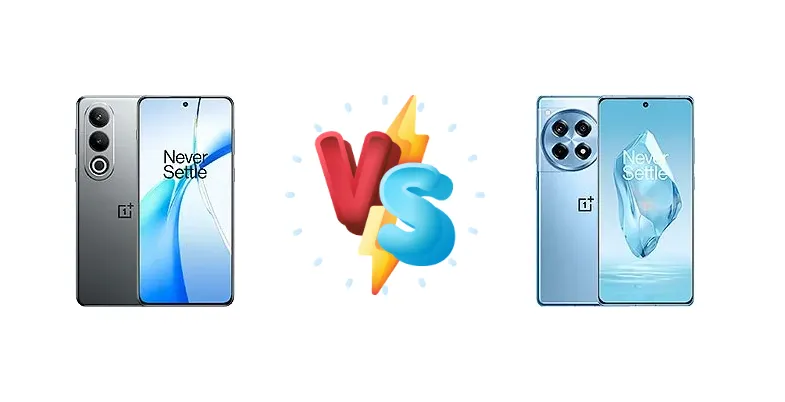
OnePlus offers a compelling range of smartphones, but navigating the lineup can be tricky. The Nord CE4 and 12R represent distinct approaches: the CE4 focuses on delivering essential features at an accessible price, while the 12R aims for near-flagship performance without the flagship price tag. This comparison dissects their key differences to help you choose the right OnePlus for your needs.
🏆 Quick Verdict
For most users, the OnePlus 12R emerges as the superior choice. Its Snapdragon 8 Gen 2 chipset provides significantly faster performance and better thermal management, justifying the price premium. However, the Nord CE4 remains a strong contender for budget-conscious buyers prioritizing efficiency and rapid 100W charging.
| Network |
|---|
| 2G bands | GSM 850 / 900 / 1800 / 1900 | GSM 850 / 900 / 1800 / 1900 |
| 3G bands | HSDPA 900 / 2100 | HSDPA 850 / 900 / 1700(AWS) / 1900 / 2100 |
| 4G bands | 1, 3, 5, 8, 28, 40, 41 | 1, 2, 3, 4, 5, 7, 8, 12, 17, 18, 19, 20, 26, 28, 32, 38, 39, 40, 41, 66 |
| 5G bands | 1, 3, 5, 8, 28, 77, 78 SA/NSA | 1, 2, 3, 5, 7, 8, 12, 20, 28, 38, 40, 41, 66, 77, 78 SA/NSA |
| Speed | HSPA, LTE, 5G | HSPA, LTE, 5G |
| Technology | GSM / HSPA / LTE / 5G | GSM / CDMA / HSPA / LTE / 5G |
| Launch |
|---|
| Announced | 2024, April 01 | 2024, January 23 |
| Status | Available. Released 2024, April 04 | Available. Released 2024, February 06 |
| Body |
|---|
| Build | - | Glass front (Gorilla Glass Victus 2), aluminum frame, glass back |
| Dimensions | 162.5 x 75.3 x 8.4 mm (6.40 x 2.96 x 0.33 in) | 163.3 x 75.3 x 8.8 mm (6.43 x 2.96 x 0.35 in) |
| SIM | Nano-SIM + Nano-SIM | · Nano-SIM + Nano-SIM + eSIM (max 2 at a time)· Nano-SIM + Nano-SIM |
| Weight | 186 g (6.56 oz) | 207 g (7.30 oz) |
| Display |
|---|
| Protection | - | Corning Gorilla Glass Victus 2 |
| Resolution | 1080 x 2412 pixels, 20:9 ratio (~394 ppi density) | 1264 x 2780 pixels (~450 ppi density) |
| Size | 6.7 inches, 108.0 cm2 (~88.3% screen-to-body ratio) | 6.78 inches, 111.7 cm2 (~90.9% screen-to-body ratio) |
| Type | Fluid AMOLED, 1B colors, 120Hz, HDR10+, 900 nits (HBM), 1100 nits (peak) | LTPO4 AMOLED, 1B colors, 120Hz, HDR10+, Dolby Vision, 1600 nits (HBM), 4500 nits (peak) |
| Platform |
|---|
| CPU | Octa-core (1x2.63 GHz Cortex-A715 & 4x2.4 GHz Cortex-A715 & 3x1.8 GHz Cortex-A510) | Octa-core (1x3.2 GHz Cortex-X3 & 2x2.8 GHz Cortex-A715 & 2x2.8 GHz Cortex-A710 & 3x2.0 GHz Cortex-A510) |
| Chipset | Qualcomm SM7550-AB Snapdragon 7 Gen 3 (4 nm) | Qualcomm SM8550-AB Snapdragon 8 Gen 2 (4 nm) |
| GPU | Adreno 720 | Adreno 740 |
| OS | Android 14, ColorOS 14 | Android 14, up to 3 major Android upgrades, OxygenOS 15 |
| Memory |
|---|
| Card slot | microSDXC (uses shared SIM slot) | No |
| Internal | 128GB 8GB RAM, 256GB 8GB RAM | 128GB 8GB RAM, 256GB 8GB RAM, 256GB 12GB RAM, 256GB 16GB RAM |
| Main Camera |
|---|
| Dual | 50 MP, f/1.8, 26mm (wide), 1/1.95", 0.8µm, PDAF, OIS
8 MP, f/2.2, 16mm, 112˚ (ultrawide), 1/4.0", 1.12µm | - |
| Features | Dual-LED flash, HDR, panorama | Laser AF, color spectrum sensor, LED flash, HDR, panorama |
| Triple | - | 50 MP, f/1.8, 24mm (wide), 1/1.56", 1.0µm, multi-directional PDAF, OIS
8 MP, f/2.2, 16mm, 112˚ (ultrawide), 1/4.0", 1.12µm
2 MP (macro) |
| Video | 4K@30fps, 1080p@30/60/120fps, gyro-EIS, OIS | 4K@30/60fps, 1080p@30/60/120/240fps, gyro-EIS, OIS |
| Selfie camera |
|---|
| Features | Panorama | HDR, panorama |
| Single | 16 MP, f/2.4, 26mm (wide), 1/3.0", 1.0µm | 16 MP, f/2.4, 26mm (wide), 1/3", 1.0µm |
| Video | 1080p@30fps | 1080p@30fps, gyro-EIS |
| Sound |
|---|
| 35mm jack | No | No |
| Loudspeaker | Yes, with stereo speakers | Yes, with stereo speakers |
| Comms |
|---|
| Bluetooth | 5.4, A2DP, LE, aptX HD, LHDC | 5.3, A2DP, LE, aptX HD |
| Infrared port | Yes | Yes |
| NFC | No | Yes |
| Positioning | GPS, GALILEO, GLONASS, BDS, QZSS | GPS, GALILEO, GLONASS, BDS, QZSS |
| Radio | No | No |
| USB | USB Type-C 2.0 | USB Type-C 2.0 |
| WLAN | Wi-Fi 802.11 a/b/g/n/ac/6, dual-band | Wi-Fi 802.11 a/b/g/n/ac/6/7, dual-band |
| Features |
|---|
| Sensors | Fingerprint (under display, optical), accelerometer, gyro, proximity, compass | Fingerprint (under display, optical), accelerometer, gyro, proximity, compass |
| Battery |
|---|
| Charging | 100W wired, 100% in 29 min | 100W wired, 100% in 26 min |
| Type | 5500 mAh | Li-Ion 5500 mAh |
| Misc |
|---|
| Colors | Celadon Marble, Dark Chrome | Iron Gray, Cool Blue, Electric Violet, Sunset Dune |
| Models | CPH2613 | CPH2609, CPH2585, CPH2611 |
| Price | ₹ 18,999 | € 410.84 / $ 399.95 / £ 649.00 |
| SAR | 1.16 W/kg (head) 0.91 W/kg (body) | 1.19 W/kg (head) 0.82 W/kg (body) |
OnePlus Nord CE4
- Faster charging (29 minutes to full)
- Potentially more affordable price point
- Efficient Snapdragon 7 Gen 3 chipset
- Significantly less powerful processor
- Likely lower display brightness
- Potentially limited camera performance
OnePlus 12R
- Flagship-level Snapdragon 8 Gen 2 performance
- Brighter and more vibrant display (1181 nits)
- Excellent battery life (14:32h active use)
- Slightly slower charging (26 minutes to full)
- Higher price tag
- May run warmer under sustained load
Display Comparison
The OnePlus 12R boasts a significantly brighter display, reaching a measured peak of 1181 nits, compared to the Nord CE4 (brightness data unavailable). This translates to better visibility outdoors and a more vibrant viewing experience. While both likely utilize AMOLED panels, the 12R’s higher brightness suggests a more advanced panel with potentially better color accuracy and contrast. The absence of LTPO on either device means refresh rate scaling isn't as efficient as on higher-end models, but both will offer a smooth 120Hz experience.
Camera Comparison
Detailed camera specifications are limited, but the focus should be on the main sensor capabilities. While both phones likely feature multi-camera systems, the 12R’s potential for a larger sensor and more advanced image processing, typical of its price segment, will likely result in better low-light performance and dynamic range. The Snapdragon 8 Gen 2’s ISP (Image Signal Processor) is also more capable than the 7 Gen 3’s, enabling faster processing and improved image quality. We advise ignoring the inclusion of 2MP macro lenses on either device, as their image quality is typically subpar.
Performance
The core difference lies in the chipsets. The OnePlus 12R’s Snapdragon 8 Gen 2 (4nm) is a substantial upgrade over the Nord CE4’s Snapdragon 7 Gen 3 (4nm). The 8 Gen 2 features a Cortex-X3 prime core clocked at 3.2 GHz, alongside faster Cortex-A715 and A710 performance cores, resulting in markedly faster CPU and GPU performance. The 7 Gen 3’s architecture, while efficient, utilizes Cortex-A715 cores across more of its configuration, prioritizing efficiency over raw power. This difference will be most noticeable in demanding tasks like gaming and video editing, where the 12R will maintain higher frame rates and smoother performance. The 12R also benefits from the 4nm process node, offering better thermal efficiency and reducing the likelihood of throttling during sustained workloads.
Battery Life
The OnePlus 12R demonstrates impressive battery life, achieving an active use score of 14:32h. While the Nord CE4’s battery capacity is unknown, its Snapdragon 7 Gen 3 chipset is designed for efficiency. Both devices support 100W wired charging, but the 12R charges to 100% in 26 minutes, slightly faster than the Nord CE4’s 29 minutes. The 12R’s larger battery capacity, combined with the efficient Snapdragon 8 Gen 2, allows it to deliver significantly longer runtimes despite the similar charging speeds.
Buying Guide
Buy the OnePlus Nord CE4 if you need a reliable daily driver with exceptionally fast charging and are comfortable with a more modest processor. It’s ideal for users who prioritize battery life and quick top-ups over demanding gaming or intensive multitasking. Buy the OnePlus 12R if you prefer a smoother, more responsive experience for gaming, video editing, or running demanding applications. Its superior chipset and brighter display make it the better choice for power users and media consumers.
Frequently Asked Questions
❓ Does the Snapdragon 7 Gen 3 in the Nord CE4 struggle with graphically intensive games like Genshin Impact?
Yes, while the Snapdragon 7 Gen 3 is a capable chip, it will likely require significant graphics settings reductions to achieve playable frame rates in demanding titles like Genshin Impact. The 12R’s Snapdragon 8 Gen 2 offers a much smoother gaming experience with higher graphical fidelity.
❓ How much of a difference will the 1181 nits of peak brightness on the OnePlus 12R make in everyday use?
The difference is substantial, particularly outdoors or in brightly lit environments. The 12R’s display will remain easily visible under direct sunlight, while the Nord CE4’s display may appear washed out. Indoors, the higher brightness also contributes to a more vibrant and immersive viewing experience.
❓ Is the 100W charging on both phones likely to degrade the battery health significantly over time?
While fast charging can contribute to battery degradation over the long term, OnePlus employs battery health management features to mitigate this effect. Both phones are expected to maintain acceptable battery health for several years of typical use, but avoiding consistently charging to 100% and letting the battery drain completely occasionally can further extend its lifespan.