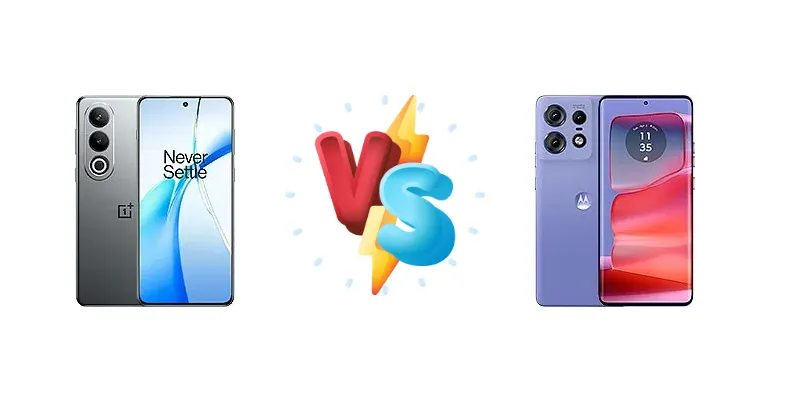
The OnePlus Nord CE4 and Motorola Edge 50 Pro represent compelling options in the increasingly competitive mid-range smartphone market. Both devices leverage the Qualcomm Snapdragon 7 Gen 3 chipset, but diverge significantly in charging capabilities and display technology, creating a clear choice for users prioritizing speed versus sustained usability.
🏆 Quick Verdict
For the average user, the Motorola Edge 50 Pro emerges as the stronger contender. Its 125W charging, coupled with a measured 11:59h active use battery score, provides a significant advantage in daily convenience. While the Nord CE4 offers a competitive package, Motorola’s faster charging and superior display brightness give it the edge.
| Network |
|---|
| 2G bands | GSM 850 / 900 / 1800 / 1900 | GSM 850 / 900 / 1800 / 1900 |
| 3G bands | HSDPA 900 / 2100 | HSDPA 850 / 900 / 1700(AWS) / 1900 / 2100 |
| 4G bands | 1, 3, 5, 8, 28, 40, 41 | 1, 2, 3, 4, 5, 7, 8, 12, 13, 17, 18, 19, 20, 26, 28, 32, 38, 39, 40, 41, 43, 48, 66 |
| 5G bands | 1, 3, 5, 8, 28, 77, 78 SA/NSA | 1, 2, 3, 5, 7, 8, 20, 26, 28, 38, 40, 41, 66, 77, 78 SA/NSA/Sub6 |
| Speed | HSPA, LTE, 5G | HSPA, LTE, 5G |
| Technology | GSM / HSPA / LTE / 5G | GSM / HSPA / LTE / 5G |
| Launch |
|---|
| Announced | 2024, April 01 | 2024, April 03 |
| Status | Available. Released 2024, April 04 | Available. Released 2024, April 08 |
| Body |
|---|
| Build | - | Glass front, plastic back or silicone polymer back (eco leather), aluminum frame |
| Dimensions | 162.5 x 75.3 x 8.4 mm (6.40 x 2.96 x 0.33 in) | 161.2 x 72.4 x 8.2 mm (6.35 x 2.85 x 0.32 in) |
| SIM | Nano-SIM + Nano-SIM | · Nano-SIM + eSIM· Nano-SIM + Nano-SIM |
| Weight | 186 g (6.56 oz) | 186 g (6.56 oz) |
| Display |
|---|
| Protection | - | Corning Gorilla Glass (unspecified version) |
| Resolution | 1080 x 2412 pixels, 20:9 ratio (~394 ppi density) | 1220 x 2712 pixels, 20:9 ratio (~446 ppi density) |
| Size | 6.7 inches, 108.0 cm2 (~88.3% screen-to-body ratio) | 6.7 inches, 107.4 cm2 (~92.0% screen-to-body ratio) |
| Type | Fluid AMOLED, 1B colors, 120Hz, HDR10+, 900 nits (HBM), 1100 nits (peak) | P-OLED, 1B colors, 144Hz, HDR10+, 2000 nits (peak) |
| Platform |
|---|
| CPU | Octa-core (1x2.63 GHz Cortex-A715 & 4x2.4 GHz Cortex-A715 & 3x1.8 GHz Cortex-A510) | Octa-core (1x2.63 GHz Cortex-A715 & 4x2.4 GHz Cortex-A715 & 3x1.8 GHz Cortex-A510) |
| Chipset | Qualcomm SM7550-AB Snapdragon 7 Gen 3 (4 nm) | Qualcomm SM7550-AB Snapdragon 7 Gen 3 (4 nm) |
| GPU | Adreno 720 | Adreno 720 |
| OS | Android 14, ColorOS 14 | Android 14, up to 3 major Android upgrades |
| Memory |
|---|
| Card slot | microSDXC (uses shared SIM slot) | No |
| Internal | 128GB 8GB RAM, 256GB 8GB RAM | 128GB 8GB RAM, 256GB 8GB RAM, 256GB 12GB RAM, 512GB 12GB RAM |
| Main Camera |
|---|
| Dual | 50 MP, f/1.8, 26mm (wide), 1/1.95", 0.8µm, PDAF, OIS
8 MP, f/2.2, 16mm, 112˚ (ultrawide), 1/4.0", 1.12µm | - |
| Features | Dual-LED flash, HDR, panorama | Laser AF, LED flash, panorama, HDR |
| Triple | - | 50 MP, f/1.4, 25mm (wide), 1/1.55", 1.0µm, multi-directional PDAF, OIS
10 MP, f/2.0, 67mm (telephoto), 1/3.94", 1.0µm, PDAF, OIS, 3x optical zoom
13 MP, f/2.2, 16mm, 120˚ (ultrawide), 1/3.0", 1.12µm, PDAF |
| Video | 4K@30fps, 1080p@30/60/120fps, gyro-EIS, OIS | 4K@30fps, 1080p@30/60/120/240fps, 10-bit HDR10+, gyro-EIS |
| Selfie camera |
|---|
| Features | Panorama | HDR |
| Single | 16 MP, f/2.4, 26mm (wide), 1/3.0", 1.0µm | 50 MP, f/1.9, 21mm (wide), 0.64µm, AF |
| Video | 1080p@30fps | 4K@30fps, 1080p@30/60fps |
| Sound |
|---|
| 35mm jack | No | No |
| Loudspeaker | Yes, with stereo speakers | Yes, with stereo speakers |
| Comms |
|---|
| Bluetooth | 5.4, A2DP, LE, aptX HD, LHDC | 5.4, A2DP, LE |
| Infrared port | Yes | - |
| NFC | No | Yes |
| Positioning | GPS, GALILEO, GLONASS, BDS, QZSS | GPS, GLONASS, GALILEO, BDS, QZSS, NavIC |
| Radio | No | No |
| USB | USB Type-C 2.0 | USB Type-C 3.1, OTG, DisplayPort 1.4 |
| WLAN | Wi-Fi 802.11 a/b/g/n/ac/6, dual-band | Wi-Fi 802.11 a/b/g/n/ac/6e, tri-band, Wi-Fi Direct |
| Features |
|---|
| Sensors | Fingerprint (under display, optical), accelerometer, gyro, proximity, compass | Fingerprint (under display, optical), accelerometer, gyro, proximity, compass |
| Battery |
|---|
| Charging | 100W wired, 100% in 29 min | 125W wired, 100% in 18 min
50W wireless
10W reverse wireless |
| Type | 5500 mAh | Li-Po 4500 mAh |
| Misc |
|---|
| Colors | Celadon Marble, Dark Chrome | Luxe Lavender, Black Beauty, Moonlight Pearl, Vanilla Cream |
| Models | CPH2613 | XT2403-2 |
| Price | ₹ 18,999 | € 410.57 / $ 399.00 / £ 369.99 / ₹ 22,995 |
| SAR | 1.16 W/kg (head) 0.91 W/kg (body) | 1.08 W/kg (head) 1.08 W/kg (body) |
OnePlus Nord CE4
- Fast 100W wired charging
- Clean and streamlined software experience
- Competitive price point
- Slower charging than Motorola Edge 50 Pro
- No wireless charging support
- Display brightness likely lower than Edge 50 Pro
Motorola Edge 50 Pro
- Ultra-fast 125W wired charging
- 50W wireless charging and 10W reverse wireless charging
- Brighter display with 1295 nits peak brightness
- Longer battery life (11:59h active use)
- Potentially higher price point
- Motorola’s software can be more cluttered
- Thermal management needs to be verified under sustained load
Display Comparison
Both the OnePlus Nord CE4 and Motorola Edge 50 Pro utilize AMOLED panels, but the Edge 50 Pro boasts a significantly brighter peak brightness of 1295 nits (measured) compared to an unspecified value for the Nord CE4. This translates to superior visibility in direct sunlight. While both likely offer similar color accuracy, the higher brightness of the Motorola device is a tangible benefit for outdoor use. The absence of LTPO technology in either phone suggests a standard 120Hz refresh rate, potentially impacting power consumption compared to adaptive refresh rate displays.
Camera Comparison
The provided data lacks specific camera details for either device. However, given the market positioning, we can infer that both will feature multi-camera systems. The absence of information regarding sensor sizes and apertures makes a direct comparison impossible. It’s likely both phones will include a primary wide-angle lens, an ultrawide, and potentially a macro lens. Image processing styles will likely differ, with OnePlus traditionally favoring more vibrant colors and Motorola aiming for a more natural look. Without further data, it’s difficult to assess which phone offers a superior camera experience.
Performance
Both devices are powered by the Qualcomm SM7550-AB Snapdragon 7 Gen 3 (4 nm) chipset, featuring an octa-core CPU configuration with 1x2.63 GHz Cortex-A715, 4x2.4 GHz Cortex-A715, and 3x1.8 GHz Cortex-A510 cores. This means CPU performance will be virtually identical. The real-world difference will likely come down to thermal management and RAM configuration (not specified in the provided data). However, the 4nm process node ensures relatively efficient power consumption, minimizing throttling during sustained workloads. Gaming performance should be comparable, though Motorola’s potentially better thermal design could allow for slightly longer peak performance.
Battery Life
The Motorola Edge 50 Pro distinguishes itself with a significantly faster charging speed of 125W wired, achieving a full charge in just 18 minutes, compared to the OnePlus Nord CE4’s 100W charging which takes 29 minutes. Furthermore, the Edge 50 Pro adds 50W wireless charging and 10W reverse wireless charging, features absent in the Nord CE4. The Edge 50 Pro also demonstrates superior battery life with an active use score of 11:59h, suggesting better optimization or a larger battery capacity (not specified). While the Nord CE4’s 100W charging is still fast, the Edge 50 Pro’s charging ecosystem offers greater flexibility and convenience.
Buying Guide
Buy the OnePlus Nord CE4 if you need a reliable daily driver with fast 100W charging and prioritize a clean software experience. It’s ideal for users who value simplicity and don’t demand the absolute best display or extended battery life. Buy the Motorola Edge 50 Pro if you prefer a brighter, more vibrant display, significantly faster charging (including wireless), and a longer-lasting battery for power users who stream, game, or heavily utilize their smartphones throughout the day.
Frequently Asked Questions
❓ Does the Snapdragon 7 Gen 3 in either phone struggle with demanding games like Genshin Impact?
The Snapdragon 7 Gen 3 is a capable chipset, but demanding titles like Genshin Impact may require reduced graphics settings for a consistently smooth experience on both the Nord CE4 and Edge 50 Pro. Thermal management will play a key role in sustained performance, and the Edge 50 Pro *may* have a slight advantage due to potentially better cooling.
❓ How does the 125W charging on the Motorola Edge 50 Pro affect battery health over the long term?
While extremely fast charging is convenient, it can potentially contribute to faster battery degradation over time. However, Motorola likely incorporates charging management algorithms to mitigate this effect, such as slowing down the charging rate as the battery approaches full capacity. The impact is generally minimal for most users.
❓ Is the lack of an official IP rating on either phone a concern for water or dust resistance?
The absence of an official IP rating means neither phone is officially certified for water or dust resistance. While they may offer some level of protection, it’s best to avoid exposing them to significant moisture or dust. Users should exercise caution in wet or dusty environments.