
OnePlus Nord CE4 vs. Google Pixel 7a: Which Mid-Range Champion Reigns Supreme?
| Phones Images | |||||
|---|---|---|---|---|---|
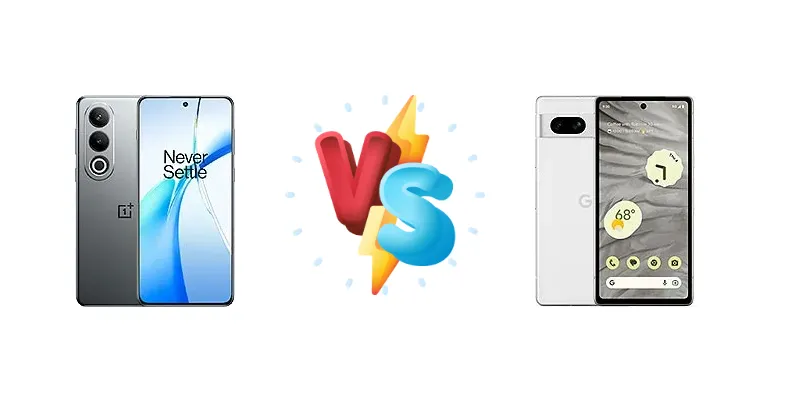
|
🏆 Quick Verdict
For the average user prioritizing all-day battery life and blazing-fast 100W charging, the OnePlus Nord CE4 emerges as the winner. However, the Pixel 7a’s superior camera processing and integrated Google experience make it the better choice for photography enthusiasts and those deeply invested in the Google ecosystem.
| PHONES | ||
|---|---|---|
| Phone Names | OnePlus Nord CE4 | Google Pixel 7a |
| Network | ||
|---|---|---|
| 2G bands | GSM 850 / 900 / 1800 / 1900 | GSM 850 / 900 / 1800 / 1900 |
| 3G bands | HSDPA 900 / 2100 | HSDPA 800 / 850 / 900 / 1700(AWS) / 1900 / 2100 |
| 4G bands | 1, 3, 5, 8, 28, 40, 41 | 1, 2, 3, 4, 5, 7, 8, 12, 13, 14, 17, 20, 25, 26, 28, 29, 30, 38, 40, 41, 48, 66, 71 - GWKK3, G0DZQ |
| 5G bands | 1, 3, 5, 8, 28, 77, 78 SA/NSA | 1, 2, 3, 5, 7, 8, 12, 14, 20, 25, 28, 30, 38, 41, 48, 66, 71, 77, 78 SA/NSA/Sub6 - GWKK3 |
| Speed | HSPA, LTE, 5G | HSPA, LTE, 5G |
| Technology | GSM / HSPA / LTE / 5G | GSM / HSPA / LTE / 5G |
| - | 1, 2, 3, 5, 7, 8, 12, 20, 25, 28, 38, 40, 41, 66, 75, 76, 77, 78, 79 SA/NSA/Sub6 - GHL1X, G82U8 | |
| Launch | ||
|---|---|---|
| Announced | 2024, April 01 | 2023, May 10 |
| Status | Available. Released 2024, April 04 | Available. Released 2023, May 10 |
| Body | ||
|---|---|---|
| Build | - | Glass front (Gorilla Glass 3), aluminum frame, plastic back |
| Dimensions | 162.5 x 75.3 x 8.4 mm (6.40 x 2.96 x 0.33 in) | 152 x 72.9 x 9 mm (5.98 x 2.87 x 0.35 in) |
| SIM | Nano-SIM + Nano-SIM | Nano-SIM + eSIM |
| Weight | 186 g (6.56 oz) | 193.5 g (6.84 oz) |
| - | IP67 dust/water resistant (up to 1m for 30 min) | |
| Display | ||
|---|---|---|
| Protection | - | Corning Gorilla Glass 3 |
| Resolution | 1080 x 2412 pixels, 20:9 ratio (~394 ppi density) | 1080 x 2400 pixels, 20:9 ratio (~429 ppi density) |
| Size | 6.7 inches, 108.0 cm2 (~88.3% screen-to-body ratio) | 6.1 inches, 90.7 cm2 (~81.8% screen-to-body ratio) |
| Type | Fluid AMOLED, 1B colors, 120Hz, HDR10+, 900 nits (HBM), 1100 nits (peak) | OLED, HDR, 90Hz |
| - | Always-on display | |
| Platform | ||
|---|---|---|
| CPU | Octa-core (1x2.63 GHz Cortex-A715 & 4x2.4 GHz Cortex-A715 & 3x1.8 GHz Cortex-A510) | Octa-core (2x2.85 GHz Cortex-X1 & 2x2.35 GHz Cortex-A78 & 4x1.80 GHz Cortex-A55) |
| Chipset | Qualcomm SM7550-AB Snapdragon 7 Gen 3 (4 nm) | Google Tensor G2 (5 nm) |
| GPU | Adreno 720 | Mali-G710 MP7 |
| OS | Android 14, ColorOS 14 | Android 13, upgradable to Android 15, up to 5 major Android upgrades |
| Memory | ||
|---|---|---|
| Card slot | microSDXC (uses shared SIM slot) | No |
| Internal | 128GB 8GB RAM, 256GB 8GB RAM | 128GB 8GB RAM |
| - | UFS 3.1 | |
| Main Camera | ||
|---|---|---|
| Dual | 50 MP, f/1.8, 26mm (wide), 1/1.95", 0.8µm, PDAF, OIS 8 MP, f/2.2, 16mm, 112˚ (ultrawide), 1/4.0", 1.12µm | 64 MP, f/1.9, 26mm (wide), 1/1.73", 0.8µm, dual pixel PDAF, OIS 13 MP, f/2.2, 120˚ (ultrawide), 1.12µm |
| Features | Dual-LED flash, HDR, panorama | Dual-LED flash, Pixel Shift, Auto-HDR, panorama |
| Video | 4K@30fps, 1080p@30/60/120fps, gyro-EIS, OIS | 4K@30/60fps, 1080p@30/60/120/240fps, OIS |
| Selfie camera | ||
|---|---|---|
| Features | Panorama | HDR, panorama |
| Single | 16 MP, f/2.4, 26mm (wide), 1/3.0", 1.0µm | 13 MP, f/2.2, 20mm (ultrawide), 1.12µm |
| Video | 1080p@30fps | 4K@30fps, 1080p@30fps |
| Sound | ||
|---|---|---|
| 3.5mm jack | - | No |
| 35mm jack | No | No |
| Loudspeaker | Yes, with stereo speakers | Yes, with stereo speakers |
| Comms | ||
|---|---|---|
| Bluetooth | 5.4, A2DP, LE, aptX HD, LHDC | 5.3, A2DP, LE |
| Infrared port | Yes | - |
| NFC | No | Yes |
| Positioning | GPS, GALILEO, GLONASS, BDS, QZSS | GPS, GLONASS, GALILEO, BDS, QZSS, NavIC |
| Radio | No | No |
| USB | USB Type-C 2.0 | USB Type-C 3.2 |
| WLAN | Wi-Fi 802.11 a/b/g/n/ac/6, dual-band | Wi-Fi 802.11 a/b/g/n/ac/6e, tri-band |
| Features | ||
|---|---|---|
| Sensors | Fingerprint (under display, optical), accelerometer, gyro, proximity, compass | Fingerprint (under display, optical), accelerometer, gyro, proximity, compass, barometer |
| Battery | ||
|---|---|---|
| Charging | 100W wired, 100% in 29 min | 18W wired, PD3.0 7.5W wireless |
| Type | 5500 mAh | Li-Po 4385 mAh |
| Misc | ||
|---|---|---|
| Colors | Celadon Marble, Dark Chrome | Charcoal, Snow, Sea, Coral |
| Models | CPH2613 | GWKK3, GHL1X, G0DZQ, G82U8 |
| Price | ₹ 18,999 | € 179.90 / $ 150.00 / £ 170.00 / ₹ 25,980 |
| SAR | 1.16 W/kg (head) 0.91 W/kg (body) | - |
OnePlus Nord CE4
- Incredibly fast 100W charging
- Potentially better sustained performance with Snapdragon 7 Gen 3
- More affordable price point
- Camera likely inferior to Pixel 7a
- Software updates may be less frequent than Pixel
Google Pixel 7a
- Exceptional camera quality and image processing
- Google’s software features and long-term support
- Excellent battery endurance
- Slow 18W charging
- Tensor G2 may throttle under sustained load
Display Comparison
The Google Pixel 7a boasts a measured peak brightness of 1070 nits, offering excellent visibility outdoors. While the Nord CE4’s display specs aren’t provided, it’s likely to be slightly dimmer. The Pixel 7a’s OLED panel delivers vibrant colors and deep blacks, crucial for media consumption. The absence of LTPO technology on either device means refresh rates are likely fixed, impacting power efficiency during dynamic content viewing. Bezels appear comparable, but the Pixel 7a’s smaller overall footprint may offer a slightly more immersive experience.
Camera Comparison
The Pixel 7a is renowned for its computational photography prowess. While sensor size isn’t specified, Google’s image processing algorithms excel at dynamic range and detail preservation, particularly in low-light scenarios. The Nord CE4’s camera specs are currently unknown, making a direct comparison difficult. However, given its mid-range positioning, it’s unlikely to match the Pixel 7a’s image quality. The Pixel 7a’s video capabilities are also likely superior, benefiting from the Tensor G2’s image signal processor. We can assume the Nord CE4 will offer a standard set of camera modes, but the Pixel 7a’s features like Magic Eraser and Photo Unblur provide a significant advantage.
Performance
The core difference lies in the chipsets. The Pixel 7a’s Google Tensor G2, fabricated on a 5nm process, prioritizes AI and machine learning tasks, enhancing features like voice recognition and image processing. Conversely, the Nord CE4 utilizes the Qualcomm Snapdragon 7 Gen 3 (4nm), focusing on raw CPU and GPU performance. The Snapdragon 7 Gen 3’s octa-core configuration, with its Cortex-A715 cores, should provide a noticeable edge in sustained gaming and multitasking compared to the Pixel 7a’s Cortex-A78 cores. The 4nm process of the Snapdragon also suggests better thermal efficiency, potentially reducing throttling during extended use. The Pixel 7a’s Tensor G2 benefits from tight software integration, but the Nord CE4’s Snapdragon offers a more conventional Android experience.
Battery Life
The Pixel 7a’s endurance rating of 76 hours suggests excellent battery life, despite a potentially smaller battery capacity than the Nord CE4. However, the Nord CE4’s 100W wired charging is a game-changer, fully charging the device in just 29 minutes. The Pixel 7a’s 18W charging, while supporting PD3.0, is significantly slower. This difference in charging speed dramatically impacts usability – the Nord CE4 allows for quick top-ups, while the Pixel 7a requires more planning. The inclusion of 7.5W wireless charging on the Pixel 7a offers convenience, but it’s considerably slower than wired charging.
Buying Guide
Buy the OnePlus Nord CE4 if you need a phone that can go from 0 to 100% charge in under 30 minutes, and prioritize consistent performance for everyday tasks and moderate gaming. Buy the Google Pixel 7a if you prefer a phone with exceptional camera capabilities, particularly in challenging lighting conditions, and value Google’s software features like Magic Eraser and Call Screen.