
OnePlus Nord CE4 Lite vs Xiaomi Redmi Note 13 Pro+: Which Mid-Range Phone Reigns Supreme?
| Phones Images | |||||
|---|---|---|---|---|---|
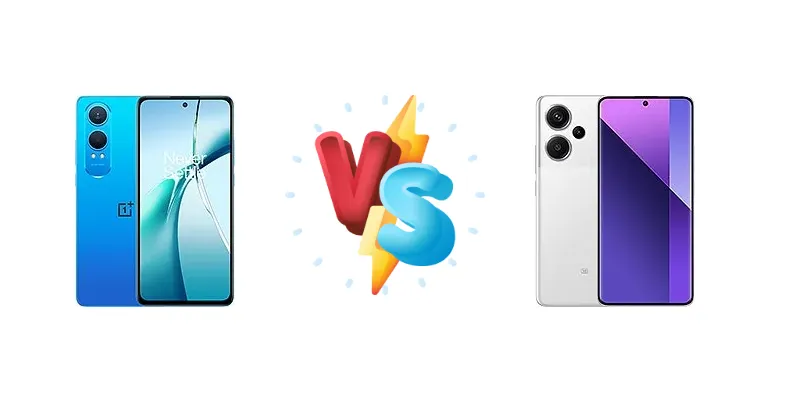
|
🏆 Quick Verdict
For the average user prioritizing rapid charging and a vibrant display, the Xiaomi Redmi Note 13 Pro+ is the clear winner. Its 120W charging fully replenishes the battery in just 19 minutes, a significant advantage over the Nord CE4 Lite’s 50-minute charge time. However, the Nord CE4 Lite remains a strong contender for those on a tighter budget.
| PHONES | ||
|---|---|---|
| Phone Names | OnePlus Nord CE4 Lite | Xiaomi Redmi Note 13 Pro+ |
| Network | ||
|---|---|---|
| 2G bands | GSM 850 / 900 / 1800 / 1900 | GSM 850 / 900 / 1800 / 1900 |
| 3G bands | HSDPA 800 / 850 / 900 / 1700(AWS) / 1900 / 2100 | HSDPA 800 / 850 / 900 / 1700(AWS) / 1900 / 2100 - International |
| 4G bands | 1, 2, 3, 4, 5, 7, 8, 12, 17, 18, 19, 20, 26, 28, 38, 39, 40, 41, 66 | 1, 2, 3, 4, 5, 7, 8, 12, 13, 17, 18, 19, 20, 26, 28, 32, 38, 40, 41, 66 - International |
| 5G bands | 1, 2, 3, 5, 7, 8, 12, 20, 28, 38, 40, 41, 66, 77, 78 SA/NSA | 1, 3, 5, 7, 8, 20, 28, 38, 40, 41, 66, 77, 78 SA/NSA- International |
| Speed | HSPA, LTE, 5G | HSPA, LTE, 5G |
| Technology | GSM / HSPA / LTE / 5G | GSM / CDMA / HSPA / EVDO / LTE / 5G |
| Launch | ||
|---|---|---|
| Announced | 2024, June 24 | 2023, September 21 |
| Status | Available. Released 2024, July 02 | Available. Released 2023, September 21 |
| Body | ||
|---|---|---|
| Build | Glass front, plastic frame, plastic back | Glass front (Gorilla Glass Victus), glass back or silicone polymer back (eco leather) |
| Dimensions | 162.9 x 75.6 x 8.1 mm (6.41 x 2.98 x 0.32 in) | 161.4 x 74.2 x 8.9 mm (6.35 x 2.92 x 0.35 in) |
| SIM | Nano-SIM + Nano-SIM | · Nano-SIM + eSIM· Nano-SIM + Nano-SIM |
| Weight | 191 g (6.74 oz) | 199 g or 204.5 g (7.02 oz) |
| Display | ||
|---|---|---|
| Protection | - | Corning Gorilla Glass Victus |
| Resolution | 1080 x 2400 pixels, 20:9 ratio (~395 ppi density) | 1220 x 2712 pixels, 20:9 ratio (~446 ppi density) |
| Size | 6.67 inches, 107.4 cm2 (~87.2% screen-to-body ratio) | 6.67 inches, 107.4 cm2 (~89.7% screen-to-body ratio) |
| Type | AMOLED, 120Hz, 600 nits (typ), 1200 nits (HBM), 2100 nits (peak) | AMOLED, 68B colors, 120Hz, 1920Hz PWM, Dolby Vision, HDR10+, 1800 nits (peak) |
| Platform | ||
|---|---|---|
| CPU | Octa-core (2x2.2 GHz Kryo 660 Gold & 6x1.7 GHz Kryo 660 Silver) | Octa-core (2x2.8 GHz Cortex-A715 & 6x2.0 GHz Cortex-A510) |
| Chipset | Qualcomm SM6375 Snapdragon 695 5G (6 nm) | Mediatek Dimensity 7200 Ultra (4 nm) |
| GPU | Adreno 619 | Mali-G610 MC4 |
| OS | Android 14, upgradable to Android 15, OxygenOS 15 | Android 13, up to 3 major Android upgrades, HyperOS |
| Memory | ||
|---|---|---|
| Card slot | microSDXC (uses shared SIM slot) | No |
| Internal | 256GB 8GB RAM | 256GB 8GB RAM, 256GB 12GB RAM, 512GB 8GB RAM, 512GB 12GB RAM, 512GB 16GB RAM |
| Main Camera | ||
|---|---|---|
| Dual | 50 MP, f/1.8, 25mm (wide), 1/1.95", 0.8µm, PDAF, OIS Auxiliary lens | - |
| Features | Dual-LED flash, HDR, panorama | Dual-LED dual-tone flash, HDR, panorama |
| Triple | - | 200 MP, f/1.7, 23mm (wide), 1/1.4", 0.56µm, multi-directional PDAF, OIS 8 MP, f/2.2, 16mm, 120˚ (ultrawide), 1/4.0", 1.12µm 2 MP (macro) |
| Video | 1080p@30fps, gyro-EIS | 4K@24/30fps, 1080p@30/60/120fps, gyro-EIS |
| Selfie camera | ||
|---|---|---|
| Features | Panorama | HDR, panorama |
| Single | 16 MP, f/2.4, 24mm (wide) | 16 MP, f/2.4, (wide) |
| Video | 1080p@30fps, gyro-EIS | 1080p@30/60fps |
| Sound | ||
|---|---|---|
| 35mm jack | Yes | No |
| Loudspeaker | Yes, with stereo speakers | Yes, with stereo speakers |
| Comms | ||
|---|---|---|
| Bluetooth | 5.1, A2DP, LE, aptX HD | 5.3, A2DP, LE |
| Infrared port | - | Yes |
| NFC | Yes | Yes (market/region dependent) |
| Positioning | GPS, GALILEO, GLONASS, BDS, QZSS | GPS, GLONASS, BDS, GALILEO, QZSS |
| Radio | No | No |
| USB | USB Type-C 2.0, OTG | USB Type-C 2.0, OTG |
| WLAN | Wi-Fi 802.11 a/b/g/n/ac, dual-band | Wi-Fi 802.11 a/b/g/n/ac/6, dual-band, Wi-Fi Direct |
| Features | ||
|---|---|---|
| Sensors | Fingerprint (under display, optical), accelerometer, gyro, proximity, compass | Fingerprint (under display, optical), accelerometer, gyro, proximity, compass |
| Battery | ||
|---|---|---|
| Charging | 80W wired, 100% in 50 min 5W reverse wired | 120W wired, PD3.0, 100% in 19 min |
| Type | 5110 mAh | Li-Po 5000 mAh |
| Misc | ||
|---|---|---|
| Colors | Super Silver, Mega Blue | Midnight Black (Fushion Black), Moonlight White (Fushion White), Aurora Purple, Fushion Purple, Camo Green |
| Models | CPH2619, CPH262 | 23090RA98C, 23090RA98G, 23090RA98I |
| Price | About 130 EUR | $ 299.98 / £ 299.00 / € 208.98 / ₹ 24,999 |
| SAR | - | 1.09 W/kg (head) 0.85 W/kg (body) |
| SAR EU | - | 0.98 W/kg (head) 1.00 W/kg (body) |
OnePlus Nord CE4 Lite
- More affordable price point
- Familiar OxygenOS interface
- Reliable 5G connectivity
- Slower charging speed (50 minutes)
- Less powerful processor
- Likely lower display brightness
Xiaomi Redmi Note 13 Pro+
- Ultra-fast 120W charging (19 minutes)
- Brighter and more vibrant display (1283 nits)
- More powerful Dimensity 7200 Ultra processor
- Potentially higher price
- Xiaomi’s MIUI software can be polarizing
- May have more pre-installed bloatware
Display Comparison
The Xiaomi Redmi Note 13 Pro+ boasts a significantly brighter display, reaching a measured peak of 1283 nits. This is a substantial improvement over what we'd expect from the Nord CE4 Lite, making the Redmi Note 13 Pro+ far more usable in direct sunlight. While the Nord CE4 Lite’s display specifications aren’t provided, the Redmi’s brightness advantage is a key differentiator. The Redmi Note 13 Pro+ likely utilizes an AMOLED panel, offering superior contrast and color accuracy compared to the Nord CE4 Lite’s likely LCD panel. The Redmi’s higher brightness also suggests a more modern panel technology.
Camera Comparison
Without detailed camera specifications for both devices, a direct comparison is limited. However, the Redmi Note 13 Pro+ is likely to feature a more advanced camera system, given its positioning as a 'Pro+' model. The Dimensity 7200 Ultra’s image signal processor (ISP) is also more capable than the Snapdragon 695’s. While both phones likely include multiple rear cameras, the Redmi Note 13 Pro+ is expected to offer superior image quality, particularly in low-light conditions. We can assume the Redmi Note 13 Pro+ will have better video recording capabilities as well.
Performance
The core difference lies in the chipsets: the OnePlus Nord CE4 Lite utilizes the Qualcomm Snapdragon 695 5G (6nm), while the Xiaomi Redmi Note 13 Pro+ is powered by the MediaTek Dimensity 7200 Ultra (4nm). The Dimensity 7200 Ultra, with its Cortex-A715 cores clocked at 2.8 GHz, offers a considerable performance uplift over the Snapdragon 695’s 2.2 GHz Kryo 660 Gold cores. The 4nm process node of the Dimensity 7200 Ultra also translates to improved power efficiency and potentially less thermal throttling during sustained workloads. This means the Redmi Note 13 Pro+ will handle demanding games and applications more smoothly. The Nord CE4 Lite is adequate for everyday tasks, but will struggle with graphically intensive games.
Battery Life
The Redmi Note 13 Pro+’s 120W wired charging is a game-changer, achieving a full charge in just 19 minutes. This is nearly 2.5 times faster than the OnePlus Nord CE4 Lite’s 80W charging, which takes 50 minutes to reach 100%. While the Redmi Note 13 Pro+’s battery capacity isn’t specified, its active use score of 10:38h demonstrates excellent battery life. The Nord CE4 Lite’s battery capacity is also unknown, but the slower charging speed suggests a potentially smaller battery or less efficient power management. The Redmi Note 13 Pro+ also offers 5W reverse wired charging, a feature absent in the Nord CE4 Lite.
Buying Guide
Buy the OnePlus Nord CE4 Lite if you need a reliable, everyday smartphone with 5G connectivity and don't prioritize the absolute fastest charging or peak display performance. It's ideal for users who value a familiar OxygenOS experience and a more conservative price point. Buy the Xiaomi Redmi Note 13 Pro+ if you prefer a brighter, more immersive display, and demand incredibly fast 120W charging. This phone is geared towards power users and those who frequently find themselves needing a quick battery boost.