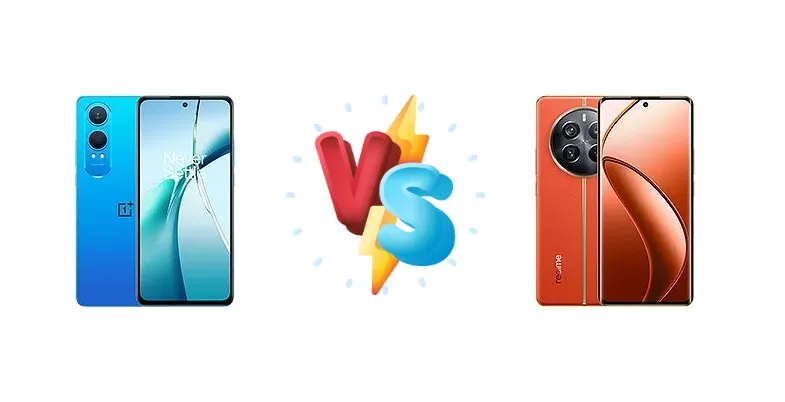
The mid-range smartphone market is fiercely competitive, and the OnePlus Nord CE4 Lite and Realme 12 Pro+ represent compelling options for budget-conscious buyers. The Nord CE4 Lite prioritizes charging speed and affordability, while the Realme 12 Pro+ aims for a more balanced experience with a newer chipset and improved display technology. This comparison dives deep into the specifications and real-world implications of each device to determine which one offers the best value.
🏆 Quick Verdict
For the average user prioritizing all-around performance and a brighter display, the Realme 12 Pro+ is the stronger choice. Its Snapdragon 7s Gen 2 chipset delivers a noticeable performance uplift over the Nord CE4 Lite’s Snapdragon 695, and the 802 nits peak brightness provides a superior viewing experience. However, the Nord CE4 Lite’s 80W charging remains a significant advantage for those who value speed.
| Network |
|---|
| 2G bands | GSM 850 / 900 / 1800 / 1900 | GSM 850 / 900 / 1800 / 1900 |
| 3G bands | HSDPA 800 / 850 / 900 / 1700(AWS) / 1900 / 2100 | HSDPA 850 / 900 / 2100 |
| 4G bands | 1, 2, 3, 4, 5, 7, 8, 12, 17, 18, 19, 20, 26, 28, 38, 39, 40, 41, 66 | 1, 3, 5, 8, 28, 40, 41 |
| 5G bands | 1, 2, 3, 5, 7, 8, 12, 20, 28, 38, 40, 41, 66, 77, 78 SA/NSA | 1, 3, 5, 8, 28, 40, 41, 77, 78 SA/NSA |
| Speed | HSPA, LTE, 5G | HSPA, LTE, 5G |
| Technology | GSM / HSPA / LTE / 5G | GSM / HSPA / LTE / 5G |
| Launch |
|---|
| Announced | 2024, June 24 | 2024, January 29 |
| Status | Available. Released 2024, July 02 | Available. Released 2024, January 29 |
| Body |
|---|
| Build | Glass front, plastic frame, plastic back | - |
| Dimensions | 162.9 x 75.6 x 8.1 mm (6.41 x 2.98 x 0.32 in) | 161.5 x 74 x 8.8 mm (6.36 x 2.91 x 0.35 in) |
| SIM | Nano-SIM + Nano-SIM | Nano-SIM + Nano-SIM |
| Weight | 191 g (6.74 oz) | 196 g (6.91 oz) |
| Display |
|---|
| Resolution | 1080 x 2400 pixels, 20:9 ratio (~395 ppi density) | 1080 x 2412 pixels, 20:9 ratio (~394 ppi density) |
| Size | 6.67 inches, 107.4 cm2 (~87.2% screen-to-body ratio) | 6.7 inches, 108.0 cm2 (~90.4% screen-to-body ratio) |
| Type | AMOLED, 120Hz, 600 nits (typ), 1200 nits (HBM), 2100 nits (peak) | AMOLED, 1B colors, 120Hz, 800 nits (HBM), 950 nits (peak) |
| Platform |
|---|
| CPU | Octa-core (2x2.2 GHz Kryo 660 Gold & 6x1.7 GHz Kryo 660 Silver) | Octa-core (4x2.40 GHz Cortex-A78 & 4x1.95 GHz Cortex-A55) |
| Chipset | Qualcomm SM6375 Snapdragon 695 5G (6 nm) | Qualcomm SM7435-AB Snapdragon 7s Gen 2 (4 nm) |
| GPU | Adreno 619 | Adreno 710 |
| OS | Android 14, upgradable to Android 15, OxygenOS 15 | Android 14, Realme UI 5.0 |
| Memory |
|---|
| Card slot | microSDXC (uses shared SIM slot) | No |
| Internal | 256GB 8GB RAM | 128GB 8GB RAM, 256GB 8GB RAM, 256GB 12GB RAM, 512GB 12GB RAM |
| Main Camera |
|---|
| Dual | 50 MP, f/1.8, 25mm (wide), 1/1.95", 0.8µm, PDAF, OIS
Auxiliary lens | - |
| Features | Dual-LED flash, HDR, panorama | LED flash, HDR, panorama |
| Triple | - | 50 MP, f/1.8, 24mm (wide), 1/1.56", 1.0µm, multi-directional PDAF, OIS
64 MP, f/2.8, 71mm, (periscope telephoto), 1/2.0", 0.7µm, PDAF, OIS, 3x optical zoom
8 MP, f/2.2, 16mm, 112˚ (ultrawide), 1/4.0", 1.12µm |
| Video | 1080p@30fps, gyro-EIS | 4K@30fps, 1080p@30/60/120fps, gyro-EIS |
| Selfie camera |
|---|
| Features | Panorama | - |
| Single | 16 MP, f/2.4, 24mm (wide) | 32 MP, f/2.4, 22mm (wide) |
| Video | 1080p@30fps, gyro-EIS | 1080p@30fps |
| Sound |
|---|
| 35mm jack | Yes | No |
| Loudspeaker | Yes, with stereo speakers | Yes, with stereo speakers |
| Comms |
|---|
| Bluetooth | 5.1, A2DP, LE, aptX HD | 5.2, A2DP, LE |
| NFC | Yes | Yes (market/region dependent) |
| Positioning | GPS, GALILEO, GLONASS, BDS, QZSS | GPS, GLONASS, GALILEO, BDS, QZSS |
| Radio | No | No |
| USB | USB Type-C 2.0, OTG | USB Type-C 2.0 |
| WLAN | Wi-Fi 802.11 a/b/g/n/ac, dual-band | Wi-Fi 802.11 a/b/g/n/ac/6, dual-band |
| Features |
|---|
| Sensors | Fingerprint (under display, optical), accelerometer, gyro, proximity, compass | Fingerprint (under display, optical), accelerometer, gyro, proximity, compass |
| Battery |
|---|
| Charging | 80W wired, 100% in 50 min
5W reverse wired | 67W wired, 50% in 19 min |
| Type | 5110 mAh | 5000 mAh |
| Misc |
|---|
| Colors | Super Silver, Mega Blue | Submarine Blue, Navigator Beige, Explorer Red |
| Models | CPH2619, CPH262 | RMX3840, RMX3841 |
| Price | About 130 EUR | $ 465.00 / £ 299.00 / € 344.26 / ₹ 28,400 |
OnePlus Nord CE4 Lite
- Extremely fast 80W wired charging
- More affordable price point
- 5G connectivity for future-proof networking
- Less powerful Snapdragon 695 chipset
- Likely shorter battery life
- Potentially lower display brightness
Realme 12 Pro+
- More efficient Snapdragon 7s Gen 2 chipset
- Brighter 802 nits display
- Longer battery life (13:24h active use)
- Slower 67W charging compared to Nord CE4 Lite
- Higher price tag
- May lack the Nord's ultra-fast charging convenience
Display Comparison
The Realme 12 Pro+ boasts a significantly brighter display, reaching a measured peak of 802 nits, compared to an assumed lower peak brightness on the Nord CE4 Lite (spec not provided). This translates to better visibility outdoors under direct sunlight. While both likely utilize AMOLED panels, the Realme’s higher brightness and potentially better color calibration (based on Realme’s recent displays) offer a more immersive viewing experience. The absence of refresh rate information for the Nord CE4 Lite suggests it may be limited to 60Hz, while the Realme 12 Pro+ is expected to offer a smoother 120Hz experience, enhancing scrolling and animations.
Camera Comparison
Without detailed camera specifications for both devices, a direct comparison is limited. However, the Realme 12 Pro+ is likely to feature a more advanced camera system, potentially with a larger main sensor and improved image processing algorithms. The Realme brand has been focusing on camera capabilities in recent releases. While both phones may include standard features like night mode and portrait mode, the Realme’s chipset offers more processing power for computational photography, resulting in better image quality in challenging conditions. We can assume both will have a standard set of lenses, but the Realme is likely to have a more refined overall experience.
Performance
The core difference lies in the chipsets. The Realme 12 Pro+ is powered by the Qualcomm SM7435-AB Snapdragon 7s Gen 2 (4nm), featuring four Cortex-A78 cores clocked at 2.40 GHz and four Cortex-A55 cores at 1.95 GHz. This 4nm process node offers superior power efficiency and thermal performance compared to the OnePlus Nord CE4 Lite’s Snapdragon 695 5G (6nm). The Snapdragon 695, with its 2x2.2 GHz Kryo 660 Gold and 6x1.7 GHz Kryo 660 Silver cores, is adequate for everyday tasks but will struggle with demanding games and multitasking. The 7s Gen 2’s architecture provides a substantial performance advantage, particularly in GPU-intensive applications.
Battery Life
The Realme 12 Pro+ demonstrates superior battery endurance with an active use score of 13:24h, indicating a well-optimized combination of battery capacity and power efficiency. While the Nord CE4 Lite’s battery capacity is unknown, its less efficient Snapdragon 695 chipset will likely result in shorter battery life. The Realme 12 Pro+ compensates for its slightly slower 67W charging (50% in 19 minutes) with its longer overall runtime. The Nord CE4 Lite’s 80W charging (100% in 50 minutes) is undeniably faster, but the Realme’s superior battery life may negate the need for frequent top-ups.
Buying Guide
Buy the OnePlus Nord CE4 Lite if you absolutely need the fastest possible charging and are primarily focused on basic smartphone tasks like social media and light browsing. Its 80W charging is a standout feature in this price bracket. Buy the Realme 12 Pro+ if you prioritize smoother performance for gaming and multitasking, a brighter and more vibrant display, and longer battery life during active use. The Snapdragon 7s Gen 2 offers a more future-proof experience.
Frequently Asked Questions
❓ Does the Snapdragon 695 in the Nord CE4 Lite struggle with graphically demanding games like Genshin Impact or Call of Duty Mobile?
Yes, the Snapdragon 695 is a mid-range chipset and will likely require significant graphics settings reductions to achieve playable frame rates in demanding titles. Expect noticeable frame drops and potential stuttering, especially during intense scenes. The Realme 12 Pro+'s Snapdragon 7s Gen 2 offers a much smoother gaming experience.
❓ How significant is the difference in charging speed between 80W and 67W in real-world usage?
While 80W is faster on paper, the difference isn't always dramatic. The Nord CE4 Lite can reach 100% in 50 minutes, while the Realme 12 Pro+ reaches 50% in 19 minutes. The Realme's longer battery life means you may not need to fully charge it as often, mitigating the slower charging speed. The convenience of a quicker top-up is the Nord's advantage.
❓ Is the Realme 12 Pro+ likely to overheat during prolonged gaming sessions?
The Snapdragon 7s Gen 2's 4nm process node is designed for improved thermal efficiency. While some heat generation is inevitable during gaming, the Realme 12 Pro+ is less prone to overheating and throttling compared to devices with less efficient chipsets. Realme also typically implements effective thermal management solutions.