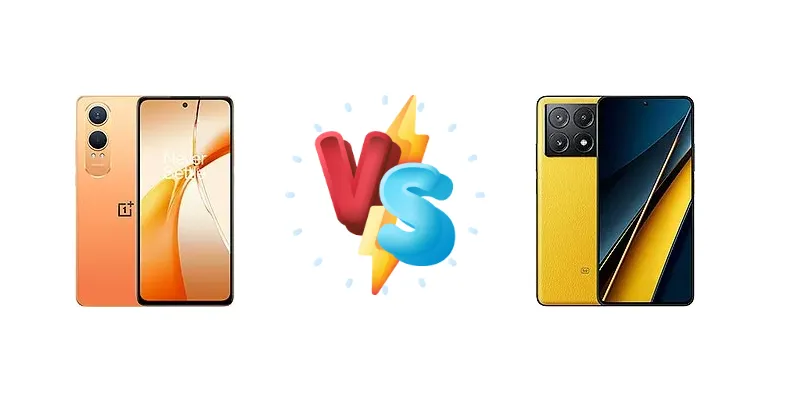
The mid-range smartphone market in India is fiercely competitive, and the OnePlus Nord CE4 Lite and Xiaomi Poco X6 Pro represent compelling options. The Nord CE4 Lite aims for efficient all-day use with a focus on fast charging, while the Poco X6 Pro aggressively targets performance with a flagship-adjacent chipset. This comparison dissects their strengths and weaknesses to determine which device best suits your needs.
🏆 Quick Verdict
For most users, the Xiaomi Poco X6 Pro is the superior choice. Its Mediatek Dimensity 8300 Ultra chipset provides a substantial performance leap over the Snapdragon 695 in the Nord CE4 Lite, making it ideal for gaming and demanding applications. While the Nord CE4 Lite offers faster charging, the Poco’s overall capabilities justify the slight difference in charging time.
| Network |
|---|
| 2G bands | GSM 850 / 900 / 1800 / 1900 | GSM 850 / 900 / 1800 / 1900 |
| 3G bands | HSDPA 850 / 900 / 1900 / 2100 | HSDPA 850 / 900 / 1700(AWS) / 1900 / 2100 |
| 4G bands | 1, 3, 4, 5, 8, 28, 40, 41 | 1, 2, 3, 4, 5, 7, 8, 18, 19, 20, 28, 38, 40, 41, 48, 66 |
| 5G bands | 1, 3, 5, 8, 28, 40, 41, 77, 78 SA/NSA | 1, 2, 3, 5, 7, 8, 20, 28, 38, 40, 41, 48, 77, 78 SA/NSA/Sub6 |
| Speed | HSPA, LTE, 5G | HSPA, LTE, 5G |
| Technology | GSM / HSPA / LTE / 5G | GSM / HSPA / LTE / 5G |
| Launch |
|---|
| Announced | 2024, June 24 | 2024, January 11 |
| Status | Available. Released 2024, June 28 | Available. Released 2024, January 12 |
| Body |
|---|
| Build | Glass front, plastic frame, plastic back | Glass front (Gorilla Glass 5), plastic frame, plastic back or silicone polymer back (eco leather) |
| Dimensions | 162.9 x 75.6 x 8.1 mm (6.41 x 2.98 x 0.32 in) | 160.5 x 74.3 x 8.3 mm (6.32 x 2.93 x 0.33 in) |
| SIM | Nano-SIM + Nano-SIM | Nano-SIM + Nano-SIM |
| Weight | 191 g (6.74 oz) | 186 g or 190 g (6.56 oz) |
| Display |
|---|
| Protection | - | Corning Gorilla Glass 5 |
| Resolution | 1080 x 2400 pixels, 20:9 ratio (~395 ppi density) | 1220 x 2712 pixels, 20:9 ratio (~446 ppi density) |
| Size | 6.67 inches, 107.4 cm2 (~87.2% screen-to-body ratio) | 6.67 inches, 107.4 cm2 (~90.1% screen-to-body ratio) |
| Type | AMOLED, 120Hz, 600 nits (typ), 1200 nits (HBM), 2100 nits (peak) | AMOLED, 68B colors, 120Hz, 1920Hz PWM, HDR10+, Dolby Vision, 500 nits (typ), 1200 nits (HBM), 1800 nits (peak) |
| Platform |
|---|
| CPU | Octa-core (2x2.2 GHz Kryo 660 Gold & 6x1.7 GHz Kryo 660 Silver) | Octa-core (1x3.35 GHz Cortex-A715 & 3x3.20 GHz Cortex-A715 & 4x2.20 GHz Cortex-A510) |
| Chipset | Qualcomm SM6375 Snapdragon 695 5G (6 nm) | Mediatek Dimensity 8300 Ultra (4 nm) |
| GPU | Adreno 619 | Mali G615-MC6 |
| OS | Android 14, OxygenOS 14 | Android 14, up to 3 major Android upgrades, HyperOS |
| Memory |
|---|
| Card slot | microSDXC (uses shared SIM slot) | No |
| Internal | 128GB 8GB RAM, 256GB 8GB RAM | 256GB 8GB RAM, 256GB 12GB RAM, 512GB 12GB RAM |
| Main Camera |
|---|
| Dual | 50 MP, f/1.8, 25mm (wide), 1/1.95", 0.8µm, PDAF, OIS
Auxiliary lens | - |
| Features | Dual-LED flash, HDR, panorama | LED flash, HDR, panorama |
| Triple | - | 64 MP, f/1.7, 25mm (wide), 1/2.0", 0.7µm, PDAF, OIS
8 MP, f/2.2, 120˚ (ultrawide), 1/4.0", 1.12µm
2 MP (macro) |
| Video | 1080p@30fps, gyro-EIS | 4K@24/30fps, 1080p@30/60fps, gyro-EIS |
| Selfie camera |
|---|
| Features | Panorama | HDR, panorama |
| Single | 16 MP, f/2.4, 24mm (wide) | 16 MP, f/2.4, (wide), 1/3.06", 1.0µm |
| Video | 1080p@30fps, gyro-EIS | 1080p@30/60fps |
| Sound |
|---|
| 35mm jack | Yes | No |
| Loudspeaker | Yes, with stereo speakers | Yes, with dual speakers |
| Comms |
|---|
| Bluetooth | 5.1, A2DP, LE, aptX HD | 5.4, A2DP, LE, aptX HD |
| Infrared port | - | Yes |
| NFC | No | Yes (market/region dependent) |
| Positioning | GPS, GALILEO, GLONASS, BDS, QZSS | GPS, GALILEO, GLONASS, QZSS, BDS (B1I+B1c) |
| Radio | No | No |
| USB | USB Type-C 2.0, OTG | USB Type-C 2.0, OTG |
| WLAN | Wi-Fi 802.11 a/b/g/n/ac, dual-band | Wi-Fi 802.11 a/b/g/n/ac/6, dual-band, Wi-Fi Direct |
| Features |
|---|
| Sensors | Fingerprint (under display, optical), accelerometer, gyro, proximity, compass | Fingerprint (under display, optical), accelerometer, gyro, compass |
| Battery |
|---|
| Charging | 80W wired, 100% in 52 min
5W reverse wired | 67W wired, QC2.0, PD3.0, 100% in 45 min |
| Type | 5500 mAh | 5000 mAh |
| Misc |
|---|
| Colors | Super Silver, Mega Blue, Ultra Orange | Black, Yellow, Gray |
| Models | CPH2621 | 2311DRK48G, 2311DRK48I |
| Price | About 220 EUR | € 195.30 / $ 209.79 / £ 274.99 / ₹ 21,999 |
| SAR EU | - | 0.99 W/kg (head) 1.00 W/kg (body) |
OnePlus Nord CE4 Lite (India)
- Faster 80W wired charging
- Potentially more efficient Snapdragon 695 chipset
- 5W reverse wired charging
- Significantly weaker processor performance
- Likely lower display brightness and refresh rate
Xiaomi Poco X6 Pro
- Much more powerful Mediatek Dimensity 8300 Ultra
- Brighter display (1148 nits)
- Excellent battery life (11:46h active use)
- Slightly slower 67W charging
- Potentially higher price
Display Comparison
The Poco X6 Pro boasts a significantly brighter display, reaching a measured peak of 1148 nits, compared to an unstated value for the Nord CE4 Lite. This higher brightness translates to better visibility outdoors under direct sunlight. While both likely utilize AMOLED panels (based on market segment), the Poco’s brightness advantage is a clear win. The absence of refresh rate information for the Nord CE4 Lite suggests it may be limited to 60Hz, while the Poco X6 Pro is expected to offer a 120Hz panel, further enhancing smoothness.
Camera Comparison
Detailed camera specifications are limited for both devices. However, the Poco X6 Pro is expected to feature a more capable primary sensor, likely with a larger sensor size and wider aperture, enabling better low-light performance. While both phones likely include standard features like HDR and portrait modes, the Poco’s superior image signal processor (ISP) within the Dimensity 8300 Ultra will likely result in more detailed and dynamic images. The Nord CE4 Lite’s camera system is likely geared towards casual photography, while the Poco X6 Pro aims for a more versatile and higher-quality experience.
Performance
The performance gap between these two devices is substantial. The Poco X6 Pro’s Mediatek Dimensity 8300 Ultra (4nm) is in a different league than the Nord CE4 Lite’s Qualcomm Snapdragon 695 5G (6nm). The Dimensity 8300 Ultra features a tri-cluster configuration with Cortex-A715 cores clocked up to 3.35 GHz, offering significantly faster CPU and GPU performance. The Snapdragon 695, while adequate for basic tasks, will struggle with demanding games and applications. The 4nm process node of the Dimensity 8300 Ultra also contributes to better thermal efficiency, potentially reducing throttling during sustained workloads. The Poco X6 Pro is the clear winner for power users.
Battery Life
The Poco X6 Pro achieves a full charge in 45 minutes with 67W wired charging, while the Nord CE4 Lite reaches 100% in 52 minutes with 80W. Despite the Nord’s higher wattage, the Poco’s charging speed is comparable, and its active use score of 11:46h suggests excellent battery life. The difference in charging time is minimal, and the Poco’s overall performance advantage outweighs this slight disadvantage. The Nord CE4 Lite’s 5W reverse wired charging is a useful addition for topping up accessories, but the Poco’s larger battery capacity and efficient chipset contribute to longer real-world usage.
Buying Guide
Buy the OnePlus Nord CE4 Lite (India) if you prioritize efficient power consumption for extended daily use and value the fastest possible charging speeds. It’s a solid choice for users who primarily browse, use social media, and make calls. Buy the Xiaomi Poco X6 Pro if you demand significantly higher performance for gaming, video editing, or multitasking, and are willing to trade a small amount of charging speed for a much more powerful processor and brighter display.
Frequently Asked Questions
❓ Does the Mediatek Dimensity 8300 Ultra in the Poco X6 Pro get hot during extended gaming sessions?
The Dimensity 8300 Ultra is built on a 4nm process, which inherently offers better thermal efficiency than the 6nm Snapdragon 695. While some heat generation is inevitable during prolonged gaming, the Poco X6 Pro is expected to manage temperatures effectively, minimizing throttling and maintaining consistent performance. The phone likely incorporates vapor chamber cooling to further aid thermal management.
❓ Is the 80W charging on the Nord CE4 Lite significantly faster in real-world use compared to the Poco X6 Pro's 67W?
While the Nord CE4 Lite boasts higher wattage, the difference in charging time is minimal – 52 minutes versus 45 minutes for a full charge. The Poco X6 Pro’s optimized charging algorithms and potentially larger battery capacity contribute to a comparable charging experience. The performance benefits of the Poco X6 Pro outweigh the slight charging speed difference.
❓ What kind of gaming performance can I expect from the Snapdragon 695 in the OnePlus Nord CE4 Lite?
The Snapdragon 695 is capable of handling less demanding mobile games at medium settings. However, it will likely struggle with graphically intensive titles like Genshin Impact or Call of Duty: Mobile, even at lower settings. Expect frame drops and potential lag during extended gaming sessions.
❓ Does the Poco X6 Pro support high refresh rate gaming?
While not explicitly stated in the provided data, the Poco X6 Pro is expected to feature a 120Hz display. This, combined with the powerful Dimensity 8300 Ultra, should enable smooth and responsive gaming experiences at high frame rates in supported titles. Check game settings to enable higher refresh rate options.