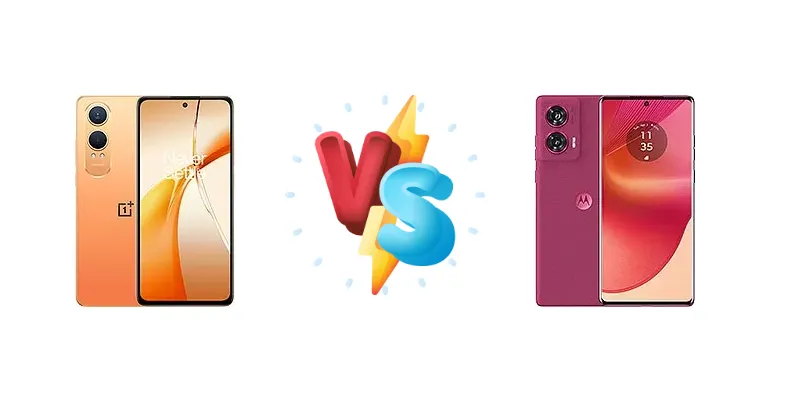
The mid-range smartphone market is fiercely competitive, and the OnePlus Nord CE4 Lite (India) and Motorola Edge 50 Fusion represent compelling options. The Nord CE4 Lite focuses on rapid charging and affordability, while the Edge 50 Fusion aims for a more balanced experience with a brighter display and a more powerful chipset – at least in international markets. This comparison dissects their key differences to help you choose.
🏆 Quick Verdict
For most users, the Motorola Edge 50 Fusion (International version) emerges as the stronger contender. Its Snapdragon 7s Gen 2 chipset delivers significantly better performance than the Nord CE4 Lite’s Snapdragon 695, and the brighter 1322 nit display enhances usability. While the Nord CE4 Lite’s 80W charging is faster, the Fusion’s overall package offers a more refined experience.
| Network |
|---|
| 2G bands | GSM 850 / 900 / 1800 / 1900 | GSM 850 / 900 / 1800 / 1900 |
| 3G bands | HSDPA 850 / 900 / 1900 / 2100 | HSDPA 850 / 900 / 1900 / 2100 |
| 4G bands | 1, 3, 4, 5, 8, 28, 40, 41 | 1, 2, 3, 5, 7, 8, 18, 19, 20, 26, 28, 32, 38, 40, 41, 42, 71 - International |
| 5G bands | 1, 3, 5, 8, 28, 40, 41, 77, 78 SA/NSA | 1, 3, 5, 7, 8, 20, 26, 28, 38, 40, 41, 77, 78 SA/NSA |
| Speed | HSPA, LTE, 5G | HSPA, LTE, 5G |
| Technology | GSM / HSPA / LTE / 5G | GSM / HSPA / LTE / 5G |
| Launch |
|---|
| Announced | 2024, June 24 | 2024, April 16 |
| Status | Available. Released 2024, June 28 | Available. Released 2024, May 15 |
| Body |
|---|
| Build | Glass front, plastic frame, plastic back | Glass front, silicone polymer back (eco leather), plastic frame |
| Dimensions | 162.9 x 75.6 x 8.1 mm (6.41 x 2.98 x 0.32 in) | 161.9 x 73.1 x 7.9 mm (6.37 x 2.88 x 0.31 in) |
| SIM | Nano-SIM + Nano-SIM | · Nano-SIM + eSIM· Nano-SIM + Nano-SIM |
| Weight | 191 g (6.74 oz) | 174.9 g (6.17 oz) |
| Display |
|---|
| Protection | - | Corning Gorilla Glass 5 |
| Resolution | 1080 x 2400 pixels, 20:9 ratio (~395 ppi density) | 1080 x 2400 pixels, 20:9 ratio (~393 ppi density) |
| Size | 6.67 inches, 107.4 cm2 (~87.2% screen-to-body ratio) | 6.7 inches, 108.4 cm2 (~91.6% screen-to-body ratio) |
| Type | AMOLED, 120Hz, 600 nits (typ), 1200 nits (HBM), 2100 nits (peak) | P-OLED, 1B colors, 120Hz (LATAM), 144Hz (INT), 1600 nits (peak) |
| Platform |
|---|
| CPU | Octa-core (2x2.2 GHz Kryo 660 Gold & 6x1.7 GHz Kryo 660 Silver) | Octa-core (4x2.40 GHz Cortex-A78 & 4x1.95 GHz Cortex-A55) - InternationalOcta-core (4x2.2 GHz Cortex-A78 & 4x1.8 GHz Cortex-A55) - LATAM |
| Chipset | Qualcomm SM6375 Snapdragon 695 5G (6 nm) | Qualcomm SM7435-AB Snapdragon 7s Gen 2 (4 nm) - InternationalQualcomm SM6450 Snapdragon 6 Gen 1 (4 nm) - LATAM |
| GPU | Adreno 619 | Adreno 710 |
| OS | Android 14, OxygenOS 14 | Android 14, upgradable to Android 15, up to 3 major Android upgrades |
| Memory |
|---|
| Card slot | microSDXC (uses shared SIM slot) | No |
| Internal | 128GB 8GB RAM, 256GB 8GB RAM | 128GB 8GB RAM, 256GB 8GB RAM, 256GB 12GB RAM, 512GB 8GB RAM, 512GB 12GB RAM |
| Main Camera |
|---|
| Dual | 50 MP, f/1.8, 25mm (wide), 1/1.95", 0.8µm, PDAF, OIS
Auxiliary lens | 50 MP, f/1.9, (wide), 1/1.56", 1.0µm, multi-directional PDAF, OIS
13 MP, f/2.2, 120˚ (ultrawide), 1/3.0", 1.12µm, AF |
| Features | Dual-LED flash, HDR, panorama | LED flash, HDR, panorama |
| Video | 1080p@30fps, gyro-EIS | 4K@30fps, 1080p@30/60/120fps, gyro-EIS |
| Selfie camera |
|---|
| Features | Panorama | HDR |
| Single | 16 MP, f/2.4, 24mm (wide) | 32 MP, f/2.5, (wide), 1/3.14", 0.7µm |
| Video | 1080p@30fps, gyro-EIS | 4K@30fps, 1080p@30fps |
| Sound |
|---|
| 35mm jack | Yes | No |
| Loudspeaker | Yes, with stereo speakers | Yes, with stereo speakers |
| Comms |
|---|
| Bluetooth | 5.1, A2DP, LE, aptX HD | 5.2, A2DP, LE |
| NFC | No | Yes |
| Positioning | GPS, GALILEO, GLONASS, BDS, QZSS | GPS, GLONASS, GALILEO |
| Radio | No | No |
| USB | USB Type-C 2.0, OTG | USB Type-C 2.0, OTG |
| WLAN | Wi-Fi 802.11 a/b/g/n/ac, dual-band | Wi-Fi 802.11 a/b/g/n/ac, dual-band |
| Features |
|---|
| Sensors | Fingerprint (under display, optical), accelerometer, gyro, proximity, compass | Fingerprint (under display, optical), accelerometer, gyro, proximity, compass |
| Battery |
|---|
| Charging | 80W wired, 100% in 52 min
5W reverse wired | 68W wired, 50% in 15 min |
| Type | 5500 mAh | 5000 mAh |
| Misc |
|---|
| Colors | Super Silver, Mega Blue, Ultra Orange | Forest Blue, Marshmallow Blue, Hot Pink |
| Models | CPH2621 | XT2429-1 |
| Price | About 220 EUR | € 208.99 / $ 245.00 / ₹ 18,667 |
OnePlus Nord CE4 Lite (India)
- 80W SuperVOOC charging is exceptionally fast.
- Potentially more affordable price point.
- 5W reverse wired charging for accessories.
- Snapdragon 695 5G is less powerful than the 7s Gen 2.
- Display brightness is likely lower than the Edge 50 Fusion.
- Limited information on camera capabilities.
Motorola Edge 50 Fusion
- Snapdragon 7s Gen 2 (International) offers significantly better performance.
- 1322 nits peak brightness provides excellent outdoor visibility.
- Strong battery life with 12:40h active use.
- 68W charging is slower than the Nord CE4 Lite’s 80W.
- LATAM version uses the less powerful Snapdragon 6 Gen 1.
- Reverse charging is not specified.
Display Comparison
The Motorola Edge 50 Fusion boasts a significantly brighter display, reaching a measured 1322 nits, compared to an unspecified brightness for the Nord CE4 Lite. This higher peak brightness translates to superior outdoor visibility. While both likely utilize AMOLED panels, the Fusion’s brightness advantage is a clear win. The Nord CE4 Lite’s display specifications are currently limited, making a detailed comparison of color accuracy and refresh rate impossible, but the Fusion’s brightness alone sets a high bar.
Camera Comparison
Detailed camera specifications are lacking for both devices. However, focusing on the chipsets, the Edge 50 Fusion’s Snapdragon 7s Gen 2 includes a more advanced ISP (Image Signal Processor) capable of superior image processing. This translates to better dynamic range, noise reduction, and overall image quality, particularly in challenging lighting conditions. Without knowing sensor sizes or lens apertures, it’s difficult to make a definitive statement, but the chipset advantage leans heavily in favor of the Motorola.
Performance
The core difference lies in the chipsets. The Motorola Edge 50 Fusion, in its international configuration, features the Qualcomm Snapdragon 7s Gen 2 (4nm), a substantial upgrade over the OnePlus Nord CE4 Lite’s Snapdragon 695 5G (6nm). The 7s Gen 2 utilizes Cortex-A78 cores clocked at 2.40 GHz, offering a noticeable performance boost in CPU-intensive tasks and gaming compared to the 695’s 2.2 GHz Kryo 660 Gold cores. However, it's crucial to note the LATAM version of the Edge 50 Fusion uses the Snapdragon 6 Gen 1, narrowing the performance gap. The 4nm process of the 7s Gen 2 also contributes to better thermal efficiency, reducing the likelihood of throttling during extended use.
Battery Life
The Motorola Edge 50 Fusion demonstrates strong battery life, achieving 12:40 hours of active use. While the Nord CE4 Lite’s battery capacity is unknown, its 80W wired charging is significantly faster than the Fusion’s 68W charging, promising a full charge in just 52 minutes. The Fusion reaches 50% charge in 15 minutes. This faster charging is a key advantage for the Nord CE4 Lite, potentially offsetting a smaller battery capacity, but the Fusion’s overall endurance is commendable.
Buying Guide
Buy the OnePlus Nord CE4 Lite (India) if your priority is the absolute fastest charging speeds and you primarily engage in light smartphone tasks like social media and calls. Buy the Motorola Edge 50 Fusion if you prioritize smoother performance for gaming and multitasking, a brighter and more vibrant display, and a more future-proof chipset, especially if you are purchasing the international version with the Snapdragon 7s Gen 2.
Frequently Asked Questions
❓ Does the Snapdragon 695 in the Nord CE4 Lite struggle with demanding games like Genshin Impact?
Yes, the Snapdragon 695 is a mid-range chipset and will likely require significant graphics settings reductions to achieve playable frame rates in demanding titles like Genshin Impact. Expect noticeable frame drops and potential stuttering, especially during intense scenes. The Edge 50 Fusion with the Snapdragon 7s Gen 2 will provide a much smoother gaming experience.
❓ Is the difference between the Snapdragon 7s Gen 2 and Snapdragon 6 Gen 1 versions of the Edge 50 Fusion significant?
Absolutely. The Snapdragon 7s Gen 2 is a considerably more powerful chipset than the Snapdragon 6 Gen 1. The 7s Gen 2 features faster CPU cores (Cortex-A78 vs A78) and a more capable GPU, resulting in a noticeable improvement in overall performance, especially in gaming and multitasking. If performance is a priority, ensure you are purchasing the international version with the 7s Gen 2.
❓ How does the 80W charging on the Nord CE4 Lite compare to other phones in this price range?
80W charging is exceptionally fast for this price segment. Most competitors offer 33W or 67W charging. The Nord CE4 Lite can fully charge in approximately 52 minutes, significantly reducing downtime compared to slower charging alternatives. However, consider that faster charging can potentially contribute to slightly faster battery degradation over the long term.