
OnePlus Nord 5 vs Xiaomi 13 Lite: A Deep Dive into Performance and Value
| Phones Images | |||||
|---|---|---|---|---|---|
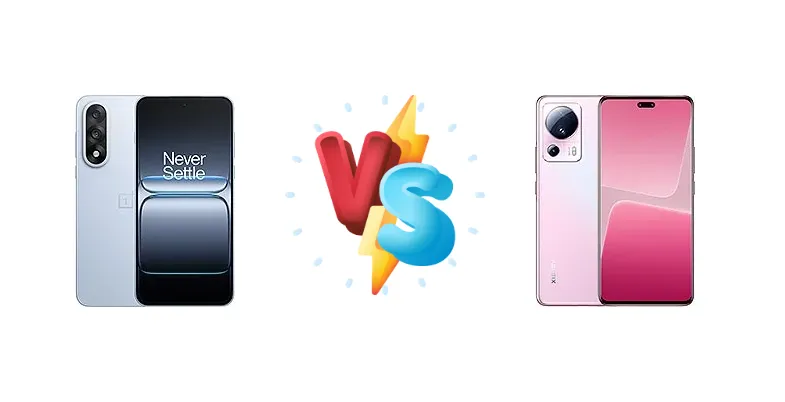
|
🏆 Quick Verdict
For most users, the OnePlus Nord 5 emerges as the stronger contender. Its Snapdragon 8s Gen 3 chipset delivers significantly faster performance, crucial for demanding tasks and future-proofing. While the Xiaomi 13 Lite boasts a respectable endurance rating, the Nord 5’s faster charging and superior processing power make it the better overall value.
| PHONES | ||
|---|---|---|
| Phone Names | OnePlus Nord 5 | Xiaomi 13 Lite |
| Network | ||
|---|---|---|
| 2G bands | GSM 850 / 900 / 1800 / 1900 | GSM 850 / 900 / 1800 / 1900 |
| 3G bands | HSDPA 850 / 900 / 1900 / 2100 | HSDPA 800 / 850 / 900 / 1700(AWS) / 1900 / 2100 |
| 4G bands | 1, 2, 3, 4, 5, 7, 8, 12, 17, 18, 19, 20, 26, 28, 32, 38, 39, 40, 41, 42, 66 - International | 1, 2, 3, 4, 5, 7, 8, 12, 13, 17, 18, 19, 20, 26, 28, 32, 38, 40, 41, 42, 66 |
| 5G bands | 1, 2, 3, 5, 7, 8, 12, 20, 28, 38, 40, 41, 66, 75, 77, 78 SA/NSA - International | 1, 3, 5, 7, 8, 20, 28, 38, 40, 41, 66, 77, 78 SA/NSA |
| Speed | HSPA, LTE, 5G | HSPA, LTE, 5G |
| Technology | GSM / HSPA / LTE / 5G | GSM / HSPA / LTE / 5G |
| Launch | ||
|---|---|---|
| Announced | 2025, July 08 | 2023, February 26 |
| Status | Available. Released 2025, July 08 | Available. Released 2023, March 08 |
| Body | ||
|---|---|---|
| Build | Glass front (Gorilla Glass 7i), glass back, plastic frame | Glass front (Gorilla Glass 5), glass back, plastic frame |
| Dimensions | 163.4 x 77 x 8.1 mm (6.43 x 3.03 x 0.32 in) | 159.2 x 72.7 x 7.2 mm (6.27 x 2.86 x 0.28 in) |
| SIM | Nano-SIM + Nano-SIM | · Nano-SIM + eSIM· Nano-SIM + Nano-SIM |
| Weight | 211 g (7.44 oz) | 171 g (6.03 oz) |
| - | IP53, dust and splash resistant | |
| Display | ||
|---|---|---|
| Protection | Corning Gorilla Glass 7i, Mohs level 6 | Corning Gorilla Glass 5 |
| Resolution | 1272 x 2800 pixels (~450 ppi density) | 1080 x 2400 pixels, 20:9 ratio (~402 ppi density) |
| Size | 6.83 inches, 113.3 cm2 (~90.1% screen-to-body ratio) | 6.55 inches, 103.6 cm2 (~89.5% screen-to-body ratio) |
| Type | Swift AMOLED, 1B colors, 144Hz, 3840Hz PWM, HDR10+, 800 nits (typ), 1400 nits (HBM), 1800 nits (peak) | AMOLED, 68B colors, Dolby Vision, HDR10+, 120Hz, 500 nits (typ), 1000 nits (peak) |
| Platform | ||
|---|---|---|
| CPU | Octa-core (1x3.0 GHz Cortex-X4 & 4x2.8 GHz Cortex-A720 & 3x2.0 GHz Cortex-A520) | Octa-core (1x2.4 GHz Cortex-A710 & 3x2.36 GHz Cortex-A710 & 4x1.8 GHz Cortex-A510) |
| Chipset | Qualcomm SM8635 Snapdragon 8s Gen 3 (4 nm) | Qualcomm SM7450-AB Snapdragon 7 Gen 1 (4 nm) |
| GPU | Adreno 735 | Adreno 644 |
| OS | Android 15, up to 4 major Android upgrades, OxygenOS 15 | Android 12, MIUI 14 |
| Memory | ||
|---|---|---|
| Card slot | No | No |
| Internal | 256GB 8GB RAM, 256GB 12GB RAM, 512GB 12GB RAM | 64GB 8GB RAM, 128GB 8GB RAM, 256GB 8GB RAM |
| - | UFS 2.2 | |
| Main Camera | ||
|---|---|---|
| Dual | 50 MP, f/1.8, 24mm (wide), 1/1.56", 1.0µm, PDAF, OIS 8 MP, f/2.2, 15mm, 116˚ (ultrawide), 1/4.0", 1.12µm, AF | - |
| Features | LED flash, Ultra HDR, panorama | Dual-LED dual-tone flash, HDR, panorama |
| Triple | - | 50 MP, f/1.8, 23mm (wide), 1/1.56", 1.0µm, PDAF 8 MP, f/2.2, 119˚ (ultrawide), 1/4.0", 1.12µm 2 MP (macro) |
| Video | 4K@30/60fps, 1080p@30/60/120fps, gyro-EIS | 4K@30fps, 1080p@30/60/120fps, 720p@960fps |
| Selfie camera | ||
|---|---|---|
| Dual | - | 32 MP, f/2.4, 100˚ (ultrawide), 1/2.74", 0.8µm 8 MP, f/2.3, (depth) |
| Features | Panorama | Dual-LED flash, HDR |
| Single | 50 MP, f/2.0, 21mm (wide), 1/2.76", 0.64µm, AF | - |
| Video | 4K@30/60fps, 1080p@30/60fps; gyro-EIS | 1080p@30/60fps |
| Sound | ||
|---|---|---|
| 3.5mm jack | - | No |
| 35mm jack | No | No |
| Loudspeaker | Yes, with stereo speakers | Yes |
| - | 24-bit/192kHz audio | |
| Comms | ||
|---|---|---|
| Bluetooth | 5.4, A2DP, LE, aptX HD, LHDC 5 | 5.2, A2DP, LE |
| Infrared port | Yes | Yes |
| NFC | Yes | Yes (market/region dependent) |
| Positioning | GPS, GLONASS, GALILEO, BDS, QZSS, NavIC | GPS (L1), GLONASS (G1), BDS (B1I+B1c), GALILEO (E1), QZSS (L1) |
| Radio | No | No |
| USB | USB Type-C 2.0 | USB Type-C 2.0, OTG |
| WLAN | Wi-Fi 802.11 a/b/g/n/ac/6, dual-band, Wi-Fi Direct | Wi-Fi 802.11 a/b/g/n/ac/6, dual-band |
| Features | ||
|---|---|---|
| Sensors | Fingerprint (under display, optical), accelerometer, gyro, proximity, compass | Fingerprint (under display, optical), accelerometer, gyro, proximity, compass |
| Battery | ||
|---|---|---|
| Charging | 80W wired, 33W PPS, 18W PD, 100% in just 54 min 5W reverse wired Bypass charging | 67W wired, 100% in 40 min |
| Type | Market-dependent versions:· 5200 mAh (Europe)· 6800 mAh (Global) | Li-Po 4500 mAh |
| Misc | ||
|---|---|---|
| Colors | Phantom Grey, Dry Ice, Marble Sands | Black, Lite Blue, Lite Pink |
| Models | CPH2709 | - |
| Price | £ 339.00 / € 294.97 / ₹ 31,998 | About 180 EUR |
| SAR | 1.18 W/kg (head) 0.90 W/kg (body) | - |
| Tests | ||
|---|---|---|
| Battery life | - | Endurance rating 93h |
| Camera | - | Photo / Video |
| Display | - | Contrast ratio: Infinite (nominal) |
| Loudspeaker | - | -28.5 LUFS (Average) |
| Performance | - | AnTuTu: 534143 (v9) GeekBench: 2936 (v5.1), 2434 (v6) GFXBench: 33fps (ES 3.1 onscreen) |
| EU LABEL | ||
|---|---|---|
| Battery | 49:12h endurance, 1200 cycles | - |
| Energy | Class B | - |
| Free fall | Class C (90 falls) | - |
| Repairability | Class B | - |
OnePlus Nord 5
- Significantly faster processor (Snapdragon 8s Gen 3)
- Faster charging speed (80W)
- Higher display brightness (1330 nits)
- Lower claimed battery endurance rating
- Potentially higher price
Xiaomi 13 Lite
- Higher claimed battery endurance rating
- Sleek and lightweight design
- Faster charging than older Xiaomi models
- Less powerful processor (Snapdragon 7 Gen 1)
- Lower display brightness
Display Comparison
The OnePlus Nord 5 boasts a significantly brighter display, reaching a measured peak of 1330 nits, compared to the Xiaomi 13 Lite’s 938 nits. This translates to superior visibility outdoors under direct sunlight. While both displays feature an 'infinite' contrast ratio (nominal for the Xiaomi), the higher brightness of the Nord 5 provides a more vibrant and engaging viewing experience. We lack PWM frequency data for both, but the brightness difference is a key differentiator. The Nord 5’s panel is likely to be more comfortable in bright environments.
Camera Comparison
Both phones are listed as having 'Photo / Video' capabilities, but detailed sensor information is missing for both. Given the market positioning, we can infer the Xiaomi 13 Lite likely emphasizes selfie performance, a common Xiaomi strength. However, without knowing the main sensor size or aperture, it’s difficult to make a definitive judgment. The Nord 5, with its more powerful ISP (Image Signal Processor) within the Snapdragon 8s Gen 3, has the potential for better image processing and low-light performance, assuming comparable sensor hardware. We'll disregard the likely presence of low-resolution macro lenses on both devices as they offer minimal practical benefit.
Performance
The core difference lies in the chipsets. The OnePlus Nord 5’s Qualcomm SM8635 Snapdragon 8s Gen 3 (4nm) is a substantial upgrade over the Xiaomi 13 Lite’s Snapdragon 7 Gen 1 (4nm). The 8s Gen 3 features a more powerful CPU configuration – an octa-core setup with a 3.0 GHz Cortex-X4 prime core, alongside 4x 2.8 GHz Cortex-A720 cores and 3x 2.0 GHz Cortex-A520 cores – compared to the 7 Gen 1’s 1x 2.4 GHz Cortex-A710 & 3x 2.36 GHz Cortex-A710 & 4x 1.8 GHz Cortex-A510. This architectural advantage translates to faster app loading times, smoother multitasking, and a more responsive user experience. The Nord 5 will excel in graphically intensive tasks like gaming, while the 13 Lite may exhibit some frame drops in demanding titles. The lack of LPDDR5x RAM specification for the 13 Lite suggests it may be slower than the Nord 5's likely configuration.
Battery Life
The Xiaomi 13 Lite’s claimed 93-hour endurance rating is higher than the OnePlus Nord 5’s 49:12h. However, this figure is likely based on lighter usage scenarios. The Nord 5 compensates with significantly faster charging – 80W wired, capable of a full charge in just 54 minutes, compared to the 13 Lite’s 67W (40 minutes). The Nord 5 also supports 33W PPS and 18W PD, offering greater charging flexibility. Furthermore, the Nord 5’s 1200 charge cycles suggest a longer lifespan before battery degradation becomes noticeable. The active use score of 13:47h for the Nord 5 indicates strong real-world performance despite the lower endurance rating.
Buying Guide
Buy the OnePlus Nord 5 if you need a phone capable of handling demanding games, video editing, or multitasking without slowdowns. Its superior chipset and faster charging are ideal for power users. Buy the Xiaomi 13 Lite if you prioritize a lightweight design, a decent camera experience, and a slightly longer battery endurance rating, and are less concerned with peak performance.