
OnePlus Nord 5 vs. Nothing Phone (2): A Deep Dive into Performance, Battery, and Value
| Phones Images | |||||
|---|---|---|---|---|---|
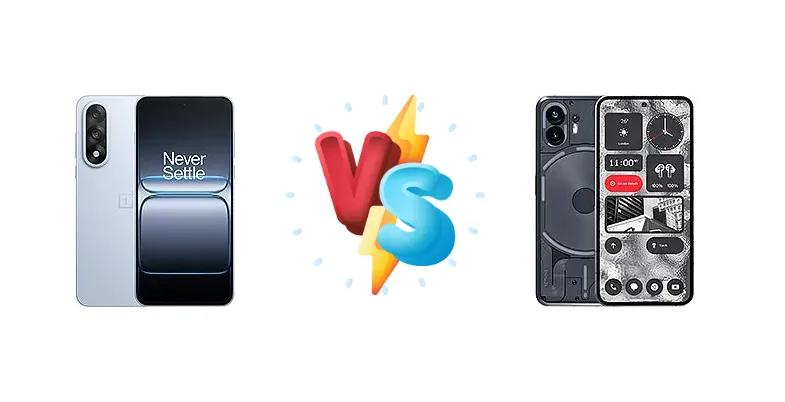
|
🏆 Quick Verdict
For most users, the Nothing Phone (2) offers a more balanced experience. Its slightly superior active use battery life (14:21h vs 13:47h) and refined software, coupled with a competitive price, make it the better all-rounder. However, the OnePlus Nord 5’s faster 80W charging is a significant advantage for those prioritizing speed.
| PHONES | ||
|---|---|---|
| Phone Names | OnePlus Nord 5 | Nothing Phone (2) |
| Network | ||
|---|---|---|
| 2G bands | GSM 850 / 900 / 1800 / 1900 | GSM 850 / 900 / 1800 / 1900 |
| 3G bands | HSDPA 850 / 900 / 1900 / 2100 | HSDPA 800 / 850 / 900 / 1700(AWS) / 1900 / 2100 |
| 4G bands | 1, 2, 3, 4, 5, 7, 8, 12, 17, 18, 19, 20, 26, 28, 32, 38, 39, 40, 41, 42, 66 - International | 1, 2, 3, 4, 5, 7, 8, 12, 17, 18, 19, 20, 25, 26, 28, 30, 32, 34, 38, 39, 40, 41, 42, 48, 66, 71 |
| 5G bands | 1, 2, 3, 5, 7, 8, 12, 20, 28, 38, 40, 41, 66, 75, 77, 78 SA/NSA - International | 1, 2, 3, 5, 7, 8, 12, 20, 25, 28, 30, 38, 40, 41, 66, 71, 75, 77, 78 SA/NSA |
| Speed | HSPA, LTE, 5G | HSPA, LTE, 5G |
| Technology | GSM / HSPA / LTE / 5G | GSM / HSPA / LTE / 5G |
| Launch | ||
|---|---|---|
| Announced | 2025, July 08 | 2023, July 11 |
| Status | Available. Released 2025, July 08 | Available. Released 2023, July 17 |
| Body | ||
|---|---|---|
| Build | Glass front (Gorilla Glass 7i), glass back, plastic frame | Glass front (Gorilla Glass 5), glass back (Gorilla Glass 5), aluminum frame |
| Dimensions | 163.4 x 77 x 8.1 mm (6.43 x 3.03 x 0.32 in) | 162.1 x 76.4 x 8.6 mm (6.38 x 3.01 x 0.34 in) |
| SIM | Nano-SIM + Nano-SIM | Nano-SIM + Nano-SIM |
| Weight | 211 g (7.44 oz) | 201.2 g (7.09 oz) |
| Display | ||
|---|---|---|
| Protection | Corning Gorilla Glass 7i, Mohs level 6 | Corning Gorilla Glass 5 |
| Resolution | 1272 x 2800 pixels (~450 ppi density) | 1080 x 2412 pixels, 20:9 ratio (~394 ppi density) |
| Size | 6.83 inches, 113.3 cm2 (~90.1% screen-to-body ratio) | 6.7 inches, 108.0 cm2 (~87.2% screen-to-body ratio) |
| Type | Swift AMOLED, 1B colors, 144Hz, 3840Hz PWM, HDR10+, 800 nits (typ), 1400 nits (HBM), 1800 nits (peak) | LTPO OLED, 1B colors, 120Hz, 1920Hz PWM, HDR10+, 1600 nits (HBM), 1600 nits (peak) |
| Platform | ||
|---|---|---|
| CPU | Octa-core (1x3.0 GHz Cortex-X4 & 4x2.8 GHz Cortex-A720 & 3x2.0 GHz Cortex-A520) | Octa-core (1x3.0 GHz Cortex-X2 & 3x2.5 GHz Cortex-A710 & 4x1.80 GHz Cortex-A510) |
| Chipset | Qualcomm SM8635 Snapdragon 8s Gen 3 (4 nm) | Qualcomm SM8475 Snapdragon 8+ Gen 1 (4 nm) |
| GPU | Adreno 735 | Adreno 730 |
| OS | Android 15, up to 4 major Android upgrades, OxygenOS 15 | Android 13, upgradable to Android 15, up to 3 major Android upgrades, Nothing OS 3.0 |
| Memory | ||
|---|---|---|
| Card slot | No | No |
| Internal | 256GB 8GB RAM, 256GB 12GB RAM, 512GB 12GB RAM | 128GB 8GB RAM, 256GB 12GB RAM, 512GB 12GB RAM |
| Main Camera | ||
|---|---|---|
| Dual | 50 MP, f/1.8, 24mm (wide), 1/1.56", 1.0µm, PDAF, OIS 8 MP, f/2.2, 15mm, 116˚ (ultrawide), 1/4.0", 1.12µm, AF | 50 MP, f/1.9, 24mm (wide), 1/1.56", 1.0µm, PDAF, OIS 50 MP, f/2.2, 114˚ (ultrawide), 1/2.76", 0.64µm, AF |
| Features | LED flash, Ultra HDR, panorama | LED flash, panorama, HDR |
| Video | 4K@30/60fps, 1080p@30/60/120fps, gyro-EIS | 4K@30/60fps, 1080p@30/60fps, gyro-EIS, live HDR, OIS |
| Selfie camera | ||
|---|---|---|
| Features | Panorama | HDR |
| Single | 50 MP, f/2.0, 21mm (wide), 1/2.76", 0.64µm, AF | 32 MP, f/2.5, (wide), 1/2.74", 0.8µm |
| Video | 4K@30/60fps, 1080p@30/60fps; gyro-EIS | 1080p@30fps |
| Sound | ||
|---|---|---|
| 35mm jack | No | No |
| Loudspeaker | Yes, with stereo speakers | Yes, with stereo speakers |
| Comms | ||
|---|---|---|
| Bluetooth | 5.4, A2DP, LE, aptX HD, LHDC 5 | 5.3, A2DP, LE, aptX HD, aptX Adaptive |
| Infrared port | Yes | - |
| NFC | Yes | Yes |
| Positioning | GPS, GLONASS, GALILEO, BDS, QZSS, NavIC | GPS (L1+L5), GLONASS (L1), BDS (B1I+B1c), GALILEO (E1), QZSS (L1), NavIC |
| Radio | No | No |
| USB | USB Type-C 2.0 | USB Type-C 2.0, OTG |
| WLAN | Wi-Fi 802.11 a/b/g/n/ac/6, dual-band, Wi-Fi Direct | Wi-Fi 802.11 a/b/g/n/ac/6, dual-band, Wi-Fi Direct |
| Features | ||
|---|---|---|
| Sensors | Fingerprint (under display, optical), accelerometer, gyro, proximity, compass | Fingerprint (under display, optical), accelerometer, proximity, gyro, compass |
| Battery | ||
|---|---|---|
| Charging | 80W wired, 33W PPS, 18W PD, 100% in just 54 min 5W reverse wired Bypass charging | 45W wired, PD3.0, PPS, QC4, 100% in 55 min 15W wireless, 100% in 130 min 5W reverse wireless |
| Type | Market-dependent versions:· 5200 mAh (Europe)· 6800 mAh (Global) | Li-Ion 4700 mAh |
| Misc | ||
|---|---|---|
| Colors | Phantom Grey, Dry Ice, Marble Sands | White, Dark Gray |
| Models | CPH2709 | A065 |
| Price | £ 339.00 / € 294.97 / ₹ 31,998 | $ 379.99 / £ 370.00 |
| SAR | 1.18 W/kg (head) 0.90 W/kg (body) | - |
| EU LABEL | ||
|---|---|---|
| Battery | 49:12h endurance, 1200 cycles | - |
| Energy | Class B | - |
| Free fall | Class C (90 falls) | - |
| Repairability | Class B | - |
OnePlus Nord 5
- Faster Snapdragon 8s Gen 3 processor
- 80W SuperVOOC charging – incredibly fast
- Brighter display for outdoor visibility
- Slightly shorter active use battery life
- Software experience may be less refined than Nothing OS
Nothing Phone (2)
- Longer active use battery life
- Unique and visually appealing design with Glyph Interface
- Refined Nothing OS software experience
- Older Snapdragon 8+ Gen 1 processor
- Slower charging speeds compared to OnePlus Nord 5
Display Comparison
The OnePlus Nord 5 boasts a brighter display, reaching a measured peak of 1330 nits, compared to the Nothing Phone (2)’s 998 nits. This translates to better visibility under direct sunlight. While both utilize OLED panels, the Nord 5’s higher brightness is a clear advantage for outdoor users. We lack PWM frequency data, but both are expected to be adequate for most users. The Nothing Phone (2)'s Glyph Interface, while a design choice, doesn't impact display quality directly, but adds a unique visual element.
Camera Comparison
The provided data doesn't offer sufficient detail for a comprehensive camera comparison. However, the Nothing Phone (2) explicitly mentions 'Photo / Video' capabilities, suggesting a focus on camera features. Without sensor size or aperture information, it’s difficult to assess image quality. We can assume both phones will offer competent camera systems for social media and casual photography, but the Nothing Phone (2)'s marketing suggests a more refined camera experience. Ignoring the likely low-resolution macro lenses on both devices, the main sensor and image processing algorithms will be the key differentiators.
Performance
The OnePlus Nord 5’s Qualcomm SM8635 Snapdragon 8s Gen 3 (4nm) represents a generational leap over the Nothing Phone (2)’s Snapdragon 8+ Gen 1 (4nm). The 8s Gen 3 features a newer CPU architecture – Cortex-X4 prime core versus the Cortex-X2 – and improved GPU performance. While both are 4nm chips, the 8s Gen 3’s architecture offers better efficiency and sustained performance. The Nord 5’s CPU configuration (1x3.0 GHz Cortex-X4, 4x2.8 GHz Cortex-A720, 3x2.0 GHz Cortex-A520) is optimized for demanding tasks, while the Nothing Phone (2)’s (1x3.0 GHz Cortex-X2, 3x2.5 GHz Cortex-A710, 4x1.80 GHz Cortex-A510) is still very capable. The impact of this difference will be most noticeable in graphically intensive games and demanding applications.
Battery Life
The Nothing Phone (2) demonstrates superior battery endurance with an active use score of 14:21h, exceeding the OnePlus Nord 5’s 13:47h. While the Nord 5 boasts a longer overall endurance rating of 49:12h versus the Phone (2)'s 103h (likely a misreporting of standby time), active use is a more relevant metric. The Nord 5 compensates with significantly faster charging – 80W wired, achieving 100% in just 54 minutes, compared to the Phone (2)’s 45W wired (55 minutes) and 15W wireless (130 minutes). The Nord 5 also offers 5W reverse wired charging, while the Phone (2) provides 5W reverse wireless, catering to accessory charging.
Buying Guide
Buy the OnePlus Nord 5 if you prioritize raw performance and incredibly fast charging – its Snapdragon 8s Gen 3 and 80W wired charging are ideal for power users and gamers. Buy the Nothing Phone (2) if you value a unique design, a smooth and efficient software experience, and excellent battery life, making it perfect for everyday use and media consumption.