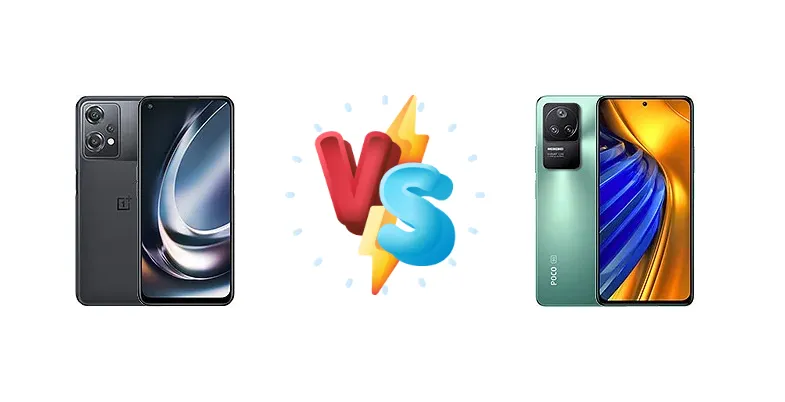
The mid-range smartphone market is fiercely competitive, and the OnePlus Nord 2 Lite and Xiaomi Poco F4 represent compelling options for users seeking a balance of features and affordability. While both aim to deliver a premium experience without the flagship price tag, they take distinctly different approaches, primarily centered around their chipset choices. This comparison dissects those differences and more, helping you determine which device best suits your needs.
🏆 Quick Verdict
For most users, the Xiaomi Poco F4 emerges as the stronger contender. Its Snapdragon 870 chipset provides significantly superior performance, making it ideal for gaming and demanding applications. While the Nord 2 Lite offers a more modern design and potentially better software support, the Poco F4’s raw power and faster 67W charging justify the slight price premium.
| Network |
|---|
| 2G bands | GSM 850 / 900 / 1800 / 1900 | GSM 850 / 900 / 1800 / 1900 |
| 3G bands | HSDPA 800 / 850 / 900 / 1700(AWS) / 1900 / 2100 | HSDPA 850 / 900 / 1700(AWS) / 1900 / 2100 |
| 4G bands | LTE | 1, 2, 3, 4, 5, 7, 8, 12, 17, 18, 19, 20, 26, 28, 38, 40, 41 |
| 5G bands | SA/NSA | 1, 3, 5, 7, 8, 20, 28, 38, 40, 41, 77, 78 SA/NSA |
| Speed | HSPA, LTE, 5G | HSPA, LTE, 5G |
| Technology | GSM / HSPA / LTE / 5G | GSM / HSPA / LTE / 5G |
| Launch |
|---|
| Announced | Not announced yet | 2022, June 23 |
| Status | Cancelled | Available. Released 2022, June 27 |
| Body |
|---|
| Build | Glass front, plastic frame, plastic back | Glass front (Gorilla Glass 5), glass back |
| Dimensions | 164.3 x 75.6 x 8.5 mm (6.47 x 2.98 x 0.33 in) | 163.2 x 76 x 7.7 mm (6.43 x 2.99 x 0.30 in) |
| SIM | Nano-SIM + Nano-SIM | Nano-SIM + Nano-SIM |
| Weight | 195 g (6.88 oz) | 195 g (6.88 oz) |
| | - | IP53, dust and splash resistant |
| Display |
|---|
| Protection | - | Corning Gorilla Glass 5 |
| Resolution | 1080 x 2412 pixels, 20:9 ratio (~401 ppi density) | 1080 x 2400 pixels, 20:9 ratio (~395 ppi density) |
| Size | 6.59 inches, 104.5 cm2 (~84.1% screen-to-body ratio) | 6.67 inches, 107.4 cm2 (~86.6% screen-to-body ratio) |
| Type | IPS LCD, 120Hz | AMOLED, 120Hz, HDR10+, Dolby Vision, 900 nits (HBM), 1300 nits (peak) |
| Platform |
|---|
| CPU | Octa-core (2x2.2 GHz Kryo 660 Gold & 6x1.7 GHz Kryo 660 Silver) | Octa-core (1x3.2 GHz Kryo 585 & 3x2.42 GHz Kryo 585 & 4x1.80 GHz Kryo 585) |
| Chipset | Qualcomm SM6375 Snapdragon 695 5G (6 nm) | Qualcomm SM8250-AC Snapdragon 870 5G (7 nm) |
| GPU | Adreno 619 | Adreno 650 |
| OS | Android 12, OxygenOS 12.1 | Android 12, upgradable to Android 13, MIUI 14.2 for POCO |
| Memory |
|---|
| Card slot | microSDXC (uses shared SIM slot) | No |
| Internal | 128GB 8GB RAM | 128GB 6GB RAM, 128GB 8GB RAM, 256GB 8GB RAM, 256GB 12GB RAM |
| | - | UFS 3.1 |
| Main Camera |
|---|
| Features | LED flash, HDR, panorama | LED flash, HDR, panorama |
| Triple | 64 MP, f/1.7, 26mm (wide), 0.7µm, PDAF
2 MP (macro)
Auxiliary lens | 64 MP, f/1.8, (wide) 1/2.0", 0.7µm, PDAF, OIS
8 MP, f/2.2, 119˚ (ultrawide), 1/4.0", 1.12µm
2 MP (macro) |
| Video | 1080p@30fps | 4K@30/60fps, 1080p@30/60fps |
| Selfie camera |
|---|
| Features | HDR | - |
| Single | 16 MP, f/2.0, (wide), 1/3.0", 1.0µm | 20 MP, f/2.5, (wide), 1/3.06", 1.0µm |
| Video | 1080p@30fps | 1080p@30fps |
| Sound |
|---|
| 3.5mm jack | - | No |
| 35mm jack | Yes | No |
| Loudspeaker | Yes | Yes, with stereo speakers |
| | - | 24-bit/192kHz audio |
| Comms |
|---|
| Bluetooth | 5.2, A2DP, LE, aptX HD | 5.2, A2DP, LE |
| Infrared port | - | Yes |
| NFC | Yes | Yes (market/region dependent) |
| Positioning | GPS, GLONASS, GALILEO, BDS, QZSS | GPS (L1+L5), GLONASS (L1), BDS (B1I+B2a), GALILEO (E1+E5a), QZSS (L1+L5), NavIC (L5) |
| Radio | Unspecified | No |
| USB | USB Type-C 2.0, OTG | USB Type-C 2.0, OTG |
| WLAN | Wi-Fi 802.11 a/b/g/n/ac, dual-band, Wi-Fi Direct | Wi-Fi 802.11 a/b/g/n/ac/6, dual-band, Wi-Fi Direct |
| Features |
|---|
| Sensors | Fingerprint (side-mounted), accelerometer, gyro, proximity, compass | Fingerprint (side-mounted), accelerometer, gyro, proximity, compass |
| Battery |
|---|
| Charging | 33W wired | 67W wired, PD3.0, QC3, 100% in 38 min |
| Type | Li-Po 5000 mAh | Li-Po 4500 mAh |
| Misc |
|---|
| Colors | Black Dusk, Blue Tide | Moonlight Silver, Night Black, Nebula Green |
| Models | - | 22021211RG, 22021211RI |
| Price | - | ₹ 16,999 |
| Tests |
|---|
| Battery life | - |
Endurance rating 101h
|
| Camera | - |
Photo / Video |
| Display | - |
Contrast ratio: Infinite (nominal) |
| Loudspeaker | - |
-26.1 LUFS (Good)
|
| Performance | - |
AnTuTu: 590961 (v8), 698586 (v9)
GeekBench: 3190 (v5.1)
GFXBench: 49fps (ES 3.1 onscreen) |
OnePlus Nord 2 Lite
- Sleek and modern design
- Potentially better software support from OnePlus
- Competitive price point
- Significantly weaker processor compared to Poco F4
- Slower charging speed (33W)
- Less detailed display specifications
Xiaomi Poco F4
- Powerful Snapdragon 870 processor
- Very fast 67W charging
- Brighter and more vibrant display
- Design may appear less modern than Nord 2 Lite
- Xiaomi’s MIUI software can be polarizing
- Potentially less frequent software updates compared to OnePlus
Display Comparison
The Xiaomi Poco F4 boasts a significantly brighter display, reaching a measured peak brightness of 1003 nits, compared to an unspecified value for the Nord 2 Lite. This translates to superior visibility outdoors under direct sunlight. While both likely utilize AMOLED panels (based on brand trends), the Poco F4’s higher brightness and infinite contrast ratio suggest a more vibrant and immersive viewing experience. The Nord 2 Lite’s display specifications are less detailed, leaving questions about color accuracy and refresh rate unanswered, potentially impacting its suitability for media consumption.
Camera Comparison
Both phones feature photo and video capabilities, but detailed sensor information is lacking for both. However, the Poco F4’s higher processing power afforded by the Snapdragon 870 will likely result in faster image processing and potentially better low-light performance. Without specific details on sensor size and aperture, it’s difficult to definitively declare a winner. The inclusion of OIS (Optical Image Stabilization) on the Poco F4, if present (based on typical Poco F series features), would further enhance its photographic capabilities, particularly in video recording. The Nord 2 Lite’s camera system is likely geared towards everyday snapshots, while the Poco F4 aims for a more versatile experience.
Performance
The core difference lies in the chipsets. The Poco F4’s Snapdragon 870 5G (7nm) is a substantial upgrade over the Nord 2 Lite’s Snapdragon 695 5G (6nm). The 870 features a Kryo 585 core configuration with a prime core clocked at 3.2 GHz, dwarfing the Nord 2 Lite’s 2.2 GHz Kryo 660 Gold cores. This translates to a noticeable performance gap in CPU-intensive tasks and a significant advantage in GPU performance for gaming. The 7nm process node of the 870, while older, is still more efficient than the 6nm node of the 695, allowing for sustained performance under load. The Poco F4 is the clear winner for users prioritizing speed and responsiveness.
Battery Life
Both devices achieve an endurance rating of 101 hours, suggesting comparable battery life under similar usage scenarios. However, the Poco F4’s 67W wired charging with PD3.0 and QC3 support is a game-changer, achieving a full charge in just 38 minutes. The Nord 2 Lite’s 33W charging is considerably slower. While both offer similar battery capacity (implied by endurance rating), the Poco F4’s significantly faster charging speed minimizes downtime and provides greater convenience for users who frequently need to top up their battery.
Buying Guide
Buy the OnePlus Nord 2 Lite if you prioritize a sleek, modern aesthetic and are a casual smartphone user who primarily focuses on social media, communication, and light web browsing. Buy the Xiaomi Poco F4 if you are a gamer, a power user who frequently multitasks, or someone who values fast charging and future-proofing with a more capable processor.
Frequently Asked Questions
❓ Is the Snapdragon 695 in the Nord 2 Lite sufficient for playing demanding games like Genshin Impact?
While the Snapdragon 695 can handle some gaming, Genshin Impact and similar titles will likely require significant graphics settings reductions and may still experience frame drops. The Poco F4’s Snapdragon 870 is far better equipped for a smooth gaming experience at higher settings.
❓ Does the Poco F4’s MIUI software come with a lot of bloatware?
Xiaomi’s MIUI is known for including pre-installed apps (bloatware). However, many of these can be uninstalled. Recent versions of MIUI have reduced the amount of bloatware, but it remains a potential concern for users who prefer a cleaner software experience.
❓ How does the 67W charging on the Poco F4 compare to standard fast charging?
67W charging is significantly faster than typical fast charging solutions. It can charge the Poco F4 from 0% to 100% in approximately 38 minutes, whereas standard fast charging often takes over an hour. This is a major convenience factor for users who are always on the go.
❓ Will the Nord 2 Lite receive more software updates than the Poco F4?
OnePlus generally has a reputation for providing more consistent and timely software updates compared to Xiaomi. While Xiaomi has improved its update schedule, OnePlus typically offers longer software support for its devices.