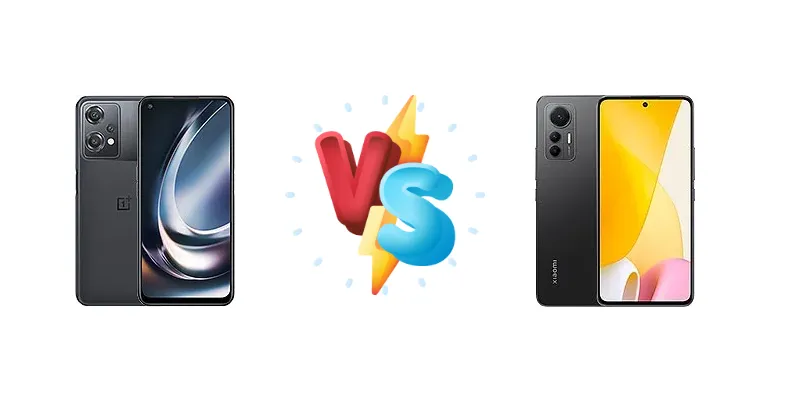
The mid-range smartphone market is fiercely competitive, and the OnePlus Nord 2 Lite and Xiaomi 12 Lite represent compelling options for users seeking a balance of features and affordability. While both devices aim for a similar demographic, they diverge in key areas like chipset choice and charging technology, creating a clear distinction in performance and user experience.
🏆 Quick Verdict
For the average user prioritizing all-around performance and faster charging, the Xiaomi 12 Lite emerges as the stronger contender. Its Snapdragon 778G chipset provides a noticeable performance uplift, and the 67W charging significantly reduces downtime. However, the Nord 2 Lite remains a viable option for those on a tighter budget.
| Network |
|---|
| 2G bands | GSM 850 / 900 / 1800 / 1900 | GSM 850 / 900 / 1800 / 1900 |
| 3G bands | HSDPA 800 / 850 / 900 / 1700(AWS) / 1900 / 2100 | HSDPA 850 / 900 / 1700(AWS) / 1900 / 2100 |
| 4G bands | LTE | 1, 2, 3, 4, 5, 7, 8, 12, 13, 17, 18, 19, 20, 26, 28, 32, 38, 40, 41, 42, 48, 66 |
| 5G bands | SA/NSA | 1, 3, 5, 7, 8, 20, 28, 38, 40, 41, 66, 77, 78 SA/NSA |
| Speed | HSPA, LTE, 5G | HSPA, LTE, 5G |
| Technology | GSM / HSPA / LTE / 5G | GSM / HSPA / LTE / 5G |
| Launch |
|---|
| Announced | Not announced yet | 2022, July 09 |
| Status | Cancelled | Available. Released 2022, July 11 |
| Body |
|---|
| Build | Glass front, plastic frame, plastic back | Glass front (Gorilla Glass 5), glass back, plastic frame |
| Dimensions | 164.3 x 75.6 x 8.5 mm (6.47 x 2.98 x 0.33 in) | 159.3 x 73.7 x 7.3 mm (6.27 x 2.90 x 0.29 in) |
| SIM | Nano-SIM + Nano-SIM | Nano-SIM + Nano-SIM |
| Weight | 195 g (6.88 oz) | 173 g (6.10 oz) |
| Display |
|---|
| Protection | - | Corning Gorilla Glass 5 |
| Resolution | 1080 x 2412 pixels, 20:9 ratio (~401 ppi density) | 1080 x 2400 pixels, 20:9 ratio (~402 ppi density) |
| Size | 6.59 inches, 104.5 cm2 (~84.1% screen-to-body ratio) | 6.55 inches, 103.6 cm2 (~88.2% screen-to-body ratio) |
| Type | IPS LCD, 120Hz | AMOLED, 68B colors, 120Hz, Dolby Vision, HDR10+, 950 nits (peak) |
| Platform |
|---|
| CPU | Octa-core (2x2.2 GHz Kryo 660 Gold & 6x1.7 GHz Kryo 660 Silver) | Octa-core (1x2.4 GHz Cortex-A78 & 3x2.2 GHz Cortex-A78 & 4x1.9 GHz Cortex-A55) |
| Chipset | Qualcomm SM6375 Snapdragon 695 5G (6 nm) | Qualcomm SM7325 Snapdragon 778G 5G (6 nm) |
| GPU | Adreno 619 | Adreno 642L |
| OS | Android 12, OxygenOS 12.1 | Android 12, upgradable to Android 14, HyperOS |
| Memory |
|---|
| Card slot | microSDXC (uses shared SIM slot) | No |
| Internal | 128GB 8GB RAM | 128GB 6GB RAM, 128GB 8GB RAM, 256GB 8GB RAM |
| | - | UFS 2.2 |
| Main Camera |
|---|
| Features | LED flash, HDR, panorama | Dual-LED dual-tone flash, HDR, panorama |
| Single | - | 32 MP, f/2.5, (wide), 1/2.8", 0.8µm, AF |
| Triple | 64 MP, f/1.7, 26mm (wide), 0.7µm, PDAF
2 MP (macro)
Auxiliary lens | 108 MP, f/1.9, 26mm (wide), 1/1.52", 0.7µm, PDAF
8 MP, f/2.2, 120˚ (ultrawide), 1/4.0", 1.12µm
2 MP (macro) |
| Video | 1080p@30fps | 4K@30fps, 1080p@30/60/120fps; gyro-EIS |
| Selfie camera |
|---|
| Features | HDR | HDR, panorama |
| Single | 16 MP, f/2.0, (wide), 1/3.0", 1.0µm | 32 MP, f/2.5, (wide), 1/2.8", 0.8µm, AF |
| Video | 1080p@30fps | 1080p@30/60fps, 720p@120fps |
| Sound |
|---|
| 3.5mm jack | - | No |
| 35mm jack | Yes | No |
| Loudspeaker | Yes | Yes, with dual speakers |
| | - | 24-bit/192kHz audio |
| Comms |
|---|
| Bluetooth | 5.2, A2DP, LE, aptX HD | 5.2, A2DP, LE, aptX HD, aptX Adaptive |
| Infrared port | - | Yes |
| NFC | Yes | Yes (market/region dependent) |
| Positioning | GPS, GLONASS, GALILEO, BDS, QZSS | GPS (L1), GLONASS (G1), BDS (B1I+B1c), GALILEO (E1), QZSS (L1) |
| Radio | Unspecified | No |
| USB | USB Type-C 2.0, OTG | USB Type-C 2.0, OTG |
| WLAN | Wi-Fi 802.11 a/b/g/n/ac, dual-band, Wi-Fi Direct | Wi-Fi 802.11 a/b/g/n/ac/6, dual-band, Wi-Fi Direct |
| Features |
|---|
| Sensors | Fingerprint (side-mounted), accelerometer, gyro, proximity, compass | Fingerprint (under display, optical), accelerometer, gyro, compass |
| | - | Virtual proximity sensing |
| Battery |
|---|
| Charging | 33W wired | 67W wired, PD3.0, QC4, 50% in 13 min |
| Type | Li-Po 5000 mAh | Li-Po 4300 mAh |
| Misc |
|---|
| Colors | Black Dusk, Blue Tide | Black, Lite Green, Lite Pink |
| Models | - | 2203129G |
| Price | - | € 119.80 / $ 269.00 / £ 121.15 |
| SAR | - | 1.09 W/kg (head) 0.73 W/kg (body) |
| SAR EU | - | 0.60 W/kg (head) 1.00 W/kg (body) |
| Tests |
|---|
| Battery life | - |
Endurance rating 100h
|
| Camera | - |
Photo / Video |
| Display | - |
Contrast ratio: Infinite (nominal) |
| Loudspeaker | - |
-25.2 LUFS (Very good)
|
| Performance | - |
AnTuTu: 528905 (v9)
GeekBench: 2943 (v5.1)
GFXBench: 29fps (ES 3.1 onscreen) |
OnePlus Nord 2 Lite
- Potentially lower price point
- Decent performance for everyday tasks
- Reliable brand reputation
- Slower charging speed
- Less powerful chipset compared to the 778G
- Display brightness likely lower than Xiaomi 12 Lite
Xiaomi 12 Lite
- Faster Snapdragon 778G 5G chipset
- Significantly faster 67W charging
- Brighter display for better outdoor visibility
- Potentially higher price
- Battery life may not be significantly better despite faster charging
- Software experience may differ from OnePlus' OxygenOS
Display Comparison
The Xiaomi 12 Lite boasts a brighter display, reaching a measured peak brightness of 824 nits, which translates to better visibility outdoors compared to the Nord 2 Lite (brightness data unavailable). While both likely utilize AMOLED panels for vibrant colors, the Xiaomi’s higher peak brightness is a tangible advantage. The 'Infinite' contrast ratio specification on the Xiaomi 12 Lite is typical for AMOLED displays, offering deep blacks and excellent color reproduction. Without specific details on the Nord 2 Lite’s panel, it’s difficult to assess color accuracy or PWM dimming rates, but users sensitive to flicker should investigate this aspect further.
Camera Comparison
Both phones are advertised as having capable photo and video capabilities, but detailed sensor information is lacking. Without specifics on sensor size or aperture, it’s difficult to make a definitive judgment. However, the chipset difference suggests the Xiaomi 12 Lite’s image signal processor (ISP) will offer more advanced processing capabilities, potentially leading to better dynamic range and low-light performance. The absence of details on optical image stabilization (OIS) on either device makes it difficult to assess video stabilization quality. It's likely both rely heavily on software processing to compensate.
Performance
The core difference lies in the chipsets: the OnePlus Nord 2 Lite features the Qualcomm Snapdragon 695 5G, while the Xiaomi 12 Lite is powered by the Snapdragon 778G 5G. The 778G, built on a 6nm process like the 695, features a more powerful CPU configuration – a 1x2.4 GHz Cortex-A78 prime core alongside 3x2.2 GHz Cortex-A78 cores and 4x1.9 GHz Cortex-A55 efficiency cores, versus the Nord 2 Lite’s 2x2.2 GHz Kryo 660 Gold and 6x1.7 GHz Kryo 660 Silver. This translates to a significant performance advantage for the Xiaomi 12 Lite in CPU-intensive tasks and gaming. The 778G’s Adreno 642L GPU also outperforms the 695’s Adreno 619, offering a smoother gaming experience. While both support 5G, the 778G’s superior processing power will handle more complex 5G tasks efficiently.
Battery Life
Both devices share an endurance rating of 100 hours, suggesting similar real-world battery life despite potentially different battery capacities (data unavailable for Nord 2 Lite). However, the charging speeds are drastically different. The Xiaomi 12 Lite’s 67W wired charging, supporting PD3.0 and QC4, can replenish 50% of the battery in just 13 minutes. The OnePlus Nord 2 Lite’s 33W charging is considerably slower. This difference in charging speed is a significant convenience factor for users who frequently need to top up their battery quickly.
Buying Guide
Buy the OnePlus Nord 2 Lite if you need a reliable daily driver with decent performance for everyday tasks and prioritize value for money. It's ideal for users who aren't heavy gamers or power users. Buy the Xiaomi 12 Lite if you prefer a smoother, more responsive experience, especially when multitasking or playing demanding games, and value the convenience of incredibly fast charging. This phone caters to users who demand more from their smartphone.
Frequently Asked Questions
❓ Does the Snapdragon 695 in the Nord 2 Lite struggle with graphically demanding games like Genshin Impact?
The Snapdragon 695 is a capable chipset for most mobile games, but it will likely require lower graphics settings and frame rates in demanding titles like Genshin Impact to maintain a smooth experience. The Xiaomi 12 Lite’s Snapdragon 778G offers a more comfortable gaming experience with higher settings.
❓ How much faster is the 67W charging on the Xiaomi 12 Lite compared to the 33W charging on the Nord 2 Lite in real-world usage?
The Xiaomi 12 Lite can charge from 0-50% in approximately 13 minutes, while the Nord 2 Lite will take significantly longer – likely over 45 minutes to reach the same level. This difference is substantial for users who need a quick power boost.
❓ Are there any significant differences in the software experience between OxygenOS on the Nord 2 Lite and MIUI on the Xiaomi 12 Lite?
OxygenOS is generally praised for its clean, near-stock Android experience, while MIUI is known for its extensive customization options and feature set. Some users may prefer the simplicity of OxygenOS, while others may appreciate the added functionality of MIUI. Both offer regular software updates.