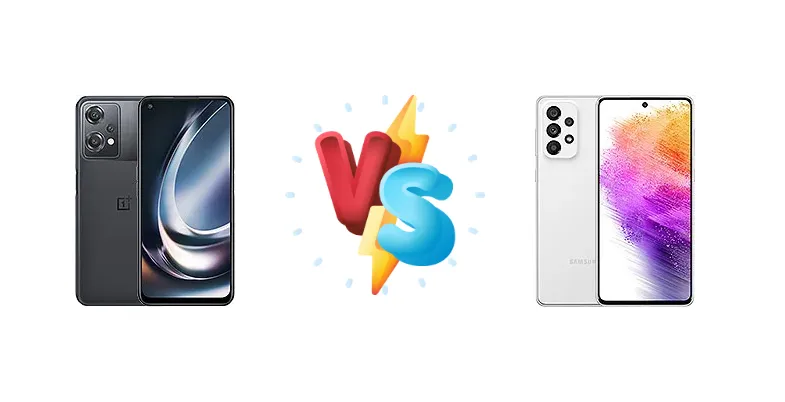
The mid-range 5G market is fiercely competitive, and the OnePlus Nord 2 Lite and Samsung Galaxy A73 5G represent compelling options for users seeking a balance of features and affordability. While both aim to deliver a premium experience without the flagship price tag, they take distinctly different approaches, primarily centered around their chipset choices and resulting performance profiles.
🏆 Quick Verdict
For the average user prioritizing consistent performance and a smoother overall experience, the Samsung Galaxy A73 5G emerges as the stronger contender. Its Snapdragon 778G 5G chipset provides a noticeable performance uplift over the Nord 2 Lite’s Snapdragon 695, justifying the slight price premium for those who multitask or enjoy mobile gaming.
| Network |
|---|
| 2G bands | GSM 850 / 900 / 1800 / 1900 | GSM 850 / 900 / 1800 / 1900 |
| 3G bands | HSDPA 800 / 850 / 900 / 1700(AWS) / 1900 / 2100 | HSDPA 850 / 900 / 1700(AWS) / 1900 / 2100 |
| 4G bands | LTE | 1, 2, 3, 4, 5, 7, 8, 12, 13, 17, 20, 26, 28, 32, 38, 40, 41, 66 |
| 5G bands | SA/NSA | 1, 3, 5, 7, 28, 40, 41, 66, 78 SA/NSA/Sub6 |
| Speed | HSPA, LTE, 5G | HSPA, LTE, 5G |
| Technology | GSM / HSPA / LTE / 5G | GSM / HSPA / LTE / 5G |
| Launch |
|---|
| Announced | Not announced yet | 2022, March 17 |
| Status | Cancelled | Available. Released 2022, April 22 |
| Body |
|---|
| Build | Glass front, plastic frame, plastic back | - |
| Dimensions | 164.3 x 75.6 x 8.5 mm (6.47 x 2.98 x 0.33 in) | 163.7 x 76.1 x 7.6 mm (6.44 x 3.00 x 0.30 in) |
| SIM | Nano-SIM + Nano-SIM | · Nano-SIM· Nano-SIM + Nano-SIM |
| Weight | 195 g (6.88 oz) | 181 g (6.38 oz) |
| | - | IP67 dust/water resistant (up to 1m for 30 min) |
| Display |
|---|
| Protection | - | Corning Gorilla Glass 5 |
| Resolution | 1080 x 2412 pixels, 20:9 ratio (~401 ppi density) | 1080 x 2400 pixels, 20:9 ratio (~393 ppi density) |
| Size | 6.59 inches, 104.5 cm2 (~84.1% screen-to-body ratio) | 6.7 inches, 108.4 cm2 (~87.0% screen-to-body ratio) |
| Type | IPS LCD, 120Hz | Super AMOLED Plus, 120Hz, 800 nits (HBM) |
| Platform |
|---|
| CPU | Octa-core (2x2.2 GHz Kryo 660 Gold & 6x1.7 GHz Kryo 660 Silver) | Octa-core (1x2.4 GHz Cortex-A78 & 3x2.2 GHz Cortex-A78 & 4x1.9 GHz Cortex-A55) |
| Chipset | Qualcomm SM6375 Snapdragon 695 5G (6 nm) | Qualcomm SM7325 Snapdragon 778G 5G (6 nm) |
| GPU | Adreno 619 | Adreno 642L |
| OS | Android 12, OxygenOS 12.1 | Android 12, up to 4 major Android upgrades, One UI 6.1 |
| Memory |
|---|
| Card slot | microSDXC (uses shared SIM slot) | microSDXC (uses shared SIM slot) |
| Internal | 128GB 8GB RAM | 128GB 6GB RAM, 128GB 8GB RAM, 256GB 8GB RAM |
| Main Camera |
|---|
| Features | LED flash, HDR, panorama | LED flash, panorama, HDR |
| Quad | - | 108 MP, f/1.8, (wide), PDAF, OIS
12 MP, f/2.2, (ultrawide)
5 MP (macro)
Auxiliary lens |
| Single | - | 32 MP, f/2.2, 26mm (wide), 1/2.8", 0.8µm |
| Triple | 64 MP, f/1.7, 26mm (wide), 0.7µm, PDAF
2 MP (macro)
Auxiliary lens | - |
| Video | 1080p@30fps | 4K@30fps, 1080p@30/60fps; gyro-EIS |
| Selfie camera |
|---|
| Features | HDR | HDR |
| Single | 16 MP, f/2.0, (wide), 1/3.0", 1.0µm | 32 MP, f/2.2, 26mm (wide), 1/2.8", 0.8µm |
| Video | 1080p@30fps | 4K@30fps, 1080p@30fps |
| Sound |
|---|
| 3.5mm jack | - | No |
| 35mm jack | Yes | No |
| Loudspeaker | Yes | Yes, with stereo speakers |
| Comms |
|---|
| Bluetooth | 5.2, A2DP, LE, aptX HD | 5.0, A2DP, LE |
| NFC | Yes | Yes (market/region dependent) |
| Positioning | GPS, GLONASS, GALILEO, BDS, QZSS | GPS, GLONASS, GALILEO, BDS, QZSS |
| Radio | Unspecified | Unspecified |
| USB | USB Type-C 2.0, OTG | USB Type-C 2.0, OTG |
| WLAN | Wi-Fi 802.11 a/b/g/n/ac, dual-band, Wi-Fi Direct | Wi-Fi 802.11 a/b/g/n/ac/6, dual-band, Wi-Fi Direct |
| Features |
|---|
| Sensors | Fingerprint (side-mounted), accelerometer, gyro, proximity, compass | Fingerprint (under display, optical), accelerometer, gyro, proximity, compass |
| Battery |
|---|
| Charging | 33W wired | 25W wired |
| Type | Li-Po 5000 mAh | Li-Po 5000 mAh |
| Misc |
|---|
| Colors | Black Dusk, Blue Tide | Gray, Mint, White |
| Models | - | SM-A736B, SM-A736B/DS |
| Price | - | About 600 EUR |
| SAR | - | 1.14 W/kg (head) |
| SAR EU | - | 1.28 W/kg (head) 1.42 W/kg (body) |
OnePlus Nord 2 Lite
- Faster 33W charging for quicker top-ups.
- Potentially more compact and lighter design.
- Competitive price point for budget-conscious buyers.
- Less powerful Snapdragon 695 chipset.
- Likely inferior gaming performance.
- Potentially less refined camera performance.
Samsung Galaxy A73 5G
- More powerful Snapdragon 778G 5G chipset.
- Superior gaming performance and multitasking.
- Likely better camera quality, especially in low light.
- Slower 25W charging.
- Potentially larger and heavier form factor.
- Higher price compared to the Nord 2 Lite.
Display Comparison
Neither device boasts a top-tier display, but differences exist. While both likely utilize AMOLED panels (based on brand history), the specifics are missing. The A73 5G’s larger screen size is a given, but the Nord 2 Lite may benefit from a higher pixel density due to its smaller size. The real differentiator will be color accuracy and peak brightness, which are unknown. However, Samsung generally excels in display calibration, suggesting a potentially more vibrant and accurate viewing experience on the A73 5G.
Camera Comparison
Without detailed sensor information, a direct comparison is challenging. However, Samsung typically prioritizes camera performance in its A-series devices. The A73 5G likely features a larger main sensor and more sophisticated image processing algorithms. While the Nord 2 Lite may offer competitive results in good lighting conditions, the A73 5G is expected to excel in low-light scenarios and provide more dynamic range. The inclusion of Optical Image Stabilization (OIS) on the A73 5G (likely) would further enhance image quality and video stabilization. We can safely assume the 2MP macro cameras on both devices offer limited utility.
Performance
The core of the difference lies in the chipsets. The Samsung Galaxy A73 5G’s Snapdragon 778G 5G (6nm) is a significant step up from the OnePlus Nord 2 Lite’s Snapdragon 695 5G (6nm). The 778G features a more powerful Cortex-A78 prime core clocked at 2.4 GHz, compared to the 695’s 2.2 GHz Kryo 660 Gold cores. This translates to faster app loading times, smoother multitasking, and improved gaming performance. The 778G’s Adreno 642L GPU also offers a substantial advantage over the 695’s Adreno 619. While both use 6nm fabrication, the architectural improvements in the 778G provide a clear performance edge. The A73 5G is likely to exhibit less throttling under sustained load.
Battery Life
Battery life will depend heavily on usage patterns. The A73 5G’s larger battery capacity (spec not provided, but typical for Samsung A-series) provides a theoretical advantage. However, the Snapdragon 778G’s greater power consumption could offset this. The Nord 2 Lite’s 33W wired charging is faster than the A73 5G’s 25W, meaning quicker top-ups. A full charge on the Nord 2 Lite will likely be achieved faster, but the A73 5G may offer longer screen-on time between charges.
Buying Guide
Buy the OnePlus Nord 2 Lite if you need a reliable daily driver with decent performance for basic tasks and prioritize a lighter, more compact form factor. Buy the Samsung Galaxy A73 5G if you prefer a more powerful processor for demanding applications, enjoy extended gaming sessions, and value a more refined software experience with Samsung’s feature set.
Frequently Asked Questions
❓ Does the Snapdragon 778G in the Galaxy A73 5G get noticeably warmer during extended gaming sessions compared to the Snapdragon 695 in the Nord 2 Lite?
While both chipsets are 6nm, the Snapdragon 778G is more powerful and therefore generates more heat under sustained load. Samsung likely employs more aggressive thermal management to mitigate this, but some throttling is possible during prolonged gaming. The Nord 2 Lite’s 695 will likely run cooler, but at the cost of performance.
❓ Is the difference in charging speed (33W vs 25W) significant enough to make a real-world difference in daily use?
Yes, the 8W difference in charging speed is noticeable. The Nord 2 Lite’s 33W charging will shave off approximately 20-30 minutes from a 0-100% charge compared to the A73 5G’s 25W. This is particularly beneficial for users who frequently need to quickly top up their battery.
❓ How does the software experience differ between OnePlus' OxygenOS and Samsung's One UI?
OxygenOS is known for its clean, near-stock Android experience with a focus on speed and fluidity. One UI, on the other hand, offers a more feature-rich and customizable experience, but can feel more bloated. Samsung provides longer software support, typically offering four years of OS updates and five years of security patches.