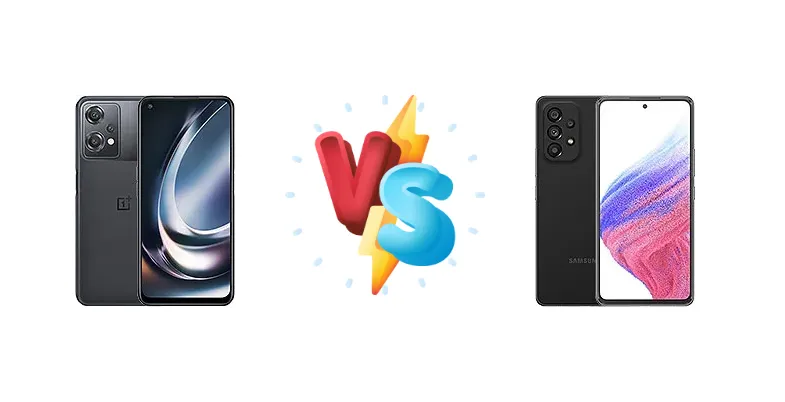
The mid-range smartphone market is fiercely competitive, and the OnePlus Nord 2 Lite and Samsung Galaxy A53 5G represent compelling options for budget-conscious buyers. While both aim to deliver a 5G experience without breaking the bank, they take different approaches to achieving this, particularly in chipset choice and display technology. This comparison dives deep into the specifics to determine which device offers the best value.
🏆 Quick Verdict
For most users, the Samsung Galaxy A53 5G emerges as the slightly stronger choice. Its brighter 830 nit display and established camera software provide a more polished experience. However, the Nord 2 Lite’s Snapdragon 695 offers a more efficient platform for everyday tasks, making it a viable alternative for those prioritizing battery life and cost savings.
| Network |
|---|
| 2G bands | GSM 850 / 900 / 1800 / 1900 | GSM 850 / 900 / 1800 / 1900 |
| 3G bands | HSDPA 800 / 850 / 900 / 1700(AWS) / 1900 / 2100 | HSDPA 850 / 900 / 1700(AWS) / 1900 / 2100 |
| 4G bands | LTE | 1, 2, 3, 4, 5, 7, 12, 14, 20, 29, 30, 38, 39, 40, 41, 46, 48, 66 - SM-A536U |
| 5G bands | SA/NSA | 2, 5, 41, 66, 77, 78 SA/NSA/Sub6/mmWave - SM-A536U |
| Speed | HSPA, LTE, 5G | HSPA, LTE, 5G |
| Technology | GSM / HSPA / LTE / 5G | GSM / HSPA / LTE / 5G |
| | - | 2, 5, 48, 66, 77, 78, 260, 261 SA/NSA/Sub6/mmWave - SM-A536V |
| Launch |
|---|
| Announced | Not announced yet | 2022, March 17 |
| Status | Cancelled | Available. Released 2022, March 24 |
| Body |
|---|
| Build | Glass front, plastic frame, plastic back | Glass front (Gorilla Glass 5), plastic frame, plastic back |
| Dimensions | 164.3 x 75.6 x 8.5 mm (6.47 x 2.98 x 0.33 in) | 159.6 x 74.8 x 8.1 mm (6.28 x 2.94 x 0.32 in) |
| SIM | Nano-SIM + Nano-SIM | · Nano-SIM· Nano-SIM + Nano-SIM |
| Weight | 195 g (6.88 oz) | 189 g (6.67 oz) |
| | - | IP67 dust/water resistant (up to 1m for 30 min) |
| Display |
|---|
| Protection | - | Corning Gorilla Glass 5 |
| Resolution | 1080 x 2412 pixels, 20:9 ratio (~401 ppi density) | 1080 x 2400 pixels, 20:9 ratio (~405 ppi density) |
| Size | 6.59 inches, 104.5 cm2 (~84.1% screen-to-body ratio) | 6.5 inches, 102.0 cm2 (~85.4% screen-to-body ratio) |
| Type | IPS LCD, 120Hz | Super AMOLED, 120Hz, 800 nits (HBM) |
| Platform |
|---|
| CPU | Octa-core (2x2.2 GHz Kryo 660 Gold & 6x1.7 GHz Kryo 660 Silver) | Octa-core (2x2.4 GHz Cortex-A78 & 6x2.0 GHz Cortex-A55) |
| Chipset | Qualcomm SM6375 Snapdragon 695 5G (6 nm) | Exynos 1280 (5 nm) |
| GPU | Adreno 619 | Mali-G68 |
| OS | Android 12, OxygenOS 12.1 | Android 12, up to 4 major Android upgrades, One UI 8 |
| Memory |
|---|
| Card slot | microSDXC (uses shared SIM slot) | microSDXC (uses shared SIM slot) |
| Internal | 128GB 8GB RAM | 128GB 4GB RAM, 128GB 6GB RAM, 128GB 8GB RAM, 256GB 6GB RAM, 256GB 8GB RAM |
| Main Camera |
|---|
| Features | LED flash, HDR, panorama | LED flash, panorama, HDR |
| Quad | - | 64 MP, f/1.8, 26mm (wide), 1/1.7X", 0.8µm, PDAF, OIS
12 MP, f/2.2, 123˚ (ultrawide), 1.12µm
5 MP (macro)
Auxiliary lens |
| Single | - | 32 MP, f/2.2, 26mm (wide), 1/2.8", 0.8µm |
| Triple | 64 MP, f/1.7, 26mm (wide), 0.7µm, PDAF
2 MP (macro)
Auxiliary lens | - |
| Video | 1080p@30fps | 4K@30fps, 1080p@30/60fps; gyro-EIS |
| Selfie camera |
|---|
| Features | HDR | HDR |
| Single | 16 MP, f/2.0, (wide), 1/3.0", 1.0µm | 32 MP, f/2.2, 26mm (wide), 1/2.8", 0.8µm |
| Video | 1080p@30fps | 4K@30fps, 1080p@30fps |
| Sound |
|---|
| 3.5mm jack | - | No |
| 35mm jack | Yes | No |
| Loudspeaker | Yes | Yes, with stereo speakers |
| Comms |
|---|
| Bluetooth | 5.2, A2DP, LE, aptX HD | 5.1, A2DP, LE |
| NFC | Yes | Yes (market/region dependent) |
| Positioning | GPS, GLONASS, GALILEO, BDS, QZSS | GPS, GLONASS, GALILEO, BDS |
| Radio | Unspecified | No |
| USB | USB Type-C 2.0, OTG | USB Type-C 2.0, OTG |
| WLAN | Wi-Fi 802.11 a/b/g/n/ac, dual-band, Wi-Fi Direct | Wi-Fi 802.11 a/b/g/n/ac, dual-band, Wi-Fi Direct |
| Features |
|---|
| Sensors | Fingerprint (side-mounted), accelerometer, gyro, proximity, compass | Fingerprint (under display, optical), accelerometer, gyro, compass, barometer (market/region dependent) |
| | - | Virtual proximity sensing |
| Battery |
|---|
| Charging | 33W wired | 25W wired |
| Type | Li-Po 5000 mAh | Li-Po 5000 mAh |
| Misc |
|---|
| Colors | Black Dusk, Blue Tide | Black, White, Blue, Peach |
| Models | - | SM-A536B, SM-A536B/DS, SM-A536U, SM-A536U1, SM-A5360, SM-A536E, SM-A536E/DS, SM-A536V, SM-A536W, SM-A536N, SM-S536DL |
| Price | - | $ 151.42 / £ 185.00 / € 169.14 |
| SAR | - | 0.75 W/kg (head) 1.58 W/kg (body) |
| SAR EU | - | 0.89 W/kg (head) 1.60 W/kg (body) |
| Tests |
|---|
| Battery life | - |
Endurance rating 113h
|
| Camera | - |
Photo / Video |
| Display | - |
Contrast ratio: Infinite (nominal) |
| Loudspeaker | - |
-26.5 LUFS (Good)
|
| Performance | - |
AnTuTu: 329802 (v8), 379313 (v9)
GeekBench: 1891 (v5.1)
GFXBench: 19fps (ES 3.1 onscreen) |
OnePlus Nord 2 Lite
- Faster 33W charging
- More power-efficient Snapdragon 695
- Potentially better sustained performance due to 6nm process
- Likely less bright display
- Potentially less refined camera software
Samsung Galaxy A53 5G
- Brighter 830 nit display
- More powerful Exynos 1280 chipset
- Established Samsung camera software
- Slower 25W charging
- Less power-efficient chipset
Display Comparison
The Samsung Galaxy A53 5G boasts a significant advantage in display brightness, reaching a measured 830 nits. This translates to superior visibility outdoors under direct sunlight, a common pain point for smartphone users. While the Nord 2 Lite’s display specifications aren’t provided, it’s unlikely to match the A53’s peak brightness. The A53’s ‘Infinite’ contrast ratio (nominal) suggests a Super AMOLED panel, offering deeper blacks and more vibrant colors compared to the likely LCD panel on the Nord 2 Lite. This difference is crucial for immersive video viewing and gaming.
Camera Comparison
Both devices are listed as having Photo/Video capabilities, but specifics are lacking. The A53 likely benefits from Samsung’s well-regarded image processing algorithms, offering consistent and pleasing results. Without sensor size details, it’s difficult to definitively declare a winner. However, Samsung’s history suggests a focus on computational photography, potentially compensating for any hardware limitations. The Nord 2 Lite, while capable, likely relies more on raw hardware and may require more user intervention to achieve optimal results. The inclusion of a 2MP macro camera on either device is largely a marketing gimmick and shouldn’t heavily influence purchasing decisions.
Performance
The core difference lies in the chipsets: the Samsung Galaxy A53 5G utilizes the Exynos 1280 (5nm), while the OnePlus Nord 2 Lite features the Snapdragon 695 5G (6nm). The Exynos 1280, with its Cortex-A78 cores clocked at 2.4 GHz, offers a theoretical performance edge over the Snapdragon 695’s Kryo 660 Gold cores at 2.2 GHz. However, the 5nm process node of the Exynos 1280 is less efficient than the 6nm node of the Snapdragon 695. This means the A53 may throttle more under sustained load, while the Nord 2 Lite could maintain consistent performance for longer periods. The A53’s performance will be noticeable in demanding tasks like video editing and graphically intensive games, but the Nord 2 Lite will likely feel smoother in everyday navigation and app switching.
Battery Life
Both the OnePlus Nord 2 Lite and Samsung Galaxy A53 5G achieve an Endurance rating of 113 hours, indicating similar overall battery life. However, this metric doesn’t tell the whole story. The A53’s more powerful Exynos 1280 will consume more power during intensive tasks. The Nord 2 Lite’s Snapdragon 695, being more efficient, will likely deliver longer screen-on time for typical usage. The A53 supports 25W wired charging, while the Nord 2 Lite offers 33W. This means the Nord 2 Lite will charge faster, potentially offsetting some of the A53’s power consumption.
Buying Guide
Buy the OnePlus Nord 2 Lite if you prioritize efficient performance for daily tasks, value a lighter and potentially more power-efficient device, and are comfortable with a slightly less refined camera experience. Buy the Samsung Galaxy A53 5G if you prefer a brighter, more vibrant display for media consumption, a more established camera system with Samsung’s image processing, and are willing to accept potentially slightly lower battery life due to the more powerful Exynos chipset.
Frequently Asked Questions
❓ Does the Exynos 1280 in the Galaxy A53 5G tend to overheat during prolonged gaming sessions?
The Exynos 1280, while powerful, is built on a 5nm process which can generate more heat under sustained load compared to the Nord 2 Lite’s 6nm Snapdragon 695. While not a severe issue, users may experience some throttling after extended gaming, potentially leading to a slight drop in frame rates. The A53’s thermal management system will mitigate this, but it’s a factor to consider for hardcore mobile gamers.
❓ Is the 33W charging on the Nord 2 Lite significantly faster in real-world use than the A53’s 25W charging?
Yes, the 33W charging on the Nord 2 Lite will demonstrably charge the device faster than the A53’s 25W charging. While both phones don’t include a charger in the box, using a compatible 33W charger with the Nord 2 Lite will result in a noticeably quicker 0-100% charge time, potentially saving you 30-60 minutes.
❓ How does the Snapdragon 695 handle demanding games like PUBG Mobile or Call of Duty Mobile?
The Snapdragon 695 can run PUBG Mobile and Call of Duty Mobile, but you’ll likely need to lower the graphics settings to achieve a consistently smooth frame rate. While it won’t deliver the same peak performance as the Exynos 1280, the 6nm process helps maintain stable performance over longer gaming sessions, avoiding severe throttling.