
Google Pixel 6a vs. OnePlus Nord 2 Lite: A Deep Dive into Mid-Range Champions
| Phones Images | |||||
|---|---|---|---|---|---|
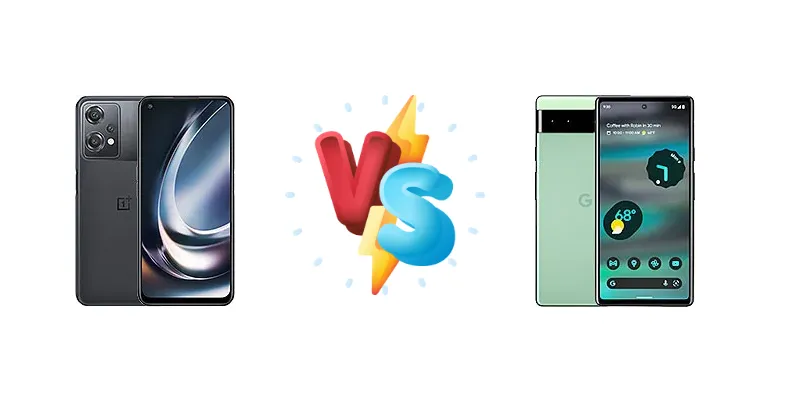
|
🏆 Quick Verdict
For most users, the Google Pixel 6a is the superior choice. While the Nord 2 Lite offers faster 33W charging, the Pixel 6a’s significantly more powerful Google Tensor chipset, superior display brightness (876 nits), and Google’s computational photography deliver a noticeably better overall experience.
| PHONES | ||
|---|---|---|
| Phone Names | OnePlus Nord 2 Lite | Google Pixel 6a |
| Network | ||
|---|---|---|
| 2G bands | GSM 850 / 900 / 1800 / 1900 | GSM 850 / 900 / 1800 / 1900 |
| 3G bands | HSDPA 800 / 850 / 900 / 1700(AWS) / 1900 / 2100 | HSDPA 800 / 850 / 900 / 1700(AWS) / 1900 / 2100 |
| 4G bands | LTE | 1, 2, 3, 4, 5, 7, 8, 12, 13, 14, 17, 18, 19, 20, 25, 26, 28, 29, 30, 38, 39, 40, 41, 42, 48, 66, 71 - GX7AS, GB62Z (USA/Canada) |
| 5G bands | SA/NSA | 1, 2, 3, 5, 7, 8, 12, 20, 25, 28, 30, 38, 40, 41, 48, 66, 71, 77, 78 SA/NSA/Sub6 - GX7AS (USA/Canada) |
| Speed | HSPA, LTE, 5G | HSPA, LTE, 5G |
| Technology | GSM / HSPA / LTE / 5G | GSM / HSPA / LTE / 5G |
| - | 1, 2, 3, 5, 7, 8, 12, 20, 25, 28, 30, 40, 48, 66, 71, 77, 78 SA/NSA/Sub6 - G1AZG (International) | |
| Launch | ||
|---|---|---|
| Announced | Not announced yet | 2022, May 11 |
| Status | Cancelled | Available. Released 2022, July 21 |
| Body | ||
|---|---|---|
| Build | Glass front, plastic frame, plastic back | Glass front (Gorilla Glass 3), aluminum frame, plastic back |
| Dimensions | 164.3 x 75.6 x 8.5 mm (6.47 x 2.98 x 0.33 in) | 152.2 x 71.8 x 8.9 mm (5.99 x 2.83 x 0.35 in) |
| SIM | Nano-SIM + Nano-SIM | Nano-SIM + eSIM |
| Weight | 195 g (6.88 oz) | 178 g (6.28 oz) |
| - | IP67 dust/water resistant (up to 1m for 30 min) | |
| Display | ||
|---|---|---|
| Protection | - | Corning Gorilla Glass 3 |
| Resolution | 1080 x 2412 pixels, 20:9 ratio (~401 ppi density) | 1080 x 2400 pixels, 20:9 ratio (~429 ppi density) |
| Size | 6.59 inches, 104.5 cm2 (~84.1% screen-to-body ratio) | 6.1 inches, 90.7 cm2 (~83.0% screen-to-body ratio) |
| Type | IPS LCD, 120Hz | OLED, HDR |
| - | Always-on display | |
| Platform | ||
|---|---|---|
| CPU | Octa-core (2x2.2 GHz Kryo 660 Gold & 6x1.7 GHz Kryo 660 Silver) | Octa-core (2x2.80 GHz Cortex-X1 & 2x2.25 GHz Cortex-A76 & 4x1.80 GHz Cortex-A55) |
| Chipset | Qualcomm SM6375 Snapdragon 695 5G (6 nm) | Google Tensor (5 nm) |
| GPU | Adreno 619 | Mali-G78 MP20 |
| OS | Android 12, OxygenOS 12.1 | Android 12, upgradable to Android 15, up to 5 major Android upgrades |
| Memory | ||
|---|---|---|
| Card slot | microSDXC (uses shared SIM slot) | No |
| Internal | 128GB 8GB RAM | 128GB 6GB RAM |
| - | UFS 3.1 | |
| Main Camera | ||
|---|---|---|
| Dual | - | 12.2 MP, f/1.7, 27mm, (wide), 1/2.55", 1.4µm, dual pixel PDAF, OIS 12 MP, f/2.2, 17mm, 114˚ (ultrawide), 1.25µm |
| Features | LED flash, HDR, panorama | Dual-LED flash, Pixel Shift, Auto-HDR, panorama |
| Single | - | 8 MP, f/2.0, 24mm (wide), 1.12µm |
| Triple | 64 MP, f/1.7, 26mm (wide), 0.7µm, PDAF 2 MP (macro) Auxiliary lens | - |
| Video | 1080p@30fps | 4K@30/60fps, 1080p@30/60/120/240fps; gyro-EIS, OIS |
| Selfie camera | ||
|---|---|---|
| Features | HDR | HDR, panorama |
| Single | 16 MP, f/2.0, (wide), 1/3.0", 1.0µm | 8 MP, f/2.0, 24mm (wide), 1.12µm |
| Video | 1080p@30fps | 1080p@30fps |
| Sound | ||
|---|---|---|
| 3.5mm jack | - | No |
| 35mm jack | Yes | No |
| Loudspeaker | Yes | Yes, with stereo speakers |
| Comms | ||
|---|---|---|
| Bluetooth | 5.2, A2DP, LE, aptX HD | 5.2, A2DP, LE |
| NFC | Yes | Yes |
| Positioning | GPS, GLONASS, GALILEO, BDS, QZSS | GPS, GLONASS, GALILEO, QZSS |
| Radio | Unspecified | No |
| USB | USB Type-C 2.0, OTG | USB Type-C 3.1 |
| WLAN | Wi-Fi 802.11 a/b/g/n/ac, dual-band, Wi-Fi Direct | Wi-Fi 802.11 a/b/g/n/ac/6e, dual-band, Wi-Fi Direct |
| Features | ||
|---|---|---|
| Sensors | Fingerprint (side-mounted), accelerometer, gyro, proximity, compass | Fingerprint (under display, optical), accelerometer, gyro, proximity, compass, barometer |
| Battery | ||
|---|---|---|
| Charging | 33W wired | 18W wired, PD3.0 |
| Type | Li-Po 5000 mAh | Li-Po 4410 mAh |
| Misc | ||
|---|---|---|
| Colors | Black Dusk, Blue Tide | Chalk, Charcoal, Sage |
| Models | - | GX7AS, GB62Z, G1AZG, GB17L |
| Price | - | $ 138.99 / C$ 228.74 / ₹ 23,999 |
| Tests | ||
|---|---|---|
| Battery life | - | Endurance rating 94h |
| Display | - | Contrast ratio: Infinite (nominal) |
OnePlus Nord 2 Lite
- Significantly more powerful Google Tensor chipset
- Brighter and higher contrast display
- Superior camera image processing
- Guaranteed software updates from Google
- Slower 18W charging
- No expandable storage
Google Pixel 6a
- Faster 33W wired charging
- Lower initial price
- Sleek design
- 5G connectivity
- Less powerful Snapdragon 695 chipset
- Inferior camera performance
- Less frequent software updates
Display Comparison
The Pixel 6a boasts a significantly brighter display, reaching a measured 876 nits, compared to an unspecified brightness for the Nord 2 Lite. This translates to better visibility outdoors under direct sunlight. While both phones likely utilize OLED panels, the Pixel 6a’s ‘Infinite’ contrast ratio suggests superior black levels and overall image quality. The lack of high refresh rate on either device is a compromise at this price point, but the Pixel 6a’s superior brightness and contrast make it the more visually appealing option.
Camera Comparison
While detailed camera specs are limited for the Nord 2 Lite, the Pixel 6a leverages Google’s renowned computational photography expertise. The Pixel 6a’s image processing algorithms excel in dynamic range, detail preservation, and low-light performance. The absence of a dedicated telephoto lens on both phones means digital zoom will be the primary method for long-distance shots. The Nord 2 Lite’s inclusion of a 2MP macro lens is largely inconsequential, as image quality from such sensors is typically poor. The Pixel 6a’s superior processing power and software optimizations will likely result in consistently better photos and videos.
Performance
The core difference lies in the chipsets. The Google Pixel 6a’s Google Tensor (5nm) is a substantial upgrade over the OnePlus Nord 2 Lite’s Qualcomm Snapdragon 695 5G (6nm). Tensor’s octa-core configuration, featuring 2x2.80 GHz Cortex-X1 cores, provides significantly more processing power than the Nord 2 Lite’s 2x2.2 GHz Kryo 660 Gold cores. This difference is particularly noticeable in demanding tasks like video editing, gaming, and AI-powered features. The 5nm fabrication process of the Tensor chip also contributes to better thermal efficiency, potentially reducing throttling during sustained workloads. While the Nord 2 Lite is adequate for everyday tasks, the Pixel 6a offers a smoother and more responsive experience.
Battery Life
Both phones achieve an endurance rating of 94 hours, suggesting comparable battery life under similar usage scenarios. However, the charging speeds differ significantly. The OnePlus Nord 2 Lite supports 33W wired charging, allowing for a faster 0-100% charge time. The Pixel 6a is limited to 18W wired charging with PD3.0, resulting in a slower charging experience. Despite the slower charging, the Pixel 6a’s efficient Tensor chip and software optimizations help maintain its impressive battery endurance.
Buying Guide
Buy the OnePlus Nord 2 Lite if you prioritize rapid charging and a slightly lower initial cost, and don't heavily rely on demanding applications or advanced camera features. Buy the Google Pixel 6a if you value performance, a brighter and more vibrant display, and Google’s industry-leading camera software and long-term software support. The Pixel 6a is the better investment for users who want a phone that will remain capable for years to come.