
OnePlus Nord 2 5G vs Samsung Galaxy A54: A Detailed Comparison
| Phones Images | |||||
|---|---|---|---|---|---|
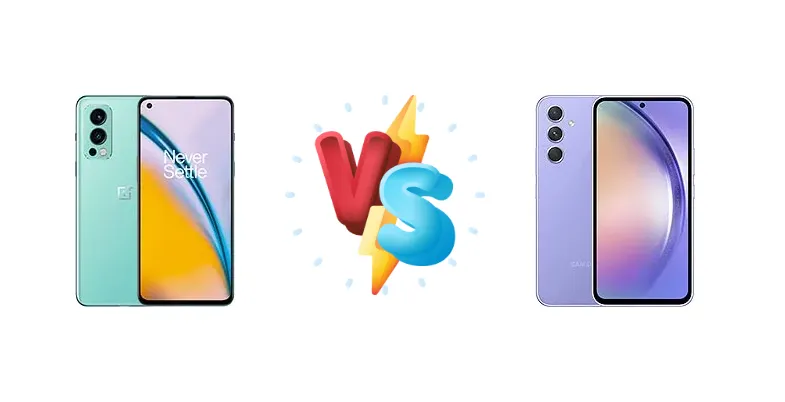
|
🏆 Quick Verdict
For users prioritizing raw performance and incredibly fast charging, the OnePlus Nord 2 5G remains a strong contender. However, the Samsung Galaxy A54 edges ahead for the average user thanks to its superior battery endurance, brighter display, and more modern software support, making it the more well-rounded choice.
| PHONES | ||
|---|---|---|
| Phone Names | OnePlus Nord 2 5G | Samsung Galaxy A54 |
| Network | ||
|---|---|---|
| 2G bands | GSM 850 / 900 / 1800 / 1900 | GSM 850 / 900 / 1800 / 1900 |
| 3G bands | HSDPA 800 / 850 / 900 / 1700(AWS) / 1800 / 1900 / 2100 | HSDPA 850 / 900 / 1700(AWS) / 1900 / 2100 |
| 4G bands | 1, 2, 3, 4, 5, 7, 8, 12, 17, 18, 19, 20, 26, 28, 32, 34, 38, 39, 40, 41, 66 - EU | 1, 2, 3, 4, 5, 7, 8, 12, 17, 20, 26, 28, 32, 38, 40, 41, 66 - International |
| 5G bands | 1, 3, 7, 8, 20, 28, 38, 41, 66, 78 SA/NSA - EU | 1, 3, 7, 8, 20, 28, 38, 40, 41, 77, 78 SA/NSA/Sub6 - International |
| Speed | HSPA 42.2/5.76 Mbps, LTE Cat18 1200/150 Mbps, 5G | HSPA, LTE, 5G |
| Technology | GSM / HSPA / LTE / 5G | GSM / HSPA / LTE / 5G |
| - | 25, 41, 66, 71 SA/NSA/Sub6/mmWave - USA | |
| Launch | ||
|---|---|---|
| Announced | 2021, July 22 | 2023, March 15 |
| Status | Available. Released 2021, July 28 | Available. Released 2023, March 24 |
| Body | ||
|---|---|---|
| Build | Glass front (Gorilla Glass 5), glass back (Gorilla Glass 5), plastic frame | Glass front (Gorilla Glass 5), glass back (Gorilla Glass 5), plastic frame |
| Dimensions | 159.1 x 73.3 x 8.3 mm (6.26 x 2.89 x 0.33 in) | 158.2 x 76.7 x 8.2 mm (6.23 x 3.02 x 0.32 in) |
| SIM | Nano-SIM + Nano-SIM | · Nano-SIM + eSIM· Nano-SIM + Nano-SIM |
| Weight | 189 g (6.67 oz) | 202 g (7.13 oz) |
| - | IP67 dust/water resistant (up to 1m for 30 min) | |
| Display | ||
|---|---|---|
| Protection | Corning Gorilla Glass 5 | Corning Gorilla Glass 5 |
| Resolution | 1080 x 2400 pixels, 20:9 ratio (~409 ppi density) | 1080 x 2340 pixels, 19.5:9 ratio (~403 ppi density) |
| Size | 6.43 inches, 99.8 cm2 (~85.6% screen-to-body ratio) | 6.4 inches, 100.5 cm2 (~82.9% screen-to-body ratio) |
| Type | Fluid AMOLED, 90Hz, HDR10+ | Super AMOLED, 120Hz, HDR10+, 1000 nits (HBM) |
| Platform | ||
|---|---|---|
| CPU | Octa-core (1x3.0 GHz Cortex-A78 & 3x2.6 GHz Cortex-A78 & 4x2.0 GHz Cortex-A55) | Octa-core (4x2.4 GHz Cortex-A78 & 4x2.0 GHz Cortex-A55) |
| Chipset | Mediatek Dimensity 1200 (6 nm) | Exynos 1380 (5 nm) |
| GPU | Mali-G77 MC9 | Mali-G68 MP5 |
| OS | Android 11, upgradable to Android 13, OxygenOS 13 | Android 13, up to 4 major Android upgrades, One UI 7 |
| Memory | ||
|---|---|---|
| Card slot | No | microSDXC (uses shared SIM slot) |
| Internal | 128GB 6GB RAM, 128GB 8GB RAM, 256GB 8GB RAM, 256GB 12GB RAM | 128GB 4GB RAM, 128GB 6GB RAM, 128GB 8GB RAM, 256GB 6GB RAM, 256GB 8GB RAM |
| Main Camera | ||
|---|---|---|
| Features | Dual-LED flash, HDR, panorama | LED flash, panorama, HDR |
| Single | - | 32 MP, f/2.2, 26mm (wide), 1/2.8", 0.8µm |
| Triple | 50 MP, f/1.9, 24mm (wide), 1/1.56", 1.0µm, PDAF, OIS 8 MP, f/2.3, 120˚ (ultrawide) Auxiliary lens | 50 MP, f/1.8, 23mm (wide), 1/1.56", 1.0µm, PDAF, OIS 12 MP, f/2.2, 13mm, 123˚ (ultrawide), 1/3.X", 1.12µm 5 MP (macro) |
| Video | 4K@30fps, 1080p@30/60/120fps, gyro-EIS | 4K@30fps, 1080p@30/60fps, 720p@480fps, gyro-EIS |
| Selfie camera | ||
|---|---|---|
| Features | Auto HDR | - |
| Single | 32 MP, f/2.5, (wide), 1/2.8", 0.8µm | 32 MP, f/2.2, 26mm (wide), 1/2.8", 0.8µm |
| Video | 1080p@30fps, gyro-EIS | 4K@30fps, 1080p@30/60fps |
| Sound | ||
|---|---|---|
| 3.5mm jack | No | No |
| 35mm jack | No | No |
| Loudspeaker | Yes, with stereo speakers | Yes, with stereo speakers |
| Comms | ||
|---|---|---|
| Bluetooth | 5.2, A2DP, LE, aptX HD | 5.3, A2DP, LE |
| NFC | Yes | Yes (market/region dependent) |
| Positioning | GPS, GLONASS, GALILEO, BDS, SBAS, NavIC | GPS, GLONASS, GALILEO, BDS |
| Radio | No | No |
| USB | USB Type-C 2.0, OTG | USB Type-C 2.0, OTG |
| WLAN | Wi-Fi 802.11 a/b/g/n/ac/6, dual-band, Wi-Fi Direct | Wi-Fi 802.11 a/b/g/n/ac/6, dual-band, Wi-Fi Direct |
| Features | ||
|---|---|---|
| Sensors | Fingerprint (under display, optical), accelerometer, gyro, proximity, compass | Fingerprint (under display, optical), accelerometer, gyro, compass, barometer (USA only) |
| - | Virtual proximity sensing | |
| Battery | ||
|---|---|---|
| Charging | 65W wired, PD, 100% in 30 min | 25W wired |
| Type | Li-Po 4500 mAh | 5000 mAh |
| Misc | ||
|---|---|---|
| Colors | Gray Sierra, Blue Haze, Green Wood, Pac-Man Edition | Lime, Graphite, Violet, White |
| Models | DN2101, DN2103 | SM-A546V, SM-A546U, SM-A546U1, SM-A546B, SM-A546B/DS, SM-A546E, SM-A546E/DS, SM-A5460, SM-A546M, SM-A546M/DS, SM-A546W |
| Price | € 189.00 / $ 219.99 / £ 148.00 | € 210.00 / $ 119.11 / £ 169.95 / ₹ 28,999 |
| SAR | - | 0.81 W/kg (head) 0.67 W/kg (body) |
| SAR EU | - | 0.69 W/kg (head) 1.34 W/kg (body) |
| Tests | ||
|---|---|---|
| Battery life | Endurance rating 102h | Endurance rating 119h |
| Camera | Photo / Video | Photo / Video |
| Display | Contrast ratio: Infinite (nominal) | Contrast ratio: Infinite (nominal) |
| Loudspeaker | -24.3 LUFS (Very good) | -26.6 LUFS (Good) |
| Performance | AnTuTu: 512164 (v8) | 598022 (v9) GeekBench: 2792 (v5.1) GFXBench: 38fps (ES 3.1 onscreen) | AnTuTu: 506678 (v9) GeekBench: 2703 (v5.1), 2797 (v6) GFXBench: 25fps (ES 3.1 onscreen) |
OnePlus Nord 2 5G
- Faster charging (65W)
- Potentially higher CPU performance
- More affordable (likely, given age)
- Shorter battery life
- Less bright display
- Older chipset and software support
Samsung Galaxy A54
- Longer battery life
- Brighter display
- More modern chipset and software
- Slower charging (25W)
- Potentially lower CPU performance
- May be more expensive
Display Comparison
The Samsung Galaxy A54’s display significantly outshines the Nord 2 5G in peak brightness, reaching 980 nits compared to the Nord 2 5G’s 633 nits. This translates to better outdoor visibility, especially in direct sunlight. Both displays share an 'Infinite' (nominal) contrast ratio, suggesting deep blacks typical of OLED panels. While both offer a smooth experience, the A54’s higher brightness and potentially better color calibration (though not specified in the data) make it the superior choice for media consumption and everyday use. The lack of LTPO on either device means refresh rate isn't dynamically adjusted for power saving.
Camera Comparison
Both phones feature capable camera systems, but the provided data lacks specifics to make a definitive judgment. Without sensor size or aperture information, it’s difficult to assess low-light performance. The presence of 'Photo / Video' capabilities on both suggests similar functionality, but image processing philosophies likely differ. Samsung typically favors vibrant, saturated colors, while OnePlus often aims for a more natural look. The usefulness of a 2MP macro camera (likely present on both) is questionable, as image quality is typically limited. A deeper analysis would require sample photos and video comparisons.
Performance
The OnePlus Nord 2 5G’s Mediatek Dimensity 1200 (6nm) and its octa-core CPU configuration (1x3.0 GHz Cortex-A78, 3x2.6 GHz Cortex-A78, 4x2.0 GHz Cortex-A55) offer a theoretical performance advantage over the Samsung Galaxy A54’s Exynos 1380 (5nm) and its octa-core CPU (4x2.4 GHz Cortex-A78, 4x2.0 GHz Cortex-A55). The Dimensity 1200’s higher clock speeds on its prime cores should result in snappier performance in CPU-intensive tasks. However, the Exynos 1380’s 5nm process node is more efficient, potentially leading to better sustained performance and thermal management under prolonged load. The A54's newer architecture may also benefit from software optimizations not available on the older Nord 2 5G.
Battery Life
The Samsung Galaxy A54 demonstrates a clear advantage in battery endurance, boasting an endurance rating of 119 hours compared to the Nord 2 5G’s 102 hours. This is further supported by the A54’s active use score of 11:15h. While the Nord 2 5G compensates with incredibly fast 65W wired charging (100% in 30 minutes), the A54’s 25W charging is significantly slower. The A54’s superior efficiency, stemming from the 5nm Exynos 1380, allows it to deliver longer runtimes despite a potentially similar battery capacity (not specified in the data). The Nord 2 5G prioritizes quick top-ups, while the A54 focuses on lasting power.
Buying Guide
Buy the OnePlus Nord 2 5G if you need a phone that can handle demanding tasks and games without compromise, and if minimizing charging time is a top priority. Buy the Samsung Galaxy A54 if you prefer a phone with exceptional battery life, a vibrant and easily visible display, and a more polished software experience with guaranteed updates.