
OnePlus Nord 2 5G vs OnePlus Nord: Which Mid-Range Champion Reigns Supreme?
| Phones Images | |||||
|---|---|---|---|---|---|
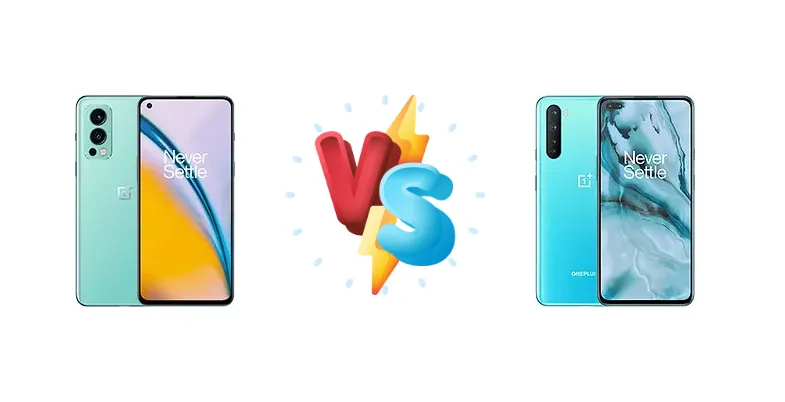
|
🏆 Quick Verdict
For most users, the OnePlus Nord 2 5G is the superior choice. Its significantly more powerful Mediatek Dimensity 1200 chipset delivers a noticeable performance boost, especially in demanding tasks and gaming, while maintaining comparable battery life and benefiting from much faster 65W charging. However, the original Nord remains a viable option for budget-conscious buyers.
| PHONES | ||
|---|---|---|
| Phone Names | OnePlus Nord 2 5G | OnePlus Nord |
| Network | ||
|---|---|---|
| 2G bands | GSM 850 / 900 / 1800 / 1900 | GSM 850 / 900 / 1800 / 1900 |
| 3G bands | HSDPA 800 / 850 / 900 / 1700(AWS) / 1800 / 1900 / 2100 | HSDPA 800 / 850 / 900 / 1700(AWS) / 1800 / 1900 / 2100 |
| 4G bands | 1, 2, 3, 4, 5, 7, 8, 12, 17, 18, 19, 20, 26, 28, 32, 34, 38, 39, 40, 41, 66 - EU | 1, 2, 3, 4, 5, 7, 8, 12, 17, 18, 19, 20, 26, 28, 32, 34, 38, 39, 40, 41, 66 - Europe |
| 5G bands | 1, 3, 7, 8, 20, 28, 38, 41, 66, 78 SA/NSA - EU | 1, 3, 7, 28, 78 SA/NSA - Europe |
| Speed | HSPA 42.2/5.76 Mbps, LTE Cat18 1200/150 Mbps, 5G | HSPA 42.2/5.76 Mbps, LTE Cat18 1200/150 Mbps, 5G |
| Technology | GSM / HSPA / LTE / 5G | GSM / HSPA / LTE / 5G |
| - | 78 SA/NSA - India | |
| Launch | ||
|---|---|---|
| Announced | 2021, July 22 | 2020, July 21 |
| Status | Available. Released 2021, July 28 | Available. Released 2020, August 04 |
| Body | ||
|---|---|---|
| Build | Glass front (Gorilla Glass 5), glass back (Gorilla Glass 5), plastic frame | Glass front (Gorilla Glass 5), glass back (Gorilla Glass 5), plastic frame |
| Dimensions | 159.1 x 73.3 x 8.3 mm (6.26 x 2.89 x 0.33 in) | 158.3 x 73.3 x 8.2 mm (6.23 x 2.89 x 0.32 in) |
| SIM | Nano-SIM + Nano-SIM | Nano-SIM + Nano-SIM |
| Weight | 189 g (6.67 oz) | 184 g (6.49 oz) |
| Display | ||
|---|---|---|
| Protection | Corning Gorilla Glass 5 | Corning Gorilla Glass 5 |
| Resolution | 1080 x 2400 pixels, 20:9 ratio (~409 ppi density) | 1080 x 2400 pixels, 20:9 ratio (~408 ppi density) |
| Size | 6.43 inches, 99.8 cm2 (~85.6% screen-to-body ratio) | 6.44 inches, 100.6 cm2 (~86.7% screen-to-body ratio) |
| Type | Fluid AMOLED, 90Hz, HDR10+ | Fluid AMOLED, 90Hz, HDR10+ |
| Platform | ||
|---|---|---|
| CPU | Octa-core (1x3.0 GHz Cortex-A78 & 3x2.6 GHz Cortex-A78 & 4x2.0 GHz Cortex-A55) | Octa-core (1x2.4 GHz Kryo 475 Prime & 1x2.2 GHz Kryo 475 Gold & 6x1.8 GHz Kryo 475 Silver) |
| Chipset | Mediatek Dimensity 1200 (6 nm) | Qualcomm SM7250 Snapdragon 765G 5G (7 nm) |
| GPU | Mali-G77 MC9 | Adreno 620 |
| OS | Android 11, upgradable to Android 13, OxygenOS 13 | Android 10, upgradable to Android 12, OxygenOS 12 |
| Memory | ||
|---|---|---|
| Card slot | No | No |
| Internal | 128GB 6GB RAM, 128GB 8GB RAM, 256GB 8GB RAM, 256GB 12GB RAM | 64GB 6GB RAM, 128GB 8GB RAM, 256GB 12GB RAM |
| - | UFS 2.1 | |
| Main Camera | ||
|---|---|---|
| Features | Dual-LED flash, HDR, panorama | Dual-LED flash, HDR, panorama |
| Quad | - | 48 MP, f/1.8, 26mm (wide), 1/2.0", 0.8µm, PDAF, OIS 8 MP, f/2.3, 119˚ (ultrawide) 2 MP (macro) Auxiliary lens |
| Triple | 50 MP, f/1.9, 24mm (wide), 1/1.56", 1.0µm, PDAF, OIS 8 MP, f/2.3, 120˚ (ultrawide) Auxiliary lens | - |
| Video | 4K@30fps, 1080p@30/60/120fps, gyro-EIS | 4K@30fps, 1080p@30/60/240fps, gyro-EIS |
| Selfie camera | ||
|---|---|---|
| Dual | - | 32 MP, f/2.5, (wide), 1/2.8", 0.8µm 8 MP, f/2.5, 105˚ (ultrawide), 1/4.0", 1.12µm |
| Features | Auto HDR | HDR |
| Single | 32 MP, f/2.5, (wide), 1/2.8", 0.8µm | - |
| Video | 1080p@30fps, gyro-EIS | 4K@30/60fps, 1080p@30/60fps |
| Sound | ||
|---|---|---|
| 3.5mm jack | No | No |
| 35mm jack | No | No |
| Loudspeaker | Yes, with stereo speakers | Yes |
| Comms | ||
|---|---|---|
| Bluetooth | 5.2, A2DP, LE, aptX HD | 5.1, A2DP, LE, aptX HD |
| NFC | Yes | Yes |
| Positioning | GPS, GLONASS, GALILEO, BDS, SBAS, NavIC | GPS (L1+L5), GLONASS (G1), BDS (B1), GALILEO (E1+E5a), NavIC |
| Radio | No | No |
| USB | USB Type-C 2.0, OTG | USB Type-C 2.0, OTG |
| WLAN | Wi-Fi 802.11 a/b/g/n/ac/6, dual-band, Wi-Fi Direct | Wi-Fi 802.11 a/b/g/n/ac, dual-band, Wi-Fi Direct |
| Features | ||
|---|---|---|
| Sensors | Fingerprint (under display, optical), accelerometer, gyro, proximity, compass | Fingerprint (under display, optical), accelerometer, gyro, proximity, compass |
| Battery | ||
|---|---|---|
| Charging | 65W wired, PD, 100% in 30 min | 30W wired, 70% in 30 min |
| Type | Li-Po 4500 mAh | Li-Po 4115 mAh |
| Misc | ||
|---|---|---|
| Colors | Gray Sierra, Blue Haze, Green Wood, Pac-Man Edition | Blue Marble, Gray Onyx (Gray Ash) |
| Models | DN2101, DN2103 | AC2001, AC2003 |
| Price | € 189.00 / $ 219.99 / £ 148.00 | € 101.45 / £ 119.99 |
| Pricing | ||
|---|---|---|
| 128GB 8GB RAM | - | $ 299.00 |
| 256GB 12GB RAM | - | $ 329.99 |
| 64GB 6GB RAM | - | C$ 865.00 |
| RENEWED | - | £ 172.00 |
| Tests | ||
|---|---|---|
| Battery life | Endurance rating 102h | Endurance rating 100h |
| Camera | Photo / Video | Photo / Video |
| Display | Contrast ratio: Infinite (nominal) | Contrast ratio: Infinite (nominal) |
| Loudspeaker | -24.3 LUFS (Very good) | -29.6 LUFS (Average) |
| Performance | AnTuTu: 512164 (v8) | 598022 (v9) GeekBench: 2792 (v5.1) GFXBench: 38fps (ES 3.1 onscreen) | AnTuTu: 315641 (v8) GeekBench: 7844 (v4.4), 1953 (v5.1) GFXBench: 19fps (ES 3.1 onscreen) |
OnePlus Nord 2 5G
- Significantly faster processor (Dimensity 1200)
- Much faster 65W charging
- Potentially better camera image processing
- Lower peak display brightness
- Potentially higher price
OnePlus Nord
- Brighter display for outdoor visibility
- More affordable price point
- Good battery life
- Slower processor (Snapdragon 765G)
- Slower 30W charging
Display Comparison
The OnePlus Nord boasts a brighter display, reaching 756 nits compared to the Nord 2 5G’s 633 nits. This difference is noticeable in direct sunlight, giving the original Nord an edge in outdoor visibility. Both displays share an 'Infinite' (nominal) contrast ratio, suggesting similar black levels and overall image quality. However, the Nord 2 5G’s display technology isn’t specified, while the Nord’s brightness advantage is a clear win for outdoor use.
Camera Comparison
Both phones feature capable camera systems, but detailed sensor information is lacking. The focus should be on image processing. While both are listed as capable of Photo/Video, the Dimensity 1200’s ISP (Image Signal Processor) in the Nord 2 5G likely offers more advanced features and faster processing speeds, potentially leading to better low-light performance and video stabilization. Without specific sensor details, it’s difficult to declare a definitive winner, but the Nord 2 5G’s chipset gives it a potential edge.
Performance
The core difference lies in the chipsets. The Nord 2 5G’s Mediatek Dimensity 1200 (6nm) is a substantial upgrade over the Nord’s Qualcomm Snapdragon 765G (7nm). The Dimensity 1200’s octa-core configuration, featuring a 3.0 GHz Cortex-A78 prime core, provides significantly faster CPU and GPU performance. This translates to smoother multitasking, quicker app loading times, and a more enjoyable gaming experience. The 7nm process of the Snapdragon 765G is more efficient, but the architectural improvements and higher clock speeds of the Dimensity 1200 outweigh this advantage. The Nord 2 5G is the clear winner for power users.
Battery Life
Both the Nord and Nord 2 5G achieve remarkably similar endurance ratings of 100 and 102 hours respectively, despite the Nord 2 5G’s more powerful processor. This suggests efficient power management on both devices. However, the Nord 2 5G’s 65W wired charging is a game-changer, achieving a full charge in just 30 minutes, compared to the Nord’s 30W charging which only reaches 70% in the same timeframe. This faster charging significantly reduces downtime and provides a more convenient user experience.
Buying Guide
Buy the OnePlus Nord 2 5G if you prioritize performance for gaming, multitasking, or content creation and value faster charging speeds. Buy the OnePlus Nord if you are on a tighter budget and primarily need a reliable smartphone for everyday tasks like browsing, social media, and basic photography. The Nord’s lower price point makes it an excellent value proposition for less demanding users.