
OnePlus Nord 2 5G vs OnePlus 9: A Detailed Comparison of Performance and Value
| Phones Images | |||||
|---|---|---|---|---|---|
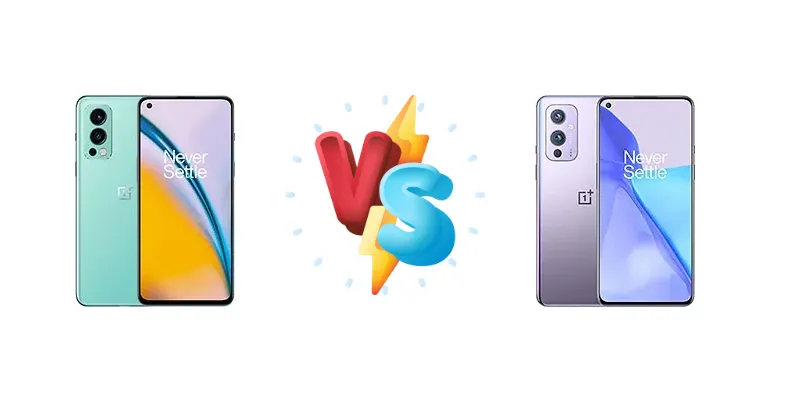
|
🏆 Quick Verdict
For the average user prioritizing battery life and efficient performance, the OnePlus Nord 2 5G emerges as the better value. Its 102-hour endurance rating significantly surpasses the OnePlus 9’s 87 hours, and the Dimensity 1200 provides ample power for daily tasks and gaming without the potential for aggressive throttling seen in the Snapdragon 888.
| PHONES | ||
|---|---|---|
| Phone Names | OnePlus Nord 2 5G | OnePlus 9 |
| Network | ||
|---|---|---|
| 2G bands | GSM 850 / 900 / 1800 / 1900 | GSM 850 / 900 / 1800 / 1900 |
| 3G bands | HSDPA 800 / 850 / 900 / 1700(AWS) / 1800 / 1900 / 2100 | HSDPA 800 / 850 / 900 / 1700(AWS) / 1800 / 1900 / 2100 |
| 4G bands | 1, 2, 3, 4, 5, 7, 8, 12, 17, 18, 19, 20, 26, 28, 32, 34, 38, 39, 40, 41, 66 - EU | 1, 2, 3, 4, 5, 7, 8, 12, 13, 17, 18, 19, 20, 25, 26, 28, 32, 38, 39, 40, 41, 66 - EU |
| 5G bands | 1, 3, 7, 8, 20, 28, 38, 41, 66, 78 SA/NSA - EU | 1, 3, 5, 7, 8, 20, 28, 38, 40, 41, 66, 78 SA/NSA - EU |
| Speed | HSPA 42.2/5.76 Mbps, LTE Cat18 1200/150 Mbps, 5G | HSPA 42.2/5.76 Mbps, LTE Cat20 2000/200 Mbps, 5G |
| Technology | GSM / HSPA / LTE / 5G | GSM / CDMA / HSPA / LTE / 5G |
| - | 1, 3, 28, 41, 78, 79 SA/NSA - CN | |
| Launch | ||
|---|---|---|
| Announced | 2021, July 22 | 2021, March 23 |
| Status | Available. Released 2021, July 28 | Available. Released 2021, March 26 |
| Body | ||
|---|---|---|
| Build | Glass front (Gorilla Glass 5), glass back (Gorilla Glass 5), plastic frame | Glass front (Gorilla Glass 5), glass back (Gorilla Glass 5), plastic frame |
| Dimensions | 159.1 x 73.3 x 8.3 mm (6.26 x 2.89 x 0.33 in) | 160 x 74.2 x 8.7 mm (EU/NA)160 x 73.9 x 8.1 mm (IN/CN) |
| SIM | Nano-SIM + Nano-SIM | · Nano-SIM· Nano-SIM + Nano-SIM |
| Weight | 189 g (6.67 oz) | 192 g (EU/NA)183 g (IN/CN) (6.46 oz) |
| - | IP68 (T-Mobile version only) | |
| Display | ||
|---|---|---|
| Protection | Corning Gorilla Glass 5 | Corning Gorilla Glass 5 |
| Resolution | 1080 x 2400 pixels, 20:9 ratio (~409 ppi density) | 1080 x 2400 pixels, 20:9 ratio (~402 ppi density) |
| Size | 6.43 inches, 99.8 cm2 (~85.6% screen-to-body ratio) | 6.55 inches, 103.6 cm2 (~87.6% screen-to-body ratio) |
| Type | Fluid AMOLED, 90Hz, HDR10+ | Fluid AMOLED, 120Hz, HDR10+, 1100 nits (peak) |
| - | Always-on display | |
| Platform | ||
|---|---|---|
| CPU | Octa-core (1x3.0 GHz Cortex-A78 & 3x2.6 GHz Cortex-A78 & 4x2.0 GHz Cortex-A55) | Octa-core (1x2.84 GHz Cortex-X1 & 3x2.42 GHz Cortex-A78 & 4x1.80 GHz Cortex-A55) |
| Chipset | Mediatek Dimensity 1200 (6 nm) | Qualcomm SM8350 Snapdragon 888 5G (5 nm) |
| GPU | Mali-G77 MC9 | Adreno 660 |
| OS | Android 11, upgradable to Android 13, OxygenOS 13 | Android 11, upgradable to Android 13, OxygenOS 13 |
| Memory | ||
|---|---|---|
| Card slot | No | No |
| Internal | 128GB 6GB RAM, 128GB 8GB RAM, 256GB 8GB RAM, 256GB 12GB RAM | 128GB 8GB RAM, 256GB 12GB RAM |
| - | UFS 3.1 | |
| Main Camera | ||
|---|---|---|
| Features | Dual-LED flash, HDR, panorama | Hasselblad Color Calibration, color spectrum sensor, dual-LED flash, HDR, panorama |
| Single | - | 16 MP, f/2.4, (wide), 1/3.06", 1.0µm |
| Triple | 50 MP, f/1.9, 24mm (wide), 1/1.56", 1.0µm, PDAF, OIS 8 MP, f/2.3, 120˚ (ultrawide) Auxiliary lens | 48 MP, f/1.8, 23mm (wide), 1/1.43", 1.12µm, multi-directional PDAF 50 MP, f/2.2, 14mm (ultrawide), 1/1.56", 1.0µm, AF 2 MP, f/2.4, (monochrome) |
| Video | 4K@30fps, 1080p@30/60/120fps, gyro-EIS | 8K@30fps, 4K@30/60fps, 1080p@30/60/240fps, Auto HDR, gyro-EIS |
| Selfie camera | ||
|---|---|---|
| Features | Auto HDR | HDR |
| Single | 32 MP, f/2.5, (wide), 1/2.8", 0.8µm | 16 MP, f/2.4, (wide), 1/3.06", 1.0µm |
| Video | 1080p@30fps, gyro-EIS | 1080p@30fps, gyro-EIS |
| Sound | ||
|---|---|---|
| 3.5mm jack | No | No |
| 35mm jack | No | No |
| Loudspeaker | Yes, with stereo speakers | Yes, with stereo speakers |
| - | 24-bit/192kHz audio | |
| Comms | ||
|---|---|---|
| Bluetooth | 5.2, A2DP, LE, aptX HD | 5.2, A2DP, LE, aptX HD |
| NFC | Yes | Yes |
| Positioning | GPS, GLONASS, GALILEO, BDS, SBAS, NavIC | GPS (L1+L5), GLONASS (G1), BDS (B1), GALILEO (E1+E5a) |
| Radio | No | No |
| USB | USB Type-C 2.0, OTG | USB Type-C 3.1, OTG |
| WLAN | Wi-Fi 802.11 a/b/g/n/ac/6, dual-band, Wi-Fi Direct | Wi-Fi 802.11 a/b/g/n/ac/6, dual-band, Wi-Fi Direct, DLNA |
| Features | ||
|---|---|---|
| Sensors | Fingerprint (under display, optical), accelerometer, gyro, proximity, compass | Fingerprint (under display, optical), accelerometer, gyro, proximity, compass |
| Battery | ||
|---|---|---|
| Charging | 65W wired, PD, 100% in 30 min | 65W wired, PD, 100% in 29 min 15W wireless (EU/NA) |
| Type | Li-Po 4500 mAh | Li-Po 4500 mAh |
| Misc | ||
|---|---|---|
| Colors | Gray Sierra, Blue Haze, Green Wood, Pac-Man Edition | Winter Mist, Arctic Sky, Astral Black |
| Models | DN2101, DN2103 | LE2113, LE2111, LE2110, LE2117, LE2115 |
| Price | € 189.00 / $ 219.99 / £ 148.00 | $ 145.00 / £ 200.00 / € 249.99 |
| Tests | ||
|---|---|---|
| Battery life | Endurance rating 102h | Endurance rating 87h |
| Camera | Photo / Video | Photo / Video |
| Display | Contrast ratio: Infinite (nominal) | - |
| Loudspeaker | -24.3 LUFS (Very good) | -24.5 LUFS (Very good) |
| Performance | AnTuTu: 512164 (v8) | 598022 (v9) GeekBench: 2792 (v5.1) GFXBench: 38fps (ES 3.1 onscreen) | - |
OnePlus Nord 2 5G
- Significantly longer battery life (102h endurance)
- Efficient Dimensity 1200 chipset for sustained performance
- Fast 65W wired charging
- Less bright display compared to OnePlus 9
- Lacks wireless charging
OnePlus 9
- Brighter display for better outdoor visibility
- More powerful Snapdragon 888 processor for peak performance
- 15W wireless charging support
- Shorter battery life (87h endurance)
- Potential for thermal throttling under heavy load
Display Comparison
The OnePlus 9 boasts a brighter display, reaching 821 nits compared to the Nord 2 5G’s 633 nits. This translates to better visibility under direct sunlight. However, both displays share an infinite (nominal) contrast ratio, suggesting excellent black levels. While neither specification details panel technology (LTPO, AMOLED), OnePlus historically uses high-quality AMOLED panels. The brightness difference is the most significant distinction, favoring the OnePlus 9 for outdoor use.
Camera Comparison
Both devices are listed as having Photo/Video capabilities, but the provided data lacks specifics regarding sensor size, aperture, or image processing algorithms. Without this information, a definitive camera comparison is impossible. However, given the OnePlus 9’s flagship status, it likely incorporates a more sophisticated camera system with potentially larger sensors and more advanced features. The absence of details regarding OIS (Optical Image Stabilization) on either device is a notable omission. The OnePlus 9 likely benefits from a more refined image processing pipeline, but the Nord 2 5G could still deliver excellent results in good lighting conditions.
Performance
The core difference lies in the chipsets: the Nord 2 5G utilizes the Mediatek Dimensity 1200 (6nm), while the OnePlus 9 features the Qualcomm Snapdragon 888 5G (5nm). The Snapdragon 888, with its Cortex-X1 prime core clocked at 2.84 GHz, theoretically offers higher peak performance. However, the 5nm process node, while generally more efficient, was known to generate significant heat under sustained load in the Snapdragon 888, potentially leading to throttling. The Dimensity 1200’s 6nm process and octa-core configuration (including three Cortex-A78 cores) provide a strong balance of performance and efficiency, potentially offering more consistent performance over extended periods. Both phones utilize Octa-core CPUs, but the architectural differences favor the Snapdragon 888 in burst performance, while the Dimensity 1200 may excel in sustained tasks.
Battery Life
Battery life is a clear win for the OnePlus Nord 2 5G, achieving an endurance rating of 102 hours versus the OnePlus 9’s 87 hours. This 15-hour difference is substantial and indicates a significant advantage in real-world usage. Both phones support 65W wired charging, achieving a full charge in approximately 30 minutes. The OnePlus 9 adds 15W wireless charging (in EU/NA regions), a feature absent on the Nord 2 5G. However, the Nord 2 5G’s superior battery endurance mitigates the need for frequent charging, making the wireless charging feature less critical for many users.
Buying Guide
Buy the OnePlus Nord 2 5G if you need exceptional battery life, fast 65W charging, and a smooth, responsive experience for everyday use and moderate gaming. You’ll appreciate the value proposition and the longevity offered by its efficient chipset. Buy the OnePlus 9 if you prioritize raw processing power for demanding tasks like video editing or consistently high frame rates in graphically intensive games, and if you value the slightly brighter display and potentially more advanced camera features (though specifics are limited by the provided data).