
OnePlus Nord 2 5G vs OnePlus 10R: A Deep Dive into Performance and Value
| Phones Images | |||||
|---|---|---|---|---|---|
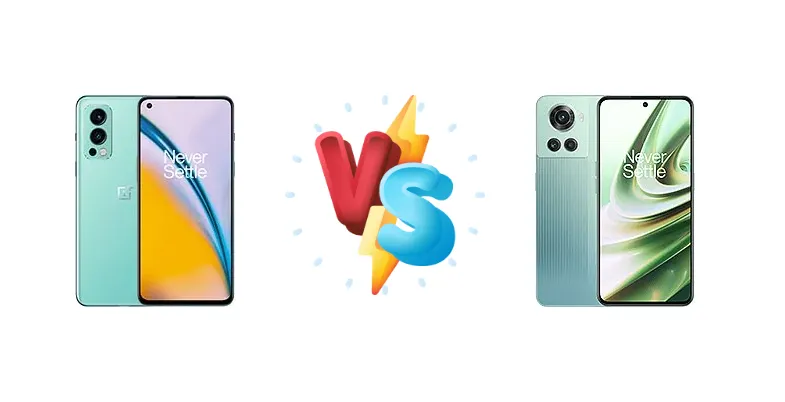
|
🏆 Quick Verdict
For most users, the OnePlus 10R emerges as the better choice. Its Mediatek Dimensity 8100 Max chipset, built on a more efficient 5nm process, delivers noticeably improved performance. While the Nord 2 5G boasts respectable endurance, the 10R’s faster 80W charging mitigates any battery capacity concerns.
| PHONES | ||
|---|---|---|
| Phone Names | OnePlus Nord 2 5G | OnePlus 10R |
| Network | ||
|---|---|---|
| 2G bands | GSM 850 / 900 / 1800 / 1900 | GSM 850 / 900 / 1800 / 1900 |
| 3G bands | HSDPA 800 / 850 / 900 / 1700(AWS) / 1800 / 1900 / 2100 | HSDPA 800 / 850 / 900 / 1700(AWS) / 1900 / 2100 |
| 4G bands | 1, 2, 3, 4, 5, 7, 8, 12, 17, 18, 19, 20, 26, 28, 32, 34, 38, 39, 40, 41, 66 - EU | 1, 2, 3, 4, 5, 7, 8, 18, 19, 26, 28, 34, 38, 39, 40, 41 |
| 5G bands | 1, 3, 7, 8, 20, 28, 38, 41, 66, 78 SA/NSA - EU | 1, 3, 5, 8, 28, 40, 41, 77, 78 SA/NSA |
| Speed | HSPA 42.2/5.76 Mbps, LTE Cat18 1200/150 Mbps, 5G | HSPA 42.2/5.76 Mbps, LTE (4CA), Cat12 600/150 Mbps, 5G |
| Technology | GSM / HSPA / LTE / 5G | GSM / HSPA / LTE / 5G |
| Launch | ||
|---|---|---|
| Announced | 2021, July 22 | 2022, April 28 |
| Status | Available. Released 2021, July 28 | Available. Released 2022, May 04 |
| Body | ||
|---|---|---|
| Build | Glass front (Gorilla Glass 5), glass back (Gorilla Glass 5), plastic frame | Glass front (Gorilla Glass 5), plastic frame, plastic back |
| Dimensions | 159.1 x 73.3 x 8.3 mm (6.26 x 2.89 x 0.33 in) | 163.3 x 75.5 x 8.2 mm (6.43 x 2.97 x 0.32 in) |
| SIM | Nano-SIM + Nano-SIM | Nano-SIM + Nano-SIM |
| Weight | 189 g (6.67 oz) | 186 g (6.56 oz) |
| Display | ||
|---|---|---|
| Protection | Corning Gorilla Glass 5 | Corning Gorilla Glass 5 |
| Resolution | 1080 x 2400 pixels, 20:9 ratio (~409 ppi density) | 1080 x 2412 pixels, 20:9 ratio (~394 ppi density) |
| Size | 6.43 inches, 99.8 cm2 (~85.6% screen-to-body ratio) | 6.7 inches, 108.0 cm2 (~87.6% screen-to-body ratio) |
| Type | Fluid AMOLED, 90Hz, HDR10+ | Fluid AMOLED, 1B colors, 120Hz, HDR10+ |
| Platform | ||
|---|---|---|
| CPU | Octa-core (1x3.0 GHz Cortex-A78 & 3x2.6 GHz Cortex-A78 & 4x2.0 GHz Cortex-A55) | Octa-core (4x2.85 GHz Cortex-A78 & 4x2.0 GHz Cortex-A55) |
| Chipset | Mediatek Dimensity 1200 (6 nm) | Mediatek Dimensity 8100 Max (5 nm) |
| GPU | Mali-G77 MC9 | Mali-G610 MC6 |
| OS | Android 11, upgradable to Android 13, OxygenOS 13 | Android 12, upgradable to Android 13, OxygenOS 13 |
| Memory | ||
|---|---|---|
| Card slot | No | No |
| Internal | 128GB 6GB RAM, 128GB 8GB RAM, 256GB 8GB RAM, 256GB 12GB RAM | 128GB 8GB RAM, 256GB 8GB RAM, 256GB 12GB RAM |
| Main Camera | ||
|---|---|---|
| Features | Dual-LED flash, HDR, panorama | Color spectrum sensor, LED flash, HDR, panorama |
| Triple | 50 MP, f/1.9, 24mm (wide), 1/1.56", 1.0µm, PDAF, OIS 8 MP, f/2.3, 120˚ (ultrawide) Auxiliary lens | 50 MP, f/1.8, 24mm (wide), 1/1.56", 1.0µm, PDAF, OIS 8 MP, f/2.2, 15mm, 120˚ (ultrawide), 1/4.0", 1.12µm 2 MP (macro) |
| Video | 4K@30fps, 1080p@30/60/120fps, gyro-EIS | 4K@30fps, 1080p@30/60/120fps, gyro-EIS |
| Selfie camera | ||
|---|---|---|
| Features | Auto HDR | HDR |
| Single | 32 MP, f/2.5, (wide), 1/2.8", 0.8µm | 16 MP, f/2.4, 26mm (wide), 1/3.09", 1.0µm |
| Video | 1080p@30fps, gyro-EIS | 1080p@30fps, gyro-EIS |
| Sound | ||
|---|---|---|
| 3.5mm jack | No | No |
| 35mm jack | No | No |
| Loudspeaker | Yes, with stereo speakers | Yes, with stereo speakers |
| Comms | ||
|---|---|---|
| Bluetooth | 5.2, A2DP, LE, aptX HD | 5.2, A2DP, LE |
| NFC | Yes | Yes |
| Positioning | GPS, GLONASS, GALILEO, BDS, SBAS, NavIC | GPS (L1+L5), GLONASS (G1), BDS (B1), GALILEO (E1+E5a) |
| Radio | No | No |
| USB | USB Type-C 2.0, OTG | USB Type-C 2.0 |
| WLAN | Wi-Fi 802.11 a/b/g/n/ac/6, dual-band, Wi-Fi Direct | Wi-Fi 802.11 a/b/g/n/ac/6, dual-band, Wi-Fi Direct |
| Features | ||
|---|---|---|
| Sensors | Fingerprint (under display, optical), accelerometer, gyro, proximity, compass | Fingerprint (under display, optical), accelerometer, gyro, proximity, compass |
| Battery | ||
|---|---|---|
| Charging | 65W wired, PD, 100% in 30 min | 80W wired, 100% in 32 min |
| Type | Li-Po 4500 mAh | Li-Po 5000 mAh |
| Misc | ||
|---|---|---|
| Colors | Gray Sierra, Blue Haze, Green Wood, Pac-Man Edition | Sierra Black, Forest Green, Prime Blue |
| Models | DN2101, DN2103 | CPH2411 |
| Price | € 189.00 / $ 219.99 / £ 148.00 | ₹ 34,999 |
| SAR | - | 0.95 W/kg (head) 0.96 W/kg (body) |
| Tests | ||
|---|---|---|
| Battery life | Endurance rating 102h | - |
| Camera | Photo / Video | - |
| Display | Contrast ratio: Infinite (nominal) | - |
| Loudspeaker | -24.3 LUFS (Very good) | - |
| Performance | AnTuTu: 512164 (v8) | 598022 (v9) GeekBench: 2792 (v5.1) GFXBench: 38fps (ES 3.1 onscreen) | - |
OnePlus Nord 2 5G
- Excellent battery endurance (102h)
- Reliable and consistent performance
- Proven track record of software support
- Older chipset (Dimensity 1200)
- Slower charging compared to the 10R
OnePlus 10R
- Significantly faster performance (Dimensity 8100 Max)
- Ultra-fast 80W charging (32 minutes to full)
- More efficient 5nm chipset
- Battery endurance likely lower than Nord 2 5G
- Potentially higher price point
Display Comparison
Both phones lack detailed display specifications in the provided data, but we can infer some differences. The Nord 2 5G’s 633 nits of measured peak brightness is respectable for outdoor visibility. The 10R, positioned as a more premium device, likely offers similar or slightly improved brightness. Without refresh rate or panel type information, it’s difficult to assess further. However, the 10R’s positioning suggests a potentially higher-quality display experience.
Camera Comparison
The provided data only indicates both phones have photo and video capabilities. Without sensor size, aperture, or image processing details, a direct comparison is impossible. However, given the 10R’s higher positioning, it’s reasonable to expect a more advanced camera system, potentially with a larger main sensor and improved low-light performance. The absence of any mention of OIS on either device suggests a reliance on software stabilization.
Performance
The core difference lies in the chipsets. The OnePlus 10R’s Mediatek Dimensity 8100 Max (5nm) is a significant upgrade over the Nord 2 5G’s Dimensity 1200 (6nm). The 5nm fabrication process inherently offers better power efficiency and thermal performance, translating to sustained performance under load. While the Nord 2 5G’s CPU configuration includes a higher clock speed on its primary Cortex-A78 core (3.0 GHz vs 2.85 GHz), the architectural improvements and efficiency of the 8100 Max will likely result in a more responsive and fluid user experience, especially in demanding tasks. The 10R’s CPU configuration of 4x2.85 GHz Cortex-A78 cores suggests a focus on sustained multi-core performance.
Battery Life
The Nord 2 5G boasts an endurance rating of 102 hours, indicating solid battery life. The 10R’s battery capacity is not specified, but its 80W charging (100% in 32 minutes) is significantly faster than the Nord 2 5G’s 65W charging (100% in 30 minutes). This faster charging speed is a major advantage for users who prioritize convenience and quick top-ups. While the Nord 2 5G’s longer endurance is appealing, the 10R’s charging speed effectively addresses any potential battery life concerns.
Buying Guide
Buy the OnePlus Nord 2 5G if you prioritize a balanced experience with proven endurance and are less concerned with having the absolute fastest processor. It’s ideal for everyday users who value reliability and a smooth, consistent performance. Buy the OnePlus 10R if you demand quicker app loading, smoother gaming, and significantly faster charging. This phone is geared towards power users and those who frequently find themselves needing to top up their battery quickly.