
OnePlus Ace vs Xiaomi Redmi K70 Pro: A Deep Dive into Performance and Value
| Phones Images | |||||
|---|---|---|---|---|---|
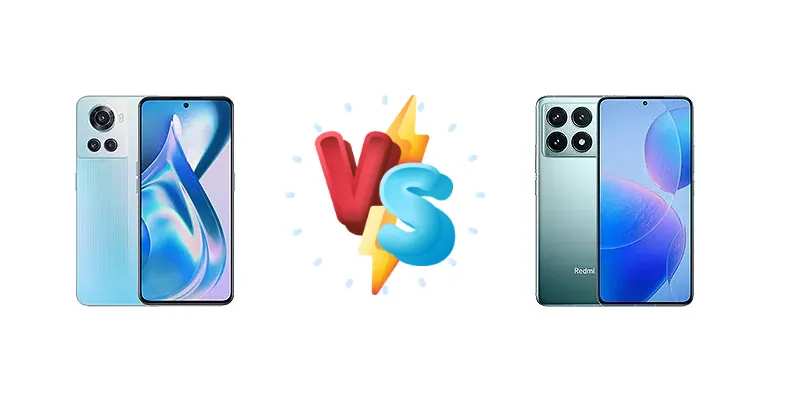
|
🏆 Quick Verdict
For the average user prioritizing raw performance and future-proofing, the Xiaomi Redmi K70 Pro is the clear winner. The Snapdragon 8 Gen 3 offers a substantial leap in CPU and GPU capabilities over the Dimensity 8100 Max, justifying the price difference. While the OnePlus Ace boasts faster wired charging, the K70 Pro’s overall package is more compelling.
| PHONES | ||
|---|---|---|
| Phone Names | OnePlus Ace | Xiaomi Redmi K70 Pro |
| Network | ||
|---|---|---|
| 2G bands | GSM 850 / 900 / 1800 / 1900 | GSM 850 / 900 / 1800 / 1900 |
| 3G bands | HSDPA 800 / 850 / 900 / 1700(AWS) / 1900 / 2100 | HSDPA 800 / 850 / 900 / 1700(AWS) / 2100 |
| 4G bands | 1, 2, 3, 4, 5, 7, 8, 18, 19, 26, 28, 34, 38, 39, 40, 41 | 1, 3, 4, 5, 8, 18, 19, 26, 28, 34, 38, 39, 40, 41, 42, 48, 66 |
| 5G bands | 1, 3, 5, 8, 28, 40, 41, 77, 78 SA/NSA | 1, 3, 5, 8, 28, 38, 41, 48, 66, 77, 78 SA/NSA |
| Speed | HSPA, LTE, 5G | HSPA, LTE, 5G |
| Technology | GSM / CDMA / HSPA / EVDO / LTE / 5G | GSM / CDMA / HSPA / CDMA2000 / LTE / 5G |
| CDMA2000 1xEV-DO | - | |
| Launch | ||
|---|---|---|
| Announced | 2022, April 21 | 2023, November 29 |
| Status | Available. Released 2022, April 26 | Available. Released 2023, November 29 |
| Body | ||
|---|---|---|
| Build | Glass front (Gorilla Glass 5), plastic frame | - |
| Dimensions | 163.3 x 75.5 x 8.2 mm (6.43 x 2.97 x 0.32 in) | 160.9 x 75 x 8.2 mm (6.33 x 2.95 x 0.32 in) |
| SIM | Nano-SIM + Nano-SIM | Nano-SIM + Nano-SIM |
| Weight | 186 g (6.56 oz) | 209 g (7.37 oz) |
| Display | ||
|---|---|---|
| Protection | Corning Gorilla Glass 5 | - |
| Resolution | 1080 x 2412 pixels, 20:9 ratio (~394 ppi density) | 1440 x 3200 pixels, 20:9 ratio (~526 ppi density) |
| Size | 6.7 inches, 108.0 cm2 (~87.6% screen-to-body ratio) | 6.67 inches, 107.4 cm2 (~89.0% screen-to-body ratio) |
| Type | OLED, 1B colors, 120Hz, HDR10+, 500 nits (typ), 800 nits (HBM), 950 nits (peak) | OLED, 68B colors, 120Hz, Dolby Vision, HDR10+, 4000 nits (peak) |
| Platform | ||
|---|---|---|
| CPU | Octa-core (4x2.85 GHz Cortex-A78 & 4x2.0 GHz Cortex-A55) | Octa-core (1x3.3 GHz Cortex-X4 & 3x3.2 GHz Cortex-A720 & 2x3.0 GHz Cortex-A720 & 2x2.3 GHz Cortex-A520) |
| Chipset | Mediatek Dimensity 8100 Max (5 nm) | Qualcomm SM8650-AB Snapdragon 8 Gen 3 (4 nm) |
| GPU | Mali-G610 MC6 | Adreno 750 |
| OS | Android 12, ColorOS 12.1 | Android 14, HyperOS |
| Memory | ||
|---|---|---|
| Card slot | No | No |
| Internal | 128GB 8GB RAM, 256GB 8GB RAM, 256GB 12GB RAM, 512GB 12GB RAM | 256GB 12GB RAM, 256GB 16GB RAM, 512GB 12GB RAM, 512GB 16GB RAM, 1TB 24GB RAM |
| UFS 3.1 | - | |
| Main Camera | ||
|---|---|---|
| Features | Color spectrum sensor, LED flash, HDR, panorama | Color spectrum sensor, LED flash, HDR, panorama |
| Single | 16 MP, f/2.4, 26mm (wide), 1/3.09", 1.0µm | - |
| Triple | 50 MP, f/1.9, 24mm (wide), 1/1.56", 1.0µm, PDAF, OIS 8 MP, f/2.2, 15mm, 120˚ (ultrawide), 1/4.0", 1.12µm 2 MP (macro) | 50 MP, f/1.6, (wide), 1/1.55", 1.0µm, PDAF, OIS 50 MP, (telephoto), PDAF, 2x optical zoom 12 MP, (ultrawide) |
| Video | 4K@30/60fps, 1080p@30/60/240fps, gyro-EIS | 8K@24fps, 4K@24/30/60fps, 1080p@30/60/120/240/960fps, 720p@1920fps, gyro-EIS |
| Selfie camera | ||
|---|---|---|
| Features | HDR | HDR |
| Single | 16 MP, f/2.4, 26mm (wide), 1/3.09", 1.0µm | 16 MP, (wide) |
| Video | 1080p@30fps, gyro-EIS | 1080p@30/60fps, gyro-EIS |
| Sound | ||
|---|---|---|
| 3.5mm jack | No | - |
| 35mm jack | No | No |
| Loudspeaker | Yes, with stereo speakers | Yes, with stereo speakers |
| Comms | ||
|---|---|---|
| Bluetooth | 5.2, A2DP, LE | 5.4, A2DP, LE, aptX HD, aptX Adaptive, aptX Lossless |
| Infrared port | - | Yes |
| NFC | Yes | Yes |
| Positioning | GPS, GLONASS, GALILEO, BDS | GPS (L1+L5), GLONASS (G1), BDS (B1I+B1c+B2a), GALILEO (E1+E5a), QZSS (L1+L5), NavIC (L5) |
| Radio | No | No |
| USB | USB Type-C 2.0 | USB Type-C, OTG |
| WLAN | Wi-Fi 802.11 a/b/g/n/ac/6, dual-band, Wi-Fi Direct | Wi-Fi 802.11 a/b/g/n/ac/6e/7, dual-band, Wi-Fi Direct |
| Features | ||
|---|---|---|
| Sensors | Fingerprint (under display, optical), accelerometer, gyro, proximity, compass | Fingerprint (under display, optical), accelerometer, proximity, gyro, compass |
| Battery | ||
|---|---|---|
| Charging | 150W wired, 50% in 5 min | 120W wired, PD3.0, QC3+, 100% in 18 min |
| Type | Li-Po 4500 mAh | Li-Po 5000 mAh |
| Misc | ||
|---|---|---|
| Colors | Black, Blue | Black, Silver, Blue/Green, Lamborgini Green, Lamborgini Yellow |
| Models | PGKM10 | 23117RK66C |
| Price | About 360 EUR | About 430 EUR |
OnePlus Ace
- Blazing-fast 150W wired charging
- Competitive price point
- Capable Dimensity 8100 Max processor
- Older chipset compared to the K70 Pro
- Potentially less efficient power consumption
Xiaomi Redmi K70 Pro
- Top-tier Snapdragon 8 Gen 3 performance
- Improved thermal efficiency
- Likely superior camera system
- Wider charging standard support (PD3.0, QC3+)
- Slower charging speed than the OnePlus Ace
- Higher price tag
Display Comparison
While display specifications aren't provided, both devices likely feature high refresh rate AMOLED panels, common in this price bracket. However, the K70 Pro, given its flagship positioning, is expected to have a higher peak brightness and potentially LTPO technology for adaptive refresh rates, leading to improved power efficiency. The Ace, while still offering a vibrant display, may compromise slightly on these premium features to maintain a competitive price point. Bezels are likely comparable, but color accuracy and calibration could favor the K70 Pro.
Camera Comparison
Without specific camera specs, it’s difficult to make a definitive judgment. However, the K70 Pro, as a flagship, is expected to feature a more advanced camera system with a larger main sensor and improved image processing capabilities. The Snapdragon 8 Gen 3’s ISP (Image Signal Processor) is also more sophisticated, enabling better dynamic range, noise reduction, and low-light performance. The Ace likely offers a competent camera experience, but it may lack the refinement and versatility of the K70 Pro’s system. We can assume both will have multiple lenses, but the K70 Pro will likely have a more robust optical image stabilization (OIS) system.
Performance
The core difference lies in the chipsets. The Xiaomi Redmi K70 Pro’s Snapdragon 8 Gen 3 (4nm) is a significant upgrade over the OnePlus Ace’s Dimensity 8100 Max (5nm). The Snapdragon 8 Gen 3’s Cortex-X4 prime core, clocked at 3.3 GHz, provides a substantial performance boost in single-core tasks. The K70 Pro’s GPU also benefits from architectural improvements, delivering superior graphics performance. The 4nm process node of the Snapdragon 8 Gen 3 also translates to better thermal efficiency, reducing the likelihood of throttling during sustained workloads. The Ace’s Dimensity 8100 Max remains a capable performer, but it will struggle to match the K70 Pro in demanding games or applications. The K70 Pro likely utilizes faster LPDDR5x RAM, further enhancing performance.
Battery Life
The OnePlus Ace’s 150W wired charging is its standout feature, capable of charging 50% in just 5 minutes. The Xiaomi Redmi K70 Pro’s 120W charging, while still fast, takes 18 minutes for a full charge. However, battery life is about more than just charging speed. The Snapdragon 8 Gen 3’s improved efficiency could offset the Ace’s faster charging, resulting in comparable real-world battery endurance. The K70 Pro also supports PD3.0 and QC3+ standards, offering wider compatibility with chargers.
Buying Guide
Buy the OnePlus Ace if you prioritize the absolute fastest wired charging speeds available and are comfortable with slightly older, but still capable, processing power. It’s ideal for users who frequently top up their phones and don’t necessarily need the latest and greatest chipset. Buy the Xiaomi Redmi K70 Pro if you demand top-tier performance for demanding tasks like gaming, video editing, or heavy multitasking, and value a more modern and efficient chipset. It’s the better choice for power users and those planning to keep their phone for several years.