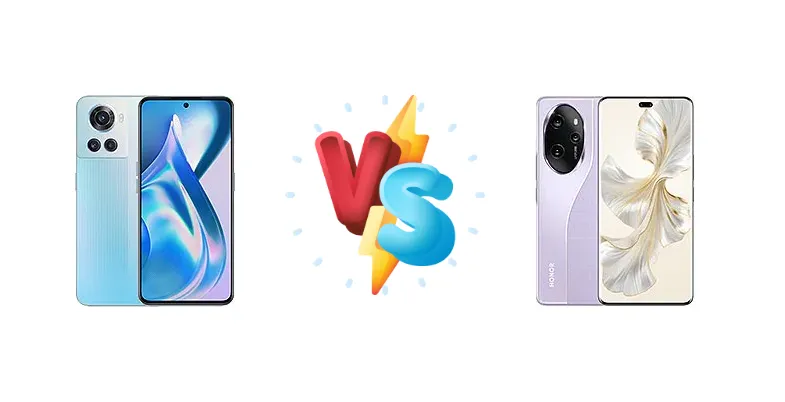
The OnePlus Ace and Honor 100 Pro represent compelling options in the increasingly competitive flagship space. The Ace, leveraging MediaTek’s Dimensity 8100 Max, focuses on rapid charging and aggressive performance. The Honor 100 Pro, powered by the Snapdragon 8 Gen 2, aims for a more balanced approach with superior efficiency and a refined camera experience. This comparison dissects the key differences to determine which device best suits your needs.
🏆 Quick Verdict
For the average user prioritizing sustained performance and camera quality, the Honor 100 Pro emerges as the winner. The Snapdragon 8 Gen 2’s 4nm process provides a clear advantage in thermal management and overall efficiency, while the 100W charging is still remarkably fast. However, the OnePlus Ace’s 150W charging is unmatched for those who absolutely need the fastest possible top-ups.
| Network |
|---|
| 2G bands | GSM 850 / 900 / 1800 / 1900 | GSM 850 / 900 / 1800 / 1900 |
| 3G bands | HSDPA 800 / 850 / 900 / 1700(AWS) / 1900 / 2100 | HSDPA 800 / 850 / 900 / 1700(AWS) / 1900 / 2100 |
| 4G bands | 1, 2, 3, 4, 5, 7, 8, 18, 19, 26, 28, 34, 38, 39, 40, 41 | LTE |
| 5G bands | 1, 3, 5, 8, 28, 40, 41, 77, 78 SA/NSA | SA/NSA |
| Speed | HSPA, LTE, 5G | HSPA, LTE, 5G |
| Technology | GSM / CDMA / HSPA / EVDO / LTE / 5G | GSM / CDMA / HSPA / CDMA2000 / LTE / 5G |
| | CDMA2000 1xEV-DO | - |
| Launch |
|---|
| Announced | 2022, April 21 | 2023, November 23 |
| Status | Available. Released 2022, April 26 | Available. Released 2023, November 23 |
| Body |
|---|
| Build | Glass front (Gorilla Glass 5), plastic frame | - |
| Dimensions | 163.3 x 75.5 x 8.2 mm (6.43 x 2.97 x 0.32 in) | 163.7 x 74.7 x 8.2 mm or 8.5 mm |
| SIM | Nano-SIM + Nano-SIM | Nano-SIM + Nano-SIM |
| Weight | 186 g (6.56 oz) | 195 g (6.88 oz) |
| Display |
|---|
| Protection | Corning Gorilla Glass 5 | - |
| Resolution | 1080 x 2412 pixels, 20:9 ratio (~394 ppi density) | 1224 x 2700 pixels (~437 ppi density) |
| Size | 6.7 inches, 108.0 cm2 (~87.6% screen-to-body ratio) | 6.78 inches, 111.5 cm2 (~91.2% screen-to-body ratio) |
| Type | OLED, 1B colors, 120Hz, HDR10+, 500 nits (typ), 800 nits (HBM), 950 nits (peak) | OLED, 1B colors, 120Hz, HDR, 2600 nits (peak) |
| Platform |
|---|
| CPU | Octa-core (4x2.85 GHz Cortex-A78 & 4x2.0 GHz Cortex-A55) | Octa-core (1x3.2 GHz Cortex-X3 & 2x2.8 GHz Cortex-A715 & 2x2.8 GHz Cortex-A710 & 3x2.0 GHz Cortex-A510) |
| Chipset | Mediatek Dimensity 8100 Max (5 nm) | Qualcomm SM8550-AB Snapdragon 8 Gen 2 (4 nm) |
| GPU | Mali-G610 MC6 | Adreno 740 |
| OS | Android 12, ColorOS 12.1 | Android 13, MagicOS 7.2 |
| Memory |
|---|
| Card slot | No | No |
| Internal | 128GB 8GB RAM, 256GB 8GB RAM, 256GB 12GB RAM, 512GB 12GB RAM | 256GB 12GB RAM, 256GB 16GB RAM, 512GB 16GB RAM, 1TB 16GB RAM |
| | UFS 3.1 | - |
| Main Camera |
|---|
| Features | Color spectrum sensor, LED flash, HDR, panorama | LED flash, HDR, panorama |
| Single | 16 MP, f/2.4, 26mm (wide), 1/3.09", 1.0µm | - |
| Triple | 50 MP, f/1.9, 24mm (wide), 1/1.56", 1.0µm, PDAF, OIS
8 MP, f/2.2, 15mm, 120˚ (ultrawide), 1/4.0", 1.12µm
2 MP (macro) | 50 MP, f/2.0, 27mm (wide), 1/1.56", 1.0µm, PDAF, OIS
32 MP, f/2.4, (telephoto), PDAF, OIS, 2.5x optical zoom
12 MP, f/2.2, 112˚ (ultrawide), AF |
| Video | 4K@30/60fps, 1080p@30/60/240fps, gyro-EIS | 4K@30fps, 1080p@30/60fps, gyro-EIS, OIS |
| Selfie camera |
|---|
| Dual | - | 50 MP, f/2.0
2 MP, f/2.4, (depth) |
| Features | HDR | HDR |
| Single | 16 MP, f/2.4, 26mm (wide), 1/3.09", 1.0µm | - |
| Video | 1080p@30fps, gyro-EIS | 4K@30fps, 1080p@30fps, gyro-EIS |
| Sound |
|---|
| 3.5mm jack | No | - |
| 35mm jack | No | No |
| Loudspeaker | Yes, with stereo speakers | Yes, with stereo speakers |
| Comms |
|---|
| Bluetooth | 5.2, A2DP, LE | 5.3, A2DP, LE, aptX HD |
| NFC | Yes | Yes |
| Positioning | GPS, GLONASS, GALILEO, BDS | GPS, GALILEO, GLONASS, BDS, QZSS |
| Radio | No | No |
| USB | USB Type-C 2.0 | USB Type-C 2.0, OTG |
| WLAN | Wi-Fi 802.11 a/b/g/n/ac/6, dual-band, Wi-Fi Direct | Wi-Fi 802.11 a/b/g/n/ac/6, dual-band, Wi-Fi Direct |
| Features |
|---|
| Sensors | Fingerprint (under display, optical), accelerometer, gyro, proximity, compass | Fingerprint (under display, optical), accelerometer, gyro, compass, ultrasound proximity |
| Battery |
|---|
| Charging | 150W wired, 50% in 5 min | 100W wired, 50% in 10 min
66W wireless, 100% in 42 min
5W reverse wired
Reverse wireless |
| Type | Li-Po 4500 mAh | Li-Po 5000 mAh |
| Misc |
|---|
| Colors | Black, Blue | Black, Silver, Blue, Violet |
| Models | PGKM10 | MAA-AN10 |
| Price | About 360 EUR | About 440 EUR |
OnePlus Ace
- Unmatched 150W wired charging speed
- Aggressive performance for short bursts
- Potentially more affordable price point
- Dimensity 8100 Max may throttle under sustained load
- Less efficient chipset compared to Snapdragon 8 Gen 2
- Likely less refined camera system
Honor 100 Pro
- Superior performance and efficiency with Snapdragon 8 Gen 2
- 66W wireless charging and reverse charging
- Potentially better camera system and image processing
- Slower wired charging compared to OnePlus Ace (100W vs 150W)
- Likely higher price point
- May not offer the absolute fastest peak performance
Display Comparison
While display specifications weren't provided, both phones likely feature high refresh rate AMOLED panels. However, the Honor 100 Pro, given its flagship positioning, is expected to boast a higher peak brightness and potentially LTPO technology for adaptive refresh rates, improving battery life. The OnePlus Ace, while still offering a vibrant display, may prioritize cost savings in this area. Bezels are likely comparable, but color accuracy and calibration will be key differentiators, favoring the Honor 100 Pro's typically more refined tuning.
Camera Comparison
Without specific camera specs, we can infer differences based on brand strategy. Honor typically invests heavily in camera technology, suggesting the 100 Pro will feature a more sophisticated camera system. The Snapdragon 8 Gen 2’s ISP (Image Signal Processor) is also more advanced, enabling better image processing, noise reduction, and dynamic range. The OnePlus Ace will likely offer a capable camera, but may prioritize speed and convenience over outright image quality. Sensor size and OIS (Optical Image Stabilization) will be crucial factors, likely favoring the Honor 100 Pro.
Performance
The core difference lies in the chipsets. The Honor 100 Pro’s Snapdragon 8 Gen 2 (4nm) is a significant step up from the OnePlus Ace’s Dimensity 8100 Max (5nm). The Snapdragon 8 Gen 2 utilizes a more advanced 4nm process, resulting in superior thermal efficiency and sustained performance. Its CPU configuration – 1x3.2 GHz Cortex-X3, 2x2.8 GHz Cortex-A715, 2x2.8 GHz Cortex-A710, and 3x2.0 GHz Cortex-A510 – offers a more balanced and powerful architecture compared to the Ace’s 4x2.85 GHz Cortex-A78 & 4x2.0 GHz Cortex-A55. This translates to faster app loading, smoother multitasking, and higher frame rates in demanding games. While the Ace is no slouch, the 8 Gen 2 will exhibit less throttling under prolonged load.
Battery Life
The Honor 100 Pro offers 100W wired charging, reaching 50% in 10 minutes, alongside 66W wireless charging and reverse charging capabilities. The OnePlus Ace boasts an industry-leading 150W wired charging, achieving 50% in just 5 minutes. While the Ace’s charging speed is undeniably faster, the Honor 100 Pro’s wireless charging and reverse charging add versatility. The Snapdragon 8 Gen 2’s efficiency also means the Honor 100 Pro may achieve comparable or even better real-world battery life despite potentially having a similar or slightly smaller battery capacity.
Buying Guide
Buy the OnePlus Ace if you prioritize the absolute fastest charging speeds available and frequently engage in short bursts of demanding tasks where peak performance is key. You’ll benefit from the 150W wired charging, getting you back to 50% in just 5 minutes. Buy the Honor 100 Pro if you value sustained performance, a more efficient chipset, and a potentially superior camera experience. The Snapdragon 8 Gen 2 offers better long-term stability and power efficiency, making it ideal for gamers and power users who demand consistent performance.
Frequently Asked Questions
❓ Does the Dimensity 8100 Max in the OnePlus Ace overheat during extended gaming sessions?
The Dimensity 8100 Max is a capable chip, but its 5nm process is less efficient than the Snapdragon 8 Gen 2’s 4nm process. This means the OnePlus Ace is more likely to experience thermal throttling during prolonged gaming, potentially leading to reduced frame rates and performance over time. While it won't shut down, expect some performance dip.
❓ How does the 100W charging on the Honor 100 Pro compare to the 150W charging on the OnePlus Ace in real-world usage?
While 150W is faster on paper, the difference in practical terms isn't as dramatic as the numbers suggest. Both phones will rapidly charge your device. The Ace gets you to 50% in 5 minutes, while the Honor 100 Pro takes 10. However, the Honor 100 Pro’s added benefit of 66W wireless charging and reverse wireless charging provides more flexibility for daily use.
❓ Is the Snapdragon 8 Gen 2 in the Honor 100 Pro significantly more power-efficient than the Dimensity 8100 Max in the OnePlus Ace?
Yes, the Snapdragon 8 Gen 2’s 4nm process is demonstrably more power-efficient. This translates to longer battery life during typical usage and less heat generation under load. You'll notice this difference particularly during demanding tasks like gaming or video editing.