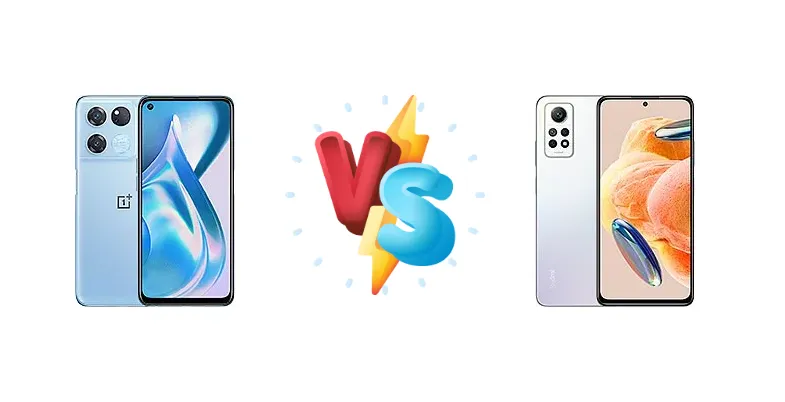
The mid-range smartphone market is fiercely competitive, and the OnePlus Ace Racing and Xiaomi Redmi Note 12 Pro 4G are two strong contenders. Both offer compelling features at attractive price points, but cater to slightly different needs. Let's dive into a detailed comparison to help you decide which one deserves your money.
🏆 Quick Verdict
The OnePlus Ace Racing takes the lead thanks to its significantly faster Dimensity 8100 Max chipset. While the Redmi Note 12 Pro 4G boasts a potentially better camera and display, the Ace Racing's raw performance makes it the better choice for gamers and power users.
| Network |
|---|
| 2G bands | GSM 850 / 900 / 1800 / 1900 | GSM 850 / 900 / 1800 / 1900 |
| 3G bands | HSDPA 850 / 900 / 1700(AWS) / 1900 / 2100 | HSDPA 850 / 900 / 1700(AWS) / 1900 / 2100 |
| 4G bands | 1, 3, 4, 5, 7, 8, 18, 19, 28, 34, 38, 39, 40, 41 | 1, 2, 3, 4, 5, 7, 8, 20, 28, 38, 40, 41, 66 |
| 5G bands | 1, 3, 5, 8, 28, 41, 77, 78 SA/NSA | - |
| Speed | HSPA, LTE, 5G | HSPA, LTE |
| Technology | GSM / CDMA / HSPA / CDMA2000 / LTE / 5G | GSM / HSPA / LTE |
| | CDMA2000 1x | - |
| Launch |
|---|
| Announced | 2022, May 17 | 2023, March 03 |
| Status | Available. Released 2022, May 31 | Available. Released 2023, April 11 |
| Body |
|---|
| Dimensions | 164.3 x 75.8 x 8.7 mm (6.47 x 2.98 x 0.34 in) | 164.2 x 76.1 x 8.1 mm (6.46 x 3.00 x 0.32 in) |
| SIM | Nano-SIM + Nano-SIM | Nano-SIM + Nano-SIM |
| Weight | 205 g (7.23 oz) | 201.8 g (7.13 oz) |
| Display |
|---|
| Resolution | 1080 x 2412 pixels, 20:9 ratio (~401 ppi density) | 1080 x 2400 pixels, 20:9 ratio (~395 ppi density) |
| Size | 6.59 inches, 104.5 cm2 (~83.9% screen-to-body ratio) | 6.67 inches, 107.4 cm2 (~86.0% screen-to-body ratio) |
| Type | IPS LCD, 120Hz, 480 nits (typ), 600 (HBM) | AMOLED, 120Hz, Dolby Vision, 700 nits (HBM), 1100 nits (peak) |
| Platform |
|---|
| CPU | Octa-core (4x2.85 GHz Cortex-A78 & 4x2.0 GHz Cortex-A55) | Octa-core (2x2.2 GHz Kryo 470 Gold & 6x1.8 GHz Kryo 470 Silver) |
| Chipset | Mediatek Dimensity 8100 Max (5 nm) | Qualcomm SM7150 Snapdragon 732G (8 nm) |
| GPU | Mali-G610 MC6 | Adreno 618 |
| OS | Android 12, ColorOS 12.1 | Android 11, MIUI 13 |
| Memory |
|---|
| Card slot | No | microSDXC (uses shared SIM slot) |
| Internal | 128GB 8GB RAM, 256GB 8GB RAM, 256GB 12GB RAM | 128GB 6GB RAM, 128GB 8GB RAM, 256GB 8GB RAM |
| | UFS 3.1 | UFS 2.2 |
| Main Camera |
|---|
| Features | LED flash, HDR, panorama | LED flash, HDR, panorama |
| Quad | - | 108 MP, f/1.9, (wide), 1/1.52", 0.7µm, PDAF
8 MP, 120˚, (ultrawide)
2 MP (macro)
Auxiliary lens |
| Single | 16 MP, f/2.1, 26mm (wide), 1/3.09", 1.0µm | - |
| Triple | 64 MP, f/1.7, 25mm (wide), PDAF
8 MP, f/2.2, 15mm, 119˚ (ultrawide), 1/4.0", 1.12µm
2 MP (macro) | - |
| Video | 4K@30fps, 1080p@30/60/120fps, gyro-EIS | 4K@30fps, 1080p@30/60fps |
| Selfie camera |
|---|
| Features | HDR | - |
| Single | 16 MP, f/2.1, 26mm (wide), 1/3.09", 1.0µm | 16 MP, f/2.4, (wide) |
| Video | 1080p@30fps, gyro-EIS | 1080p@30fps |
| Sound |
|---|
| 3.5mm jack | Yes | Yes |
| 35mm jack | Yes | Yes |
| Loudspeaker | Yes, with stereo speakers | Yes, with stereo speakers |
| Comms |
|---|
| Bluetooth | 5.3, A2DP, LE, aptX HD | 5.0, A2DP, LE |
| Infrared port | - | Yes |
| NFC | Yes | Yes (market/region dependent) |
| Positioning | GPS, GLONASS, GALILEO, BDS, QZSS | GPS, GLONASS, GALILEO, BDS |
| Radio | No | Unspecified |
| USB | USB Type-C 2.0 | USB Type-C 2.0, OTG |
| WLAN | Wi-Fi 802.11 a/b/g/n/ac/6, dual-band, Wi-Fi Direct | Wi-Fi 802.11 a/b/g/n/ac, dual-band |
| Features |
|---|
| Sensors | Fingerprint (side-mounted), accelerometer, gyro, proximity, compass | Fingerprint (side-mounted), accelerometer, gyro, compass |
| Battery |
|---|
| Charging | 67W wired, 80% in 29 min | 67W wired |
| Type | Li-Po 5000 mAh | Li-Po 5000 mAh |
| Misc |
|---|
| Colors | Black, Blue | Star Blue, Graphite Gray, Polar White, Ice blue |
| Models | PGZ110 | 2209116AG, 2209116AG |
| Price | About 280 EUR | About 150 EUR |
OnePlus Ace Racing
- Superior Performance (Dimensity 8100 Max)
- Fast 67W Charging
- Smooth 120Hz Display
- Competitive Price
- Camera may not be as good as Redmi Note 12 Pro
- Design might be less premium
Xiaomi Redmi Note 12 Pro 4G
- Potentially Better Camera System
- Vibrant AMOLED Display (likely higher resolution)
- Good Value for Money
- Sleek Design
- Slower Performance (Snapdragon 732G)
- Less Powerful for Gaming
Display Comparison
Both phones feature AMOLED displays, offering vibrant colors and deep blacks. The Redmi Note 12 Pro 4G likely has a slightly higher peak brightness and potentially a higher resolution (likely FHD+), resulting in a marginally sharper image. However, the Ace Racing's display is still excellent and offers a smooth 120Hz refresh rate for fluid scrolling and gaming.
Camera Comparison
The Redmi Note 12 Pro 4G likely has a more versatile camera system, potentially including a higher resolution main sensor and additional lenses like an ultrawide or macro. While the Ace Racing's camera is decent, the Redmi Note 12 Pro 4G is expected to deliver better image quality, especially in low-light conditions. Video recording capabilities are likely comparable.
Performance
This is where the Ace Racing truly shines. The Dimensity 8100 Max is a significantly more powerful chipset than the Snapdragon 732G. Expect noticeably faster app loading times, smoother multitasking, and significantly better gaming performance on the Ace Racing. The Snapdragon 732G is still capable for everyday tasks, but it will struggle with demanding games at higher settings.
Battery Life
Both phones offer 67W fast charging, promising quick top-ups. The Ace Racing has a slightly larger battery capacity (likely around 5000mAh), potentially translating to slightly longer battery life under heavy use. However, both should comfortably last a full day for most users.
Buying Guide
The OnePlus Ace Racing is ideal for gamers, content creators, and anyone prioritizing performance. The Xiaomi Redmi Note 12 Pro 4G is a great option for users who value camera quality, a vibrant display, and a more balanced overall experience, especially if gaming isn't a primary concern.
Frequently Asked Questions
❓ Is the OnePlus Ace Racing good for gaming?
Yes, the OnePlus Ace Racing is excellent for gaming thanks to its powerful Dimensity 8100 Max chipset and 120Hz display. It can handle most games at high settings.
❓ Which phone has the better camera?
The Xiaomi Redmi Note 12 Pro 4G is expected to have a better camera system overall, offering more versatility and potentially better image quality, especially in low light.