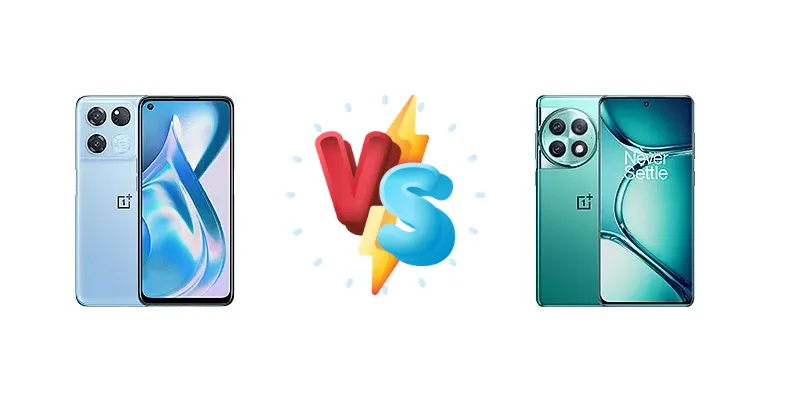
The OnePlus Ace series delivers impressive specs at competitive prices. This comparison pits the newer OnePlus Ace 2 Pro, powered by the flagship Snapdragon 8 Gen 2, against the older but still capable OnePlus Ace Racing, featuring the Dimensity 8100 Max. We'll dissect the key differences to help you determine which device best suits your needs and budget.
🏆 Quick Verdict
For users prioritizing raw performance and ultra-fast charging, the OnePlus Ace 2 Pro is the clear winner. Its Snapdragon 8 Gen 2 chipset provides a significant leap in processing power and efficiency. However, the Ace Racing remains a compelling option for budget-conscious gamers and everyday users who don't require the absolute best.
| Network |
|---|
| 2G bands | GSM 850 / 900 / 1800 / 1900 | GSM 850 / 900 / 1800 / 1900 |
| 3G bands | HSDPA 850 / 900 / 1700(AWS) / 1900 / 2100 | HSDPA 850 / 900 / 1700(AWS) / 2100 |
| 4G bands | 1, 3, 4, 5, 7, 8, 18, 19, 28, 34, 38, 39, 40, 41 | 1, 3, 4, 5, 7, 8, 18, 19, 26, 28, 34, 38, 39, 40, 41 |
| 5G bands | 1, 3, 5, 8, 28, 41, 77, 78 SA/NSA | 1, 3, 5, 8, 28, 41, 77, 78 SA/NSA |
| Speed | HSPA, LTE, 5G | HSPA, LTE, 5G |
| Technology | GSM / CDMA / HSPA / CDMA2000 / LTE / 5G | GSM / CDMA / HSPA / LTE / 5G |
| | CDMA2000 1x | - |
| Launch |
|---|
| Announced | 2022, May 17 | 2023, August 16 |
| Status | Available. Released 2022, May 31 | Available. Released 2023, August 23 |
| Body |
|---|
| Build | - | Glass front (Asahi Glass), plastic frame, glass back (Gorilla Glass 5) |
| Dimensions | 164.3 x 75.8 x 8.7 mm (6.47 x 2.98 x 0.34 in) | 163.1 x 74.2 x 9 mm (6.42 x 2.92 x 0.35 in) |
| SIM | Nano-SIM + Nano-SIM | Nano-SIM + Nano-SIM |
| Weight | 205 g (7.23 oz) | 210 g (7.41 oz) |
| Display |
|---|
| Protection | - | Asahi Glass |
| Resolution | 1080 x 2412 pixels, 20:9 ratio (~401 ppi density) | 1240 x 2772 pixels, 20:9 ratio (~451 ppi density) |
| Size | 6.59 inches, 104.5 cm2 (~83.9% screen-to-body ratio) | 6.74 inches, 109.2 cm2 (~90.3% screen-to-body ratio) |
| Type | IPS LCD, 120Hz, 480 nits (typ), 600 (HBM) | AMOLED, 1B colors, 120Hz, HDR10+, 550 nits (typ), 1200 nits (HBM), 1600 nits (peak) |
| Platform |
|---|
| CPU | Octa-core (4x2.85 GHz Cortex-A78 & 4x2.0 GHz Cortex-A55) | Octa-core (1x3.2 GHz Cortex-X3 & 2x2.8 GHz Cortex-A715 & 2x2.8 GHz Cortex-A710 & 3x2.0 GHz Cortex-A510) |
| Chipset | Mediatek Dimensity 8100 Max (5 nm) | Qualcomm SM8550-AB Snapdragon 8 Gen 2 (4 nm) |
| GPU | Mali-G610 MC6 | Adreno 740 |
| OS | Android 12, ColorOS 12.1 | Android 13, ColorOS 13.1 |
| Memory |
|---|
| Card slot | No | No |
| Internal | 128GB 8GB RAM, 256GB 8GB RAM, 256GB 12GB RAM | 256GB 12GB RAM, 512GB 16GB RAM, 1TB 24GB RAM |
| | UFS 3.1 | - |
| Main Camera |
|---|
| Features | LED flash, HDR, panorama | Color spectrum sensor, LED flash, HDR, panorama |
| Single | 16 MP, f/2.1, 26mm (wide), 1/3.09", 1.0µm | - |
| Triple | 64 MP, f/1.7, 25mm (wide), PDAF
8 MP, f/2.2, 15mm, 119˚ (ultrawide), 1/4.0", 1.12µm
2 MP (macro) | 50 MP, f/1.8, 24mm (wide), 1/1.56", 1.0µm, PDAF, OIS
8 MP, f/2.2, 16mm, 112˚ (ultrawide), 1/4.0", 1.12µm
2 MP (macro) |
| Video | 4K@30fps, 1080p@30/60/120fps, gyro-EIS | 4K@30/60fps, 1080p@30/60/120/240fps, gyro-EIS, OIS |
| Selfie camera |
|---|
| Features | HDR | HDR |
| Single | 16 MP, f/2.1, 26mm (wide), 1/3.09", 1.0µm | 16 MP, f/2.4, 26mm (wide), 1/3.09", 1.0µm |
| Video | 1080p@30fps, gyro-EIS | 1080p@30fps |
| Sound |
|---|
| 3.5mm jack | Yes | - |
| 35mm jack | Yes | No |
| Loudspeaker | Yes, with stereo speakers | Yes, with stereo speakers |
| Comms |
|---|
| Bluetooth | 5.3, A2DP, LE, aptX HD | 5.3, A2DP, LE, aptX HD |
| Infrared port | - | Yes |
| NFC | Yes | Yes |
| Positioning | GPS, GLONASS, GALILEO, BDS, QZSS | GPS (L1+L5), GLONASS (G1), BDS (B1I+B1c+B2a), GALILEO (E1+E5a), QZSS (L1+L5) |
| Radio | No | No |
| USB | USB Type-C 2.0 | USB Type-C 2.0 |
| WLAN | Wi-Fi 802.11 a/b/g/n/ac/6, dual-band, Wi-Fi Direct | Wi-Fi 802.11 a/b/g/n/ac/6/7, dual-band |
| Features |
|---|
| Sensors | Fingerprint (side-mounted), accelerometer, gyro, proximity, compass | Fingerprint (under display, optical), accelerometer, gyro, proximity, compass |
| Battery |
|---|
| Charging | 67W wired, 80% in 29 min | 150W wired |
| Type | Li-Po 5000 mAh | Li-Po 5000 mAh |
| Misc |
|---|
| Colors | Black, Blue | Aurora Green, Titanium Gray |
| Models | PGZ110 | PJA110 |
| Price | About 280 EUR | About 380 EUR |
OnePlus Ace Racing
- More affordable price point
- Solid performance for everyday tasks and gaming
- Fast 67W wired charging
- Less powerful chipset compared to Snapdragon 8 Gen 2
- Potentially more thermal throttling under heavy load
OnePlus Ace 2 Pro
- Flagship-level performance with Snapdragon 8 Gen 2
- Ultra-fast 150W wired charging
- Improved thermal efficiency
- Higher price tag
- May not represent a massive upgrade for casual users
Display Comparison
While both devices likely feature high refresh rate AMOLED displays (based on OnePlus's typical offerings), the core difference lies in the underlying processing power driving them. The Ace 2 Pro's Snapdragon 8 Gen 2 will handle graphically intensive tasks and UI animations with greater fluidity. We anticipate the Ace 2 Pro will have a higher peak brightness, enhancing visibility in direct sunlight. The Ace Racing, while still excellent, will likely exhibit slightly more lag in demanding scenarios.
Camera Comparison
Without specific camera specs, we can infer that the Ace 2 Pro likely features a more advanced camera system. The Snapdragon 8 Gen 2’s ISP (Image Signal Processor) is significantly more powerful, enabling superior image processing, better low-light performance, and faster capture speeds. While the Ace Racing will produce acceptable photos, the Ace 2 Pro will likely offer greater detail, dynamic range, and overall image quality. We expect the Ace 2 Pro to include Optical Image Stabilization (OIS) on its main sensor, further enhancing image clarity and reducing blur.
Performance
The Snapdragon 8 Gen 2 in the Ace 2 Pro, fabricated on a 4nm process, represents a substantial upgrade over the Ace Racing’s 5nm Dimensity 8100 Max. The Snapdragon 8 Gen 2’s Cortex-X3 prime core, clocked at 3.2 GHz, offers significantly higher single-core performance, crucial for responsive app launches and smooth multitasking. The Ace 2 Pro’s GPU will deliver a more substantial frame rate boost in games. Furthermore, the 4nm node translates to improved thermal efficiency, meaning the Ace 2 Pro is less likely to throttle under sustained load, maintaining peak performance for longer gaming sessions. The Ace Racing, while capable, will show its limitations in the most demanding titles.
Battery Life
The Ace 2 Pro’s 150W wired charging is a game-changer, capable of fully charging the device in under 30 minutes. The Ace Racing’s 67W charging, while still fast, takes considerably longer. While battery capacity isn’t specified, the Ace 2 Pro’s more efficient Snapdragon 8 Gen 2 chipset will likely deliver comparable or even better battery life despite potentially having a similar or smaller battery capacity. The combination of fast charging and efficient power management makes the Ace 2 Pro the superior choice for users who demand all-day battery life and minimal downtime.
Buying Guide
Buy the OnePlus Ace Racing if you need a capable gaming phone with solid performance and fast 67W charging, all while staying within a tighter budget. It's ideal for users who play demanding mobile games casually and prioritize value. Buy the OnePlus Ace 2 Pro if you demand the absolute best performance, need the fastest possible charging (150W), and are willing to pay a premium for the Snapdragon 8 Gen 2's superior efficiency and power.
Frequently Asked Questions
❓ Will the Dimensity 8100 Max in the Ace Racing struggle with graphically demanding games like Genshin Impact?
While the Dimensity 8100 Max is a capable chip, it will likely require lower graphics settings and may exhibit some frame drops in Genshin Impact compared to the Ace 2 Pro. The Snapdragon 8 Gen 2 offers a more consistent and smoother gaming experience in demanding titles.
❓ How much faster is the 150W charging on the Ace 2 Pro compared to the 67W charging on the Ace Racing in real-world use?
The 150W charging on the Ace 2 Pro can take a phone from 0% to 100% in around 25-30 minutes, while the 67W charging on the Ace Racing typically takes around 45-60 minutes. This difference is particularly noticeable for users who frequently need to top up their battery quickly.
❓ Is the Snapdragon 8 Gen 2 in the Ace 2 Pro prone to overheating?
The Snapdragon 8 Gen 2 is designed with thermal efficiency in mind, and the Ace 2 Pro likely incorporates advanced cooling solutions. While it can get warm under sustained load, it's less prone to significant throttling compared to older flagship chips.
❓ Does the Ace 2 Pro support higher RAM speeds (LPDDR5x) compared to the Ace Racing?
It's highly probable that the Ace 2 Pro utilizes faster LPDDR5x RAM, contributing to improved multitasking and overall system responsiveness. The Ace Racing likely uses LPDDR5, which is still fast but not as performant as LPDDR5x.