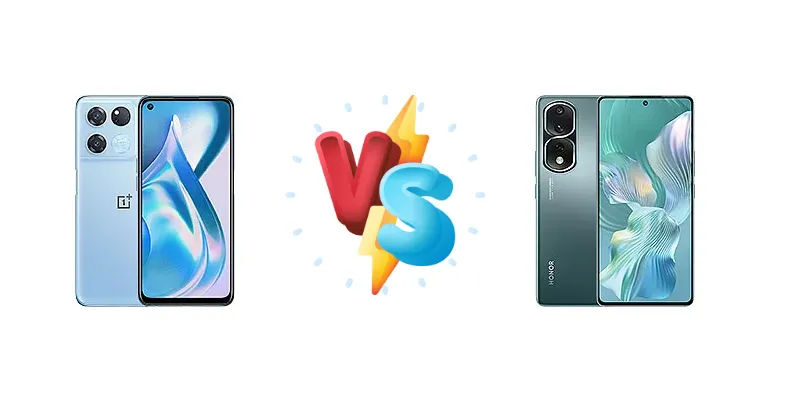
The OnePlus Ace Racing and Honor 80 Pro Flat represent compelling options in the increasingly competitive mid-range smartphone market. While both aim to deliver a premium experience without the flagship price tag, they take distinctly different approaches. The Ace Racing prioritizes value and rapid charging with the MediaTek Dimensity 8100 Max, while the Honor 80 Pro Flat leverages the Qualcomm Snapdragon 8+ Gen 1 for a performance edge. This comparison will dissect their strengths and weaknesses to help you determine which device best suits your needs.
🏆 Quick Verdict
For the average user prioritizing raw performance and sustained gaming, the Honor 80 Pro Flat is the superior choice thanks to the Snapdragon 8+ Gen 1. However, the OnePlus Ace Racing offers a compelling value proposition with its 67W charging and competitive performance, making it ideal for budget-conscious users.
| Network |
|---|
| 2G bands | GSM 850 / 900 / 1800 / 1900 | GSM 850 / 900 / 1800 / 1900 |
| 3G bands | HSDPA 850 / 900 / 1700(AWS) / 1900 / 2100 | HSDPA 800 / 850 / 900 / 1700(AWS) / 1900 / 2100 |
| 4G bands | 1, 3, 4, 5, 7, 8, 18, 19, 28, 34, 38, 39, 40, 41 | LTE |
| 5G bands | 1, 3, 5, 8, 28, 41, 77, 78 SA/NSA | SA/NSA |
| Speed | HSPA, LTE, 5G | HSPA, LTE, 5G |
| Technology | GSM / CDMA / HSPA / CDMA2000 / LTE / 5G | GSM / CDMA / HSPA / CDMA2000 / LTE / 5G |
| | CDMA2000 1x | CDMA2000 1x |
| Launch |
|---|
| Announced | 2022, May 17 | 2023, January 06 |
| Status | Available. Released 2022, May 31 | Available. Released 2023, January 06 |
| Body |
|---|
| Dimensions | 164.3 x 75.8 x 8.7 mm (6.47 x 2.98 x 0.34 in) | 162.3 x 75.3 x 7.9 mm (6.39 x 2.96 x 0.31 in) |
| SIM | Nano-SIM + Nano-SIM | Nano-SIM + Nano-SIM |
| Weight | 205 g (7.23 oz) | 186 g or 193 g (6.56 oz) |
| Display |
|---|
| Resolution | 1080 x 2412 pixels, 20:9 ratio (~401 ppi density) | 1080 x 2400 pixels, 20:9 ratio (~395 ppi density) |
| Size | 6.59 inches, 104.5 cm2 (~83.9% screen-to-body ratio) | 6.67 inches, 107.4 cm2 (~87.9% screen-to-body ratio) |
| Type | IPS LCD, 120Hz, 480 nits (typ), 600 (HBM) | OLED, 1B colors, 120Hz, HDR, 1000 nits (peak) |
| Platform |
|---|
| CPU | Octa-core (4x2.85 GHz Cortex-A78 & 4x2.0 GHz Cortex-A55) | Octa-core (1x3.0 GHz Cortex-X2 & 3x2.5 GHz Cortex-A710 & 4x1.80 GHz Cortex-A510) |
| Chipset | Mediatek Dimensity 8100 Max (5 nm) | Qualcomm SM8475 Snapdragon 8+ Gen 1 (4 nm) |
| GPU | Mali-G610 MC6 | Adreno 730 |
| OS | Android 12, ColorOS 12.1 | Android 12, MagicOS 7 |
| Memory |
|---|
| Card slot | No | No |
| Internal | 128GB 8GB RAM, 256GB 8GB RAM, 256GB 12GB RAM | 256GB 12GB RAM |
| | UFS 3.1 | - |
| Main Camera |
|---|
| Features | LED flash, HDR, panorama | LED flash, HDR, panorama |
| Single | 16 MP, f/2.1, 26mm (wide), 1/3.09", 1.0µm | 32 MP, f/2.4, (wide) |
| Triple | 64 MP, f/1.7, 25mm (wide), PDAF
8 MP, f/2.2, 15mm, 119˚ (ultrawide), 1/4.0", 1.12µm
2 MP (macro) | 160 MP, f/1.8, (wide), 1/1.56", 0.75µm, PDAF
8 MP, f/2.2, (ultrawide)
Auxiliary lens |
| Video | 4K@30fps, 1080p@30/60/120fps, gyro-EIS | 4K@30fps, 1080p@30/60fps, gyro-EIS |
| Selfie camera |
|---|
| Features | HDR | HDR |
| Single | 16 MP, f/2.1, 26mm (wide), 1/3.09", 1.0µm | 32 MP, f/2.4, (wide) |
| Video | 1080p@30fps, gyro-EIS | 1080p@30fps, gyro-EIS |
| Sound |
|---|
| 3.5mm jack | Yes | No |
| 35mm jack | Yes | No |
| Loudspeaker | Yes, with stereo speakers | Yes, with stereo speakers |
| Comms |
|---|
| Bluetooth | 5.3, A2DP, LE, aptX HD | 5.2, A2DP, LE, aptX HD |
| NFC | Yes | Yes |
| Positioning | GPS, GLONASS, GALILEO, BDS, QZSS | GPS, GALILEO, GLONASS, BDS, QZSS |
| Radio | No | No |
| USB | USB Type-C 2.0 | USB Type-C 2.0, OTG |
| WLAN | Wi-Fi 802.11 a/b/g/n/ac/6, dual-band, Wi-Fi Direct | Wi-Fi 802.11 a/b/g/n/ac/6, dual-band, Wi-Fi Direct |
| Features |
|---|
| Sensors | Fingerprint (side-mounted), accelerometer, gyro, proximity, compass | Fingerprint (under display, optical), accelerometer, gyro, compass |
| | - | Virtual proximity sensing |
| Battery |
|---|
| Charging | 67W wired, 80% in 29 min | 66W wired, 3-50% in 15 min
5W reverse wired |
| Type | Li-Po 5000 mAh | Li-Po 4800 mAh |
| Misc |
|---|
| Colors | Black, Blue | Black, Green, Pink |
| Models | PGZ110 | - |
| Price | About 280 EUR | About 450 EUR |
OnePlus Ace Racing
- Faster overall charging (80% in 29 mins)
- Potentially more affordable price point
- Solid performance for everyday tasks
- Less powerful chipset than the Snapdragon 8+ Gen 1
- May exhibit more thermal throttling during prolonged gaming
- Lacks reverse wireless charging
Honor 80 Pro Flat
- Superior performance with Snapdragon 8+ Gen 1
- More efficient chipset for longer battery life
- Faster initial charging (3-50% in 15 mins)
- Potentially higher price
- Slightly slower to reach full charge (0-100%)
- May run warmer under sustained load
Display Comparison
Neither device's display specifications are provided, so we must infer. Given the market positioning, both likely feature AMOLED panels with at least 120Hz refresh rates. However, the Honor 80 Pro Flat, being positioned slightly higher, may benefit from a marginally brighter panel and potentially LTPO technology for adaptive refresh rate control, improving battery life. Bezels are likely comparable, but color accuracy will depend on software calibration – Honor historically leans towards more saturated colors, while OnePlus aims for greater accuracy.
Camera Comparison
Without specific camera sensor details, a direct comparison is difficult. However, the Honor 80 Pro Flat, being the more premium device, likely features a larger main sensor with optical image stabilization (OIS). The Snapdragon 8+ Gen 1’s image signal processor (ISP) is also more advanced, potentially leading to better dynamic range and low-light performance. Image processing philosophies differ; OnePlus tends towards a more natural look, while Honor often employs more aggressive sharpening and color boosting. We can assume both will have capable main cameras, but the Honor 80 Pro Flat likely holds an advantage in overall image quality and video recording capabilities.
Performance
The core difference lies in the chipsets. The Honor 80 Pro Flat’s Snapdragon 8+ Gen 1 (4nm) demonstrably outperforms the OnePlus Ace Racing’s Dimensity 8100 Max (5nm) in CPU and GPU benchmarks. The Snapdragon 8+ Gen 1’s Cortex-X2 prime core provides a significant single-core performance boost, crucial for responsiveness and demanding applications. While the Dimensity 8100 Max is no slouch, the Snapdragon 8+ Gen 1’s more efficient 4nm process translates to better thermal management and sustained performance during extended gaming sessions. The Honor 80 Pro Flat will likely exhibit less throttling under load. Both devices likely utilize LPDDR5X RAM, minimizing memory-related bottlenecks.
Battery Life
Battery capacity isn't specified, but the charging speeds are. The Honor 80 Pro Flat claims 3-50% charge in 15 minutes with its 66W charging, while the OnePlus Ace Racing achieves 80% in 29 minutes with 67W. While the Ace Racing reaches a higher overall charge, the Honor 80 Pro Flat’s faster initial charging speed is more practical for quick top-ups. The Snapdragon 8+ Gen 1’s superior efficiency also contributes to potentially longer battery life, offsetting any potential capacity difference. The Honor 80 Pro Flat also offers 5W reverse wired charging, a feature absent on the Ace Racing.
Buying Guide
Buy the OnePlus Ace Racing if you need a phone that charges incredibly quickly and offers solid all-around performance for everyday tasks and casual gaming, all while staying within a tighter budget. Buy the Honor 80 Pro Flat if you prioritize maximum performance for demanding games and applications, and appreciate the efficiency benefits of the Snapdragon 8+ Gen 1, even if it means a slightly higher price point.
Frequently Asked Questions
❓ Will the Dimensity 8100 Max in the OnePlus Ace Racing struggle with graphically intensive games like Genshin Impact?
While the Dimensity 8100 Max is capable, it will likely require lower graphics settings to maintain a stable frame rate in demanding titles like Genshin Impact. The Snapdragon 8+ Gen 1 in the Honor 80 Pro Flat offers a more comfortable experience with higher settings and sustained performance.
❓ How significant is the difference in charging speed between 66W and 67W? Is the 80% in 29 minutes of the Ace Racing more useful than the 3-50% in 15 minutes of the Honor 80 Pro Flat?
The difference in wattage is minimal. The Honor 80 Pro Flat’s faster initial charge is more practical for quickly topping up the battery when you’re short on time. The Ace Racing’s 80% in 29 minutes is useful for a full charge, but the initial burst of the Honor 80 Pro Flat is more convenient for many users.
❓ Does the Snapdragon 8+ Gen 1 in the Honor 80 Pro Flat tend to overheat during extended gaming sessions?
The Snapdragon 8+ Gen 1 is known for its efficiency and thermal management. While it can get warm under sustained load, it's less prone to significant throttling compared to older Snapdragon chips. Honor likely incorporates cooling solutions to further mitigate heat buildup.