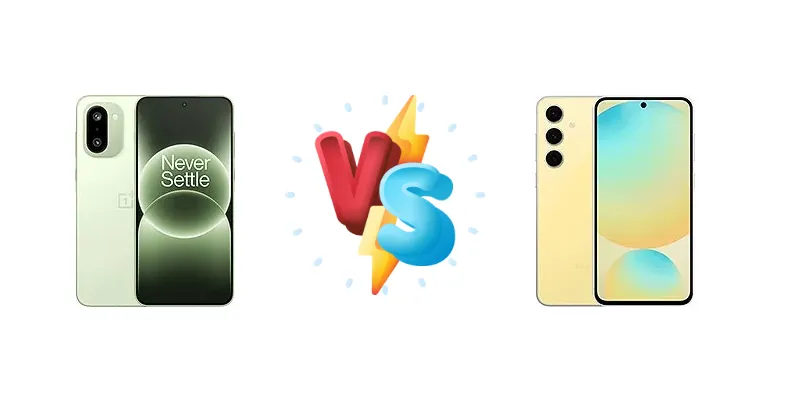
The OnePlus Ace 6T and Samsung Galaxy S24 FE represent distinct approaches to the mid-to-high range smartphone market. The Ace 6T prioritizes raw speed with the latest Snapdragon silicon and blazing-fast charging, while the S24 FE focuses on a more balanced experience, emphasizing battery longevity and a refined software experience. This comparison dissects their key differences to help you choose the right device.
🏆 Quick Verdict
For users prioritizing peak performance and rapid charging, the OnePlus Ace 6T is the clear winner. However, the Samsung Galaxy S24 FE excels in battery endurance, offering over 42 hours of usage and a more mature software ecosystem, making it ideal for those who value longevity and reliability.
| Network |
|---|
| 2G bands | GSM 850 / 900 / 1800 / 1900 | GSM 850 / 900 / 1800 / 1900 |
| 3G bands | HSDPA 800 / 850 / 900 / 1700(AWS) / 2100 | HSDPA 850 / 900 / 1700(AWS) / 1900 / 2100 |
| 4G bands | LTE | 1, 2, 3, 4, 5, 7, 8, 12, 17, 18, 19, 20, 25, 26, 28, 32, 38, 40, 41, 66 - International |
| 5G bands | SA/NSA | 1, 2, 3, 5, 7, 8, 12, 20, 25, 26, 28, 38, 40, 41, 66, 75, 77, 78 SA/NSA/Sub6 - International |
| Speed | HSPA, LTE, 5G | HSPA, LTE, 5G |
| Technology | GSM / HSPA / LTE / 5G | GSM / HSPA / LTE / 5G |
| Launch |
|---|
| Announced | Expected announcement 2025, November | 2024, September 26 |
| Status | Rumored. Exp. release 2025, December | Available. Released 2024, October 03 |
| Body |
|---|
| Build | Glass front (Crystal Shield Glass), aluminum alloy frame, glass back or fiber-reinforced plastic back | Glass front (Gorilla Glass Victus+), glass back (Gorilla Glass Victus+), aluminum frame |
| Dimensions | - | 162 x 77.3 x 8 mm (6.38 x 3.04 x 0.31 in) |
| SIM | Nano-SIM + Nano-SIM | · Nano-SIM· Nano-SIM + Nano-SIM· Nano-SIM + eSIM· eSIM + eSIM |
| Weight | - | 213 g (7.51 oz) |
| Display |
|---|
| Protection | Crystal Shield Glass | Corning Gorilla Glass Victus+, Mohs level 5 |
| Resolution | 1272 x 2800 pixels (~450 ppi density) | 1080 x 2340 pixels, 19.5:9 ratio (~385 ppi density) |
| Size | 6.83 inches, 113.3 cm2 | 6.7 inches, 110.2 cm2 (~88.0% screen-to-body ratio) |
| Type | LTPO AMOLED, 1B colors, 165Hz, PWM, HDR10+, Dolby Vision, HDR Vivid | Dynamic AMOLED 2X, 120Hz, HDR10+, 1900 nits (peak) |
| Platform |
|---|
| CPU | Octa-core | 10-core (1x3.1 GHz + 2x2.9 GHz + 3x2.6 GHz + 4x1.95 GHz) |
| Chipset | Qualcomm Snapdragon 8 Gen 5 | Exynos 2400e (4 nm) |
| GPU | Adreno | Xclipse 940 |
| OS | Android 16, ColorOS 16 | Android 14, up to 7 major Android upgrades, One UI 8.0 |
| Memory |
|---|
| Card slot | No | No |
| Internal | Up to 1TB 16GB RAM | 128GB 8GB RAM, 256GB 8GB RAM, 512GB 8GB RAM |
| Main Camera |
|---|
| Dual | 50 MP, f/1.8, 24mm (wide), PDAF, OIS
8 MP, f/2.2, 16mm, 112˚ (ultrawide), 1/4.0", 1.12µm | - |
| Features | Color spectrum sensor, LED flash, HDR, panorama | LED flash, HDR, panorama |
| Triple | - | 50 MP, f/1.8, 24mm (wide), 1/1.57", 1.0µm, dual pixel PDAF, OIS
8 MP, f/2.4, 75mm (telephoto), 1/4.4", 1.0µm, PDAF, OIS, 3x optical zoom
12 MP, f/2.2, 13mm, 123˚ (ultrawide), 1/3.0", 1.12µm |
| Video | 4K@30/60/120fps, 1080p@30/60/120fps, gyro-EIS, OIS | 8K@30fps, 4K@30/60/120fps, 1080p@30/60/120/240fps |
| Selfie camera |
|---|
| Features | HDR, panorama | - |
| Single | 16 MP, f/2.0, (wide) | 10 MP, f/2.4, 26mm (wide), 1/3.0", 1.22µm |
| Video | 4K@30fps, 1080p@30fps, gyro-EIS | 4K@30/60fps, 1080p@30/60fps; gyro-EIS |
| Sound |
|---|
| 35mm jack | No | No |
| Loudspeaker | Yes, with stereo speakers | Yes, with stereo speakers |
| Comms |
|---|
| Bluetooth | 5.4, A2DP, LE, aptX HD, aptX Adaptive, LHDC 5 | 5.3, A2DP, LE |
| Infrared port | Yes | - |
| NFC | Yes | Yes |
| Positioning | GPS (L1+L5), GLONASS (G1), BDS (B1I+B1c+B2a), GALILEO (E1+E5a), QZSS (L1+L5), NavIC (L5) | GPS, GLONASS, GALILEO, BDS |
| Radio | No | Unspecified |
| USB | USB Type-C 2.0 | USB Type-C 3.2, OTG |
| WLAN | Wi-Fi 802.11 a/b/g/n/ac/6/7, dual-band | Wi-Fi 802.11 a/b/g/n/ac/6e, dual-band or tri-band (market/region dependent), Wi-Fi Direct |
| Features |
|---|
| Sensors | Fingerprint (under display), accelerometer, gyro, proximity, compass | Fingerprint (under display, optical), accelerometer, gyro, compass |
| Battery |
|---|
| Charging | 100W wired
Bypass charging | 25W wired, PD, QC2, 50% in 30 min
15W wireless
Reverse wireless |
| Type | Si/C Li-Ion 8300 mAh | 4700 mAh |
| Misc |
|---|
| Colors | Black, Purple, Green | Blue, Graphite, Gray, Mint, Yellow |
| Models | - | SM-S721B, SM-S721B/DS, SM-S721U1, SM-S721U, SM-S721W, SM-S7210, SM-S721N |
| Price | - | $ 249.74 / C$ 498.99 / £ 335.00 / € 387.00 / ₹ 34,180 |
| SAR | - | 0.94 W/kg (head) 0.71 W/kg (body) |
| SAR EU | - | 0.86 W/kg (head) 1.29 W/kg (body) |
| EU LABEL |
|---|
| Battery | - | 42:00h endurance, 2000 cycles |
| Energy | - | Class B |
| Free fall | - | Class A (270 falls) |
| Repairability | - | Class C |
OnePlus Ace 6T
- Blazing-fast 100W wired charging
- Potentially superior gaming performance with Snapdragon 8 Gen 5
- Bypass charging for reduced battery degradation
- Battery life likely inferior to S24 FE
- OxygenOS may not appeal to all users
- Camera specs unknown, potential for lower image quality
Samsung Galaxy S24 FE
- Exceptional 42-hour battery endurance
- Brighter display for outdoor visibility
- More refined software experience with One UI
- Slower 25W wired charging
- Exynos 2400e may throttle under sustained load
- Potentially less powerful GPU compared to Snapdragon
Display Comparison
The Samsung Galaxy S24 FE boasts a significantly brighter display, reaching a measured 1372 nits, crucial for outdoor visibility. While the Ace 6T’s display specs are not provided, Samsung’s panel technology typically offers superior color accuracy and viewing angles. The S24 FE’s brightness advantage is particularly noticeable for users who frequently consume content outdoors or in brightly lit environments. The lack of LTPO on either device suggests both will rely on adaptive refresh rates, but the S24 FE’s higher peak brightness is a clear advantage.
Camera Comparison
Without detailed camera specifications for the Ace 6T, it’s difficult to make a direct comparison. However, Samsung typically excels in image processing, and the S24 FE likely benefits from advanced computational photography algorithms. The absence of information regarding sensor sizes on the Ace 6T makes it hard to assess low-light performance. The S24 FE’s image processing prioritizes vibrant colors and detail, while OnePlus often aims for a more natural look. The usefulness of a 2MP macro camera on either device is questionable, as image quality is often subpar.
Performance
The OnePlus Ace 6T’s Qualcomm Snapdragon 8 Gen 5 is expected to deliver superior raw processing power compared to the Samsung Galaxy S24 FE’s Exynos 2400e. The Exynos 2400e utilizes a 10-core architecture, but the Snapdragon 8 Gen 5’s 4nm process node and optimized CPU/GPU design likely translate to better sustained performance and thermal efficiency. The Ace 6T is geared towards demanding tasks like gaming and video editing, while the S24 FE offers a more balanced performance profile. The Snapdragon’s architecture is also likely to benefit from better optimization in many popular games.
Battery Life
The Samsung Galaxy S24 FE’s 42-hour endurance and 2000 cycle rating are significant advantages. While the Ace 6T’s battery capacity is unknown, its 100W wired charging is substantially faster than the S24 FE’s 25W charging, achieving 50% charge in just 30 minutes. The S24 FE also offers 15W wireless and reverse wireless charging, adding convenience. The S24 FE’s endurance suggests a larger battery capacity, optimized power management, and a more efficient chipset. The Ace 6T’s bypass charging feature minimizes battery degradation during charging, but the S24 FE’s longevity is still a major draw.
Buying Guide
Buy the OnePlus Ace 6T if you need uncompromising gaming performance, require the fastest possible charging speeds, and are comfortable with OxygenOS. Buy the Samsung Galaxy S24 FE if you prefer a longer-lasting battery, a more polished software experience with guaranteed updates, and a brighter, more visible display in direct sunlight. The S24 FE is also a better choice for users heavily invested in the Samsung ecosystem.
Frequently Asked Questions
❓ Does the Exynos 2400e in the Galaxy S24 FE overheat during prolonged gaming sessions?
The Exynos 2400e, while powerful, is known to generate more heat than some Snapdragon counterparts. While Samsung has implemented thermal management solutions, extended gaming at maximum settings may lead to some throttling, reducing sustained performance. The Ace 6T’s Snapdragon 8 Gen 5 is likely to handle heat more efficiently.
❓ How effective is the 100W charging on the OnePlus Ace 6T in real-world use?
The 100W charging on the Ace 6T is exceptionally fast, capable of charging the device from 0% to 50% in approximately 30 minutes. However, charging speed slows down as the battery approaches full capacity to protect battery health. This is significantly faster than the S24 FE’s 25W charging.
❓ Is the 2MP macro camera on either phone worth using?
Generally, 2MP macro cameras on smartphones offer limited utility. Image quality is often poor due to the small sensor size and lack of optical image stabilization. While they can capture close-up shots, the results are rarely comparable to those taken with the main camera.
❓ What kind of software support can I expect from each device?
Samsung typically provides longer software support for its devices, with the Galaxy S24 FE likely to receive several years of Android OS updates and security patches. OnePlus’s software support has improved, but generally lags behind Samsung’s commitment.