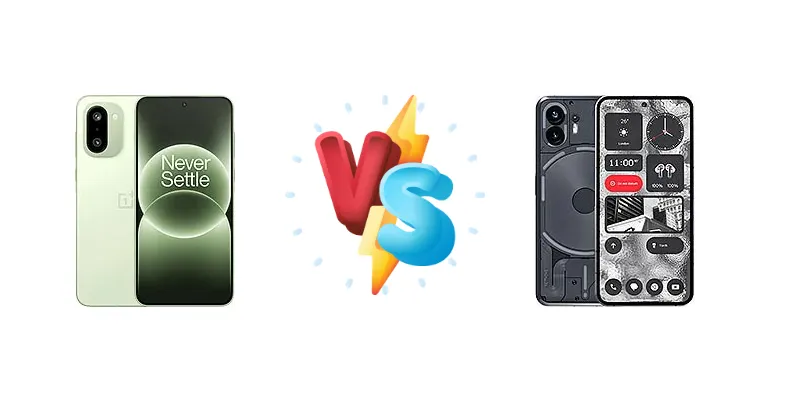
The OnePlus Ace 6T and Nothing Phone (2) represent distinct approaches to the flagship smartphone experience. The Ace 6T prioritizes raw processing power with the latest Snapdragon 8 Gen 5, while the Nothing Phone (2) focuses on a balanced package of performance, design, and software refinement built around the Snapdragon 8+ Gen 1. This comparison dissects their key differences to determine which device best suits your needs.
🏆 Quick Verdict
For users prioritizing peak performance and incredibly fast charging, the OnePlus Ace 6T is the clear winner. However, the Nothing Phone (2) offers a more polished software experience, longer battery life in real-world use, and a unique design, making it a compelling choice for those valuing overall usability.
| Network |
|---|
| 2G bands | GSM 850 / 900 / 1800 / 1900 | GSM 850 / 900 / 1800 / 1900 |
| 3G bands | HSDPA 800 / 850 / 900 / 1700(AWS) / 2100 | HSDPA 800 / 850 / 900 / 1700(AWS) / 1900 / 2100 |
| 4G bands | LTE | 1, 2, 3, 4, 5, 7, 8, 12, 17, 18, 19, 20, 25, 26, 28, 30, 32, 34, 38, 39, 40, 41, 42, 48, 66, 71 |
| 5G bands | SA/NSA | 1, 2, 3, 5, 7, 8, 12, 20, 25, 28, 30, 38, 40, 41, 66, 71, 75, 77, 78 SA/NSA |
| Speed | HSPA, LTE, 5G | HSPA, LTE, 5G |
| Technology | GSM / HSPA / LTE / 5G | GSM / HSPA / LTE / 5G |
| Launch |
|---|
| Announced | Expected announcement 2025, November | 2023, July 11 |
| Status | Rumored. Exp. release 2025, December | Available. Released 2023, July 17 |
| Body |
|---|
| Build | Glass front (Crystal Shield Glass), aluminum alloy frame, glass back or fiber-reinforced plastic back | Glass front (Gorilla Glass 5), glass back (Gorilla Glass 5), aluminum frame |
| Dimensions | - | 162.1 x 76.4 x 8.6 mm (6.38 x 3.01 x 0.34 in) |
| SIM | Nano-SIM + Nano-SIM | Nano-SIM + Nano-SIM |
| Weight | - | 201.2 g (7.09 oz) |
| Display |
|---|
| Protection | Crystal Shield Glass | Corning Gorilla Glass 5 |
| Resolution | 1272 x 2800 pixels (~450 ppi density) | 1080 x 2412 pixels, 20:9 ratio (~394 ppi density) |
| Size | 6.83 inches, 113.3 cm2 | 6.7 inches, 108.0 cm2 (~87.2% screen-to-body ratio) |
| Type | LTPO AMOLED, 1B colors, 165Hz, PWM, HDR10+, Dolby Vision, HDR Vivid | LTPO OLED, 1B colors, 120Hz, 1920Hz PWM, HDR10+, 1600 nits (HBM), 1600 nits (peak) |
| Platform |
|---|
| CPU | Octa-core | Octa-core (1x3.0 GHz Cortex-X2 & 3x2.5 GHz Cortex-A710 & 4x1.80 GHz Cortex-A510) |
| Chipset | Qualcomm Snapdragon 8 Gen 5 | Qualcomm SM8475 Snapdragon 8+ Gen 1 (4 nm) |
| GPU | Adreno | Adreno 730 |
| OS | Android 16, ColorOS 16 | Android 13, upgradable to Android 15, up to 3 major Android upgrades, Nothing OS 3.0 |
| Memory |
|---|
| Card slot | No | No |
| Internal | Up to 1TB 16GB RAM | 128GB 8GB RAM, 256GB 12GB RAM, 512GB 12GB RAM |
| Main Camera |
|---|
| Dual | 50 MP, f/1.8, 24mm (wide), PDAF, OIS
8 MP, f/2.2, 16mm, 112˚ (ultrawide), 1/4.0", 1.12µm | 50 MP, f/1.9, 24mm (wide), 1/1.56", 1.0µm, PDAF, OIS
50 MP, f/2.2, 114˚ (ultrawide), 1/2.76", 0.64µm, AF |
| Features | Color spectrum sensor, LED flash, HDR, panorama | LED flash, panorama, HDR |
| Video | 4K@30/60/120fps, 1080p@30/60/120fps, gyro-EIS, OIS | 4K@30/60fps, 1080p@30/60fps, gyro-EIS, live HDR, OIS |
| Selfie camera |
|---|
| Features | HDR, panorama | HDR |
| Single | 16 MP, f/2.0, (wide) | 32 MP, f/2.5, (wide), 1/2.74", 0.8µm |
| Video | 4K@30fps, 1080p@30fps, gyro-EIS | 1080p@30fps |
| Sound |
|---|
| 35mm jack | No | No |
| Loudspeaker | Yes, with stereo speakers | Yes, with stereo speakers |
| Comms |
|---|
| Bluetooth | 5.4, A2DP, LE, aptX HD, aptX Adaptive, LHDC 5 | 5.3, A2DP, LE, aptX HD, aptX Adaptive |
| Infrared port | Yes | - |
| NFC | Yes | Yes |
| Positioning | GPS (L1+L5), GLONASS (G1), BDS (B1I+B1c+B2a), GALILEO (E1+E5a), QZSS (L1+L5), NavIC (L5) | GPS (L1+L5), GLONASS (L1), BDS (B1I+B1c), GALILEO (E1), QZSS (L1), NavIC |
| Radio | No | No |
| USB | USB Type-C 2.0 | USB Type-C 2.0, OTG |
| WLAN | Wi-Fi 802.11 a/b/g/n/ac/6/7, dual-band | Wi-Fi 802.11 a/b/g/n/ac/6, dual-band, Wi-Fi Direct |
| Features |
|---|
| Sensors | Fingerprint (under display), accelerometer, gyro, proximity, compass | Fingerprint (under display, optical), accelerometer, proximity, gyro, compass |
| Battery |
|---|
| Charging | 100W wired
Bypass charging | 45W wired, PD3.0, PPS, QC4, 100% in 55 min
15W wireless, 100% in 130 min
5W reverse wireless |
| Type | Si/C Li-Ion 8300 mAh | Li-Ion 4700 mAh |
| Misc |
|---|
| Colors | Black, Purple, Green | White, Dark Gray |
| Models | - | A065 |
| Price | - | $ 379.99 / £ 370.00 |
OnePlus Ace 6T
- Significantly faster 100W charging
- Latest Snapdragon 8 Gen 5 chipset for peak performance
- Bypass charging for improved battery health
- Battery life likely shorter than Nothing Phone (2)
- Camera specs currently unknown
- Software experience may be less refined than Nothing OS
Nothing Phone (2)
- Excellent battery life (14:21h active use)
- Unique Glyph Interface for notifications
- Refined Nothing OS software experience
- Slower charging speed (45W wired)
- Older Snapdragon 8+ Gen 1 chipset
- Camera details are limited
Display Comparison
The Nothing Phone (2) boasts a measured peak brightness of 998 nits, providing excellent visibility in bright outdoor conditions. While the Ace 6T’s display specs are currently unknown, OnePlus typically equips its devices with high-quality AMOLED panels. The Nothing Phone (2)'s display technology is likely to offer a smoother experience due to its adaptive refresh rate, a feature not confirmed for the Ace 6T. The Nothing Phone (2)'s design also incorporates the Glyph Interface, a unique visual notification system, adding a layer of functionality not present on the Ace 6T.
Camera Comparison
The Nothing Phone (2) features a dual-camera system focused on photo and video quality, though specific sensor details are not provided. The Ace 6T’s camera specifications are also currently unknown. Given OnePlus’s history, it’s likely to include a versatile camera setup, but without knowing sensor sizes or apertures, a direct comparison is difficult. The Nothing Phone (2)'s image processing is geared towards a natural look, while OnePlus often favors more vibrant, saturated colors. The absence of detailed camera specs for the Ace 6T makes it difficult to assess its photographic capabilities relative to the Nothing Phone (2).
Performance
The OnePlus Ace 6T’s Snapdragon 8 Gen 5 chipset represents the latest generation of Qualcomm silicon, promising a performance uplift over the Nothing Phone (2)’s Snapdragon 8+ Gen 1. The 8 Gen 5’s architecture, while details are still emerging, is expected to deliver improvements in both CPU and GPU performance. However, the Snapdragon 8+ Gen 1 in the Nothing Phone (2) is a highly optimized chip built on a 4nm process, offering excellent efficiency and sustained performance. The Nothing Phone (2)'s CPU configuration – 1x3.0 GHz Cortex-X2, 3x2.5 GHz Cortex-A710, and 4x1.80 GHz Cortex-A510 – provides a balanced approach to multi-tasking and demanding applications. The Ace 6T’s octa-core CPU details are currently unavailable, but its newer chipset should theoretically offer a performance edge.
Battery Life
The Nothing Phone (2) excels in battery life, achieving an impressive 14:21 hours of active use and an endurance rating of 103 hours. The OnePlus Ace 6T, while featuring 100W wired charging – a significant advantage allowing for incredibly fast top-ups – lacks the Nothing Phone (2)'s extended endurance. The Ace 6T’s 100W charging can fully charge the device rapidly, but the Nothing Phone (2)'s 45W wired charging (with PD3.0, PPS, and QC4 support, taking 55 minutes for a full charge) and 15W wireless charging offer greater flexibility. The Ace 6T also features bypass charging, which minimizes battery degradation during charging.
Buying Guide
Buy the OnePlus Ace 6T if you are a power user demanding the absolute fastest performance for gaming or demanding applications and need 100W charging to minimize downtime. Buy the Nothing Phone (2) if you prioritize a refined user experience, excellent battery endurance (14:21h active use), and a distinctive aesthetic, even if it means sacrificing some peak processing speed.
Frequently Asked Questions
❓ Does the Snapdragon 8+ Gen 1 in the Nothing Phone (2) throttle under sustained load?
The Snapdragon 8+ Gen 1 is known for its excellent thermal management, thanks to its 4nm process. While some throttling is inevitable under prolonged, intensive gaming, the Nothing Phone (2)'s cooling system is designed to mitigate this, providing consistent performance for extended periods.
❓ How effective is the 100W charging on the OnePlus Ace 6T in practice?
The 100W charging on the Ace 6T is exceptionally fast, capable of fully charging the battery in a very short timeframe. This is ideal for users who frequently need to top up their battery quickly and minimizes downtime.
❓ What is the Glyph Interface on the Nothing Phone (2) actually used for?
The Glyph Interface is a series of LED strips on the back of the phone that can be customized to display notifications for calls, messages, charging status, and more. It also integrates with certain apps for unique visual cues, offering a novel and functional notification experience.
❓ Is the bypass charging feature on the Ace 6T a significant benefit for long-term battery health?
Yes, bypass charging is a valuable feature. By directly powering the device when plugged in, it reduces heat generation and minimizes stress on the battery, potentially extending its lifespan over time.