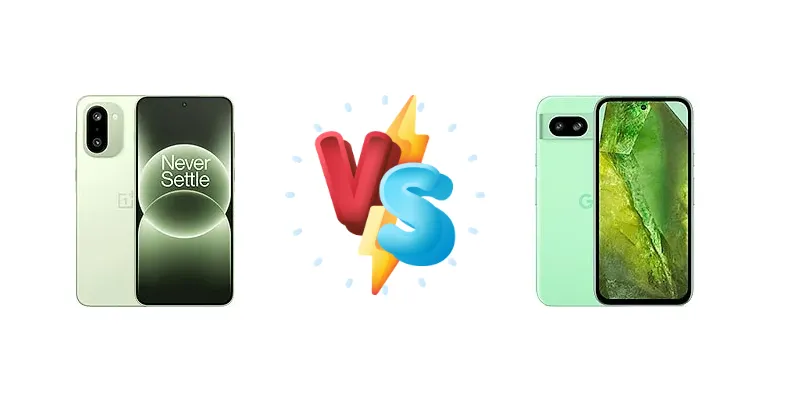
The OnePlus Ace 6T and Google Pixel 8a represent distinct philosophies in the mid-to-high range Android market. The Ace 6T aggressively targets performance with the latest Snapdragon silicon and blazing-fast charging, while the Pixel 8a focuses on a refined software experience, exceptional battery endurance, and Google’s computational photography prowess. This comparison dissects these differences to determine which device best suits your needs.
🏆 Quick Verdict
For users prioritizing raw speed and quick top-ups, the OnePlus Ace 6T is the clear winner. Its Snapdragon 8 Gen 5 delivers superior performance. However, the Google Pixel 8a takes the crown for all-day battery life, a brighter display, and Google’s signature software features, making it the better choice for the average user.
| Network |
|---|
| 2G bands | GSM 850 / 900 / 1800 / 1900 | GSM 850 / 900 / 1800 / 1900 |
| 3G bands | HSDPA 800 / 850 / 900 / 1700(AWS) / 2100 | HSDPA 800 / 850 / 900 / 1700(AWS) / 1900 / 2100 |
| 4G bands | LTE | 1, 2, 3, 4, 5, 7, 8, 12, 17, 18, 19, 20, 26, 28, 32, 38, 40, 41, 42, 66 - G6GPR (International) |
| 5G bands | SA/NSA | 1, 2, 3, 5, 7, 8, 12, 20, 26, 28, 38, 40, 41, 66, 75, 76, 77, 78 SA/NSA/Sub6 - G6GPR (International) |
| Speed | HSPA, LTE, 5G | HSPA, LTE, 5G |
| Technology | GSM / HSPA / LTE / 5G | GSM / HSPA / LTE / 5G |
| Launch |
|---|
| Announced | Expected announcement 2025, November | 2024, May 07 |
| Status | Rumored. Exp. release 2025, December | Available. Released 2024, May 14 |
| Body |
|---|
| Build | Glass front (Crystal Shield Glass), aluminum alloy frame, glass back or fiber-reinforced plastic back | Glass front (Gorilla Glass 3), aluminum frame, plastic back |
| Dimensions | - | 152.1 x 72.7 x 8.9 mm (5.99 x 2.86 x 0.35 in) |
| SIM | Nano-SIM + Nano-SIM | Nano-SIM + eSIM |
| Weight | - | 188 g (6.63 oz) |
| Display |
|---|
| Protection | Crystal Shield Glass | Corning Gorilla Glass 3, Mohs level 5 |
| Resolution | 1272 x 2800 pixels (~450 ppi density) | 1080 x 2400 pixels, 20:9 ratio (~430 ppi density) |
| Size | 6.83 inches, 113.3 cm2 | 6.1 inches, 90.3 cm2 (~81.6% screen-to-body ratio) |
| Type | LTPO AMOLED, 1B colors, 165Hz, PWM, HDR10+, Dolby Vision, HDR Vivid | OLED, HDR, 120Hz, 2000 nits (peak) |
| Platform |
|---|
| CPU | Octa-core | Nona-core (1x3.0 GHz Cortex-X3 & 4x2.45 GHz Cortex-A715 & 4x2.15 GHz Cortex-A510) |
| Chipset | Qualcomm Snapdragon 8 Gen 5 | Google Tensor G3 (4 nm) |
| GPU | Adreno | Immortalis-G715s MC10 |
| OS | Android 16, ColorOS 16 | Android 14, upgradable to Android 16, up to 7 major Android upgrades |
| Memory |
|---|
| Card slot | No | No |
| Internal | Up to 1TB 16GB RAM | 128GB 8GB RAM, 256GB 8GB RAM |
| Main Camera |
|---|
| Dual | 50 MP, f/1.8, 24mm (wide), PDAF, OIS
8 MP, f/2.2, 16mm, 112˚ (ultrawide), 1/4.0", 1.12µm | 64 MP (16 MP eff.), f/1.9, 26mm (wide), 1/1.73", 0.8µm, dual pixel PDAF, OIS
13 MP, f/2.2, 120˚ (ultrawide), 1.12µm |
| Features | Color spectrum sensor, LED flash, HDR, panorama | Dual-LED flash, Pixel Shift, Ultra HDR, panorama, Best Take |
| Video | 4K@30/60/120fps, 1080p@30/60/120fps, gyro-EIS, OIS | 4K@30/60fps, 1080p@30/60/120/240fps, OIS |
| Selfie camera |
|---|
| Features | HDR, panorama | HDR, panorama |
| Single | 16 MP, f/2.0, (wide) | 13 MP, f/2.2, 20mm (ultrawide), 1.12µm |
| Video | 4K@30fps, 1080p@30fps, gyro-EIS | 4K@30fps, 1080p@30/60fps |
| Sound |
|---|
| 35mm jack | No | No |
| Loudspeaker | Yes, with stereo speakers | Yes, with stereo speakers |
| Comms |
|---|
| Bluetooth | 5.4, A2DP, LE, aptX HD, aptX Adaptive, LHDC 5 | 5.3, A2DP, LE |
| Infrared port | Yes | - |
| NFC | Yes | Yes |
| Positioning | GPS (L1+L5), GLONASS (G1), BDS (B1I+B1c+B2a), GALILEO (E1+E5a), QZSS (L1+L5), NavIC (L5) | GPS, GLONASS, GALILEO, BDS, QZSS, NavIC |
| Radio | No | No |
| USB | USB Type-C 2.0 | USB Type-C 3.2 |
| WLAN | Wi-Fi 802.11 a/b/g/n/ac/6/7, dual-band | Wi-Fi 802.11 a/b/g/n/ac/6e, dual/tri-band (market/region dependent) |
| Features |
|---|
| Sensors | Fingerprint (under display), accelerometer, gyro, proximity, compass | Fingerprint (under display, optical), accelerometer, gyro, proximity, compass, barometer |
| Battery |
|---|
| Charging | 100W wired
Bypass charging | 18W wired, PD3.0
7.5W wireless
Bypass charging |
| Type | Si/C Li-Ion 8300 mAh | Li-Po 4492 mAh |
| Misc |
|---|
| Colors | Black, Purple, Green | Obsidian, Porcelain, Bay, Aloe |
| Models | - | GKV4X, G6GPR, G8HHN, G576D |
| Price | - | $ 229.98 / C$ 417.99 / £ 279.00 / € 299.99 / ₹ 33,300 |
| EU LABEL |
|---|
| Battery | - | 40:06h endurance, 1000 cycles |
| Energy | - | Class B |
| Free fall | - | Class A (270 falls) |
| Repairability | - | Class B |
OnePlus Ace 6T
- Blazing-fast 100W charging
- Potentially superior gaming performance with Snapdragon 8 Gen 5
- Likely higher peak CPU performance
- Battery life likely inferior to Pixel 8a
- Camera performance dependent on software optimization
Google Pixel 8a
- Exceptional battery life (40:06h endurance)
- Bright and vibrant display (1508 nits)
- Google’s renowned camera image processing
- Slower 18W charging
- Tensor G3 may not match Snapdragon 8 Gen 5 in raw power
Display Comparison
The Google Pixel 8a boasts a significantly brighter display, reaching a measured 1508 nits, ensuring excellent visibility outdoors. While the Ace 6T’s display specs are currently unknown, OnePlus typically prioritizes refresh rate over peak brightness. The Pixel 8a’s brightness advantage is crucial for users who frequently use their phones in sunny conditions. The Pixel 8a’s display technology is likely OLED, offering excellent contrast, while the Ace 6T’s panel type remains unconfirmed. The Pixel 8a’s display is a clear advantage for outdoor usability.
Camera Comparison
The Pixel 8a leverages Google’s renowned computational photography, even without detailed sensor specifications. Google’s image processing algorithms are known for their dynamic range, accurate colors, and excellent low-light performance. The Ace 6T’s camera specs are currently unknown, but OnePlus typically focuses on hardware specifications. Without knowing the Ace 6T’s sensor size and aperture, it’s difficult to directly compare. However, the Pixel 8a’s software advantage is likely to result in more consistently pleasing images, especially for casual users. The Pixel 8a’s strength lies in its ability to produce excellent photos with minimal effort.
Performance
The OnePlus Ace 6T is equipped with the Qualcomm Snapdragon 8 Gen 5, a cutting-edge chipset designed for flagship-level performance. This contrasts with the Google Pixel 8a’s Google Tensor G3 (4nm). While the Tensor G3 utilizes a nona-core configuration (1x3.0 GHz Cortex-X3, 4x2.45 GHz Cortex-A715, 4x2.15 GHz Cortex-A510) optimized for AI and machine learning tasks, the Snapdragon 8 Gen 5 is expected to deliver superior raw CPU and GPU power. The 4nm process node of the Tensor G3 offers improved efficiency compared to older chips, but the Snapdragon 8 Gen 5 is likely to maintain a performance lead, particularly in graphically intensive games. The Ace 6T will benefit users who prioritize demanding tasks.
Battery Life
The Google Pixel 8a shines in battery endurance, achieving a remarkable 40:06h endurance rating and 11:25h of active use. This is significantly better than the 83h endurance rating of the older Pixel 7a. The Ace 6T’s battery capacity is unknown, but its 100W wired charging is a major advantage, allowing for incredibly fast top-ups. While the Pixel 8a offers 18W wired charging with PD3.0 and 7.5W wireless charging, the Ace 6T can likely charge from 0-100% in under 30 minutes. The Pixel 8a prioritizes longevity, while the Ace 6T prioritizes speed of recharge.
Buying Guide
Buy the OnePlus Ace 6T if you are a power user demanding the fastest possible performance for gaming, demanding applications, or frequent multitasking, and if 100W charging is a priority. Buy the Google Pixel 8a if you value long-lasting battery life, a consistently smooth software experience, exceptional camera image processing, and a brighter, more visible display in direct sunlight.
Frequently Asked Questions
❓ Does the OnePlus Ace 6T’s 100W charging degrade the battery health faster than the Pixel 8a’s 18W charging?
While faster charging generates more heat, the OnePlus Ace 6T incorporates bypass charging, which directs power directly to the battery, minimizing heat buildup. Both phones support bypass charging, mitigating potential long-term battery degradation. However, consistently using extremely fast charging *can* contribute to slightly faster degradation over several years, but the convenience often outweighs this concern.
❓ How does the Google Tensor G3 handle demanding games compared to the Snapdragon 8 Gen 5 in the OnePlus Ace 6T?
The Snapdragon 8 Gen 5 is expected to offer a noticeable performance advantage in graphically intensive games. While the Tensor G3 is capable, the Snapdragon 8 Gen 5’s superior GPU and CPU power will translate to higher frame rates and smoother gameplay, especially in titles with demanding graphics settings. The Ace 6T is the better choice for dedicated mobile gamers.
❓ Is the Pixel 8a’s camera significantly better in low-light conditions than what OnePlus typically offers?
Yes, the Pixel 8a is expected to excel in low-light photography due to Google’s advanced computational photography algorithms, such as Night Sight. These algorithms combine multiple exposures to create brighter, clearer images with reduced noise. While OnePlus cameras are generally good, they typically don’t match the Pixel’s low-light capabilities without significant software processing.