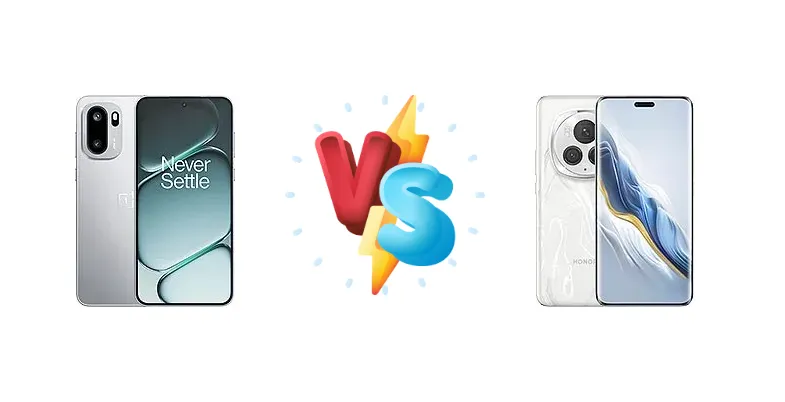
The OnePlus Ace 6 and Honor Magic6 Pro represent distinct approaches to the modern flagship smartphone. The Ace 6 aggressively targets performance enthusiasts with Qualcomm’s latest Snapdragon 8 Elite, while the Magic6 Pro focuses on a holistic experience, emphasizing battery endurance and a stunning display. This comparison dissects their key differences to help you choose the right device.
🏆 Quick Verdict
For users prioritizing raw speed and incredibly fast charging, the OnePlus Ace 6 is the clear winner. Its Snapdragon 8 Elite and 120W charging are unmatched. However, the Honor Magic6 Pro excels in battery life and offers a brighter, more visually immersive display, making it ideal for media consumption and extended use.
| Network |
|---|
| 2G bands | GSM 850 / 900 / 1800 / 1900 | GSM 850 / 900 / 1800 / 1900 |
| 3G bands | HSDPA 800 / 850 / 900 / 1700(AWS) / 2100 | HSDPA 800 / 850 / 900 / 1700(AWS) / 1900 / 2100 |
| 4G bands | 1, 3, 4, 5, 8, 18, 19, 26, 28, 34, 38, 39, 40, 41, 42, 43, 48, 66 | LTE |
| 5G bands | 1, 3, 5, 8, 18, 26, 28A, 38, 40, 41, 48, 66, 77, 78 SA/NSA | SA/NSA |
| Speed | HSPA, LTE, 5G | HSPA, LTE, 5G |
| Technology | GSM / HSPA / LTE / 5G | GSM / CDMA / HSPA / CDMA2000 / LTE / 5G |
| Launch |
|---|
| Announced | 2025, October 27 | 2024, January 11 |
| Status | Available. Released 2025, October 30 | Available. Released 2024, January 18 |
| Body |
|---|
| Build | Glass front (Crystal Shield Glass), glass back, aluminum alloy frame | Glass front (NanoCrystal Shield), glass back or silicone polymer back (eco leather) |
| Dimensions | 163.4 x 77 x 8.3 mm (6.43 x 3.03 x 0.33 in) | 162.5 x 75.8 x 8.9 mm (6.40 x 2.98 x 0.35 in) |
| SIM | Nano-SIM + Nano-SIM | · Nano-SIM + eSIM· Nano-SIM + Nano-SIM |
| Weight | 213 g (7.51 oz) | 225 g or 229 g (7.94 oz) |
| Display |
|---|
| Protection | Crystal Shield Glass | NanoCrystal Shield |
| Resolution | 1272 x 2800 pixels (~450 ppi density) | 1280 x 2800 pixels, 19.5:9 ratio (~453 ppi density) |
| Size | 6.83 inches, 113.3 cm2 (~90.1% screen-to-body ratio) | 6.8 inches, 112.8 cm2 (~91.6% screen-to-body ratio) |
| Type | LTPO AMOLED, 1B colors, 165Hz, PWM, HDR10+, Dolby Vision, HDR Vivid, 800 nits (typ), 1800 nits (HBM) | LTPO OLED, 1B colors, 120Hz, Dolby Vision, HDR, 1600 nits (HBM), 5000 nits (peak) |
| Platform |
|---|
| CPU | Octa-core (2x4.32 GHz Oryon V2 Phoenix L + 6x3.53 GHz Oryon V2 Phoenix M) | Octa-core (1x3.3 GHz Cortex-X4 & 3x3.2 GHz Cortex-A720 & 2x3.0 GHz Cortex-A720 & 2x2.3 GHz Cortex-A520) |
| Chipset | Qualcomm SM8750-AB Snapdragon 8 Elite (3 nm) | Qualcomm SM8650-AB Snapdragon 8 Gen 3 (4 nm) |
| GPU | Adreno 830 | Adreno 750 |
| OS | Android 16, ColorOS 16 | Android 14, up to 4 major Android upgrades, MagicOS 8 |
| Memory |
|---|
| Card slot | No | No |
| Internal | 256GB 12GB RAM, 256GB 16GB RAM, 512GB 12GB RAM, 512GB 16GB RAM, 1TB 16GB RAM | 256GB 12GB RAM, 256GB 16GB RAM, 512GB 12GB RAM, 512GB 16GB RAM, 1TB 16GB RAM |
| Main Camera |
|---|
| Dual | 50 MP, f/1.8, 24mm (wide), PDAF, OIS
8 MP, f/2.2, 16mm, 112˚ (ultrawide), 1/4.0", 1.12µm | - |
| Features | Color spectrum sensor, LED flash, HDR, panorama | Laser AF, color spectrum sensor, LED flash, HDR, panorama |
| Triple | - | 50 MP, f/1.4-2.0, 23mm (wide), 1/1.3", 1.2µm, PDAF, OIS
180 MP, f/2.6, (periscope telephoto), 1/1.49", 0.56µm, PDAF, OIS, 2.5x optical zoom
50 MP, f/2.0, 13mm, 122˚ (ultrawide), 1/2.88", 0.61µm, AF |
| Video | 4K@30/60/120fps, 1080p@30/60/120fps, gyro-EIS, OIS | 4K@24/30/60fps, 1080p@30/60/120/240fps, gyro-EIS, OIS, HDR, 10-bit video |
| Selfie camera |
|---|
| Features | HDR, panorama | - |
| Single | 16 MP, f/2.4, 23mm (wide), 1/3", 1.0µm | 50 MP, f/2.0, 22mm (wide), 1/2.93", 0.6µm, AF
TOF 3D, (depth/biometrics sensor) |
| Video | 1080p@30fps, gyro-EIS | 4K@30fps, 1080p@30/60fps, gyro-EIS |
| Sound |
|---|
| 35mm jack | No | No |
| Loudspeaker | Yes, with stereo speakers | Yes, with stereo speakers |
| Comms |
|---|
| Bluetooth | 5.4, A2DP, LE, aptX HD, aptX Adaptive, LHDC 5 | 5.3, A2DP, LE, aptX HD |
| Infrared port | Yes | Yes |
| NFC | Yes | Yes |
| Positioning | GPS (L1+L5), GLONASS (G1), BDS (B1I+B1c+B2a), GALILEO (E1+E5a), QZSS (L1+L5), NavIC (L5) | GPS (L1+L5), GLONASS, BDS (B1I+B1c+B2a), GALILEO (E1+E5a) |
| Radio | No | No |
| USB | USB Type-C 2.0 | USB Type-C 3.2, DisplayPort 1.2, OTG |
| WLAN | Wi-Fi 802.11 a/b/g/n/ac/6/7, dual-band | Wi-Fi 802.11 a/b/g/n/ac/6/7, dual-band, Wi-Fi Direct |
| Features |
|---|
| Sensors | Fingerprint (under display, ultrasonic), accelerometer, gyro, proximity, compass | Fingerprint (under display, optical), Face ID, accelerometer, gyro, proximity, compass |
| Battery |
|---|
| Charging | 120W wired, 120W UFCS, 55W PPS, 18W PD, 18W QC, 58% in 20 min, 100% in 43 min
Bypass charging | 80W wired
66W wireless
Reverse wireless
5W reverse wired |
| Type | Si/C Li-Ion 7800 mAh | Si/C Li-Ion 5600 mAh |
| Misc |
|---|
| Colors | Black, White, Silver | Black, Green, Blue, Purple, White |
| Models | PLQ110 | BVL-AN16, BVL-N49 |
| Price | About 310 EUR | € 455.54 / $ 899.00 / £ 598.99 |
OnePlus Ace 6
- Blazing-fast 120W charging
- Cutting-edge Snapdragon 8 Elite processor
- Potentially superior single-core performance with Oryon cores
- Potentially shorter battery life due to power-hungry chipset
- Display specs currently unknown
Honor Magic6 Pro
- Exceptional battery life (14:06h active use)
- Class-leading 1578 nits peak display brightness
- Versatile charging options (wired, wireless, reverse)
- Slower charging speeds compared to OnePlus Ace 6
- Snapdragon 8 Gen 3 may not match the 8 Elite in peak performance
Display Comparison
The Honor Magic6 Pro immediately stands out with its measured peak brightness of 1578 nits, significantly exceeding what’s typically found in flagship displays. While the Ace 6’s display specs are not provided, the Magic6 Pro’s brightness ensures excellent visibility even in direct sunlight. The Magic6 Pro likely employs LTPO technology for adaptive refresh rates, contributing to power efficiency. The Ace 6’s display quality will be a key factor, but the Magic6 Pro sets a high bar for outdoor readability and visual vibrancy.
Camera Comparison
Without detailed camera specifications for either device, a direct comparison is limited. However, the market positioning suggests the Honor Magic6 Pro will likely prioritize camera capabilities. Honor has a history of investing heavily in camera technology, and the Magic series is known for its image processing prowess. The Ace 6, while likely equipped with a capable camera system, will likely focus more on overall performance. Sensor size and optical image stabilization (OIS) will be critical differentiating factors, but are currently unknown.
Performance
The core difference lies in the chipsets. The OnePlus Ace 6 utilizes the Qualcomm SM8750-AB Snapdragon 8 Elite (3nm), featuring a unique Oryon V2 Phoenix CPU architecture with a 2x4.32 GHz prime core cluster and a 6x3.53 GHz secondary cluster. This contrasts with the Honor Magic6 Pro’s Snapdragon 8 Gen 3 (4nm) which employs a 1x3.3 GHz Cortex-X4 prime core, 3x3.2 GHz Cortex-A720 cores, 2x3.0 GHz Cortex-A720 cores, and 2x2.3 GHz Cortex-A520 cores. The 3nm process of the Snapdragon 8 Elite *should* offer better power efficiency and thermal headroom, potentially allowing for sustained peak performance. However, the Snapdragon 8 Gen 3 is a proven performer, and the Magic6 Pro’s thermal design will be crucial. The Ace 6’s Oryon cores are designed for single-core dominance, potentially giving it an edge in lightly threaded tasks.
Battery Life
The Honor Magic6 Pro boasts an impressive 14:06h active use score, indicating exceptional battery life. This is likely due to the efficient Snapdragon 8 Gen 3 and optimized software. The OnePlus Ace 6, while featuring a fast 120W wired charging system (and 120W UFCS, 55W PPS, 18W PD, 18W QC), may require more frequent charging due to the power demands of the Snapdragon 8 Elite. The Ace 6 can reach 58% charge in 20 minutes and 100% in 43 minutes, a significant advantage for users who need a quick top-up. The Magic6 Pro offers 80W wired and 66W wireless charging, along with reverse wireless and wired charging, providing versatility but slower overall charging speeds.
Buying Guide
Buy the OnePlus Ace 6 if you need uncompromising gaming performance, the fastest possible charging speeds, and are comfortable with potentially shorter battery life. Buy the Honor Magic6 Pro if you prioritize all-day battery life, a class-leading display for media consumption, and a more balanced overall experience. The Ace 6 is for the power user, while the Magic6 Pro caters to the everyday enthusiast.
Frequently Asked Questions
❓ Does the Snapdragon 8 Elite in the OnePlus Ace 6 suffer from significant thermal throttling during extended gaming sessions?
The 3nm process of the Snapdragon 8 Elite *should* mitigate throttling compared to previous generations. However, sustained peak performance will depend heavily on OnePlus’s thermal management solution. Reviews will be crucial to determine real-world throttling behavior under heavy load.
❓ How does the 66W wireless charging on the Honor Magic6 Pro compare to the 80W wired charging in terms of actual charging time?
While 66W wireless charging is fast, it will always be slower than 80W wired charging. Expect a full wireless charge to take significantly longer – likely over an hour – compared to the roughly 43 minutes for a full wired charge on the OnePlus Ace 6.
❓ Is the UFCS charging standard on the OnePlus Ace 6 compatible with all USB-C chargers?
UFCS (USB Fast Charging Specification) is not universally supported. While the Ace 6 also supports PPS, PD, and QC, to achieve the full 120W charging speed, you'll need a charger specifically supporting UFCS or PPS.
❓ What type of display technology does the Honor Magic6 Pro use (e.g., OLED, AMOLED) and does it support a high refresh rate?
While not explicitly stated, the Magic6 Pro likely utilizes an OLED or AMOLED panel given its high brightness and contrast. It almost certainly supports an adaptive refresh rate (likely LTPO) to balance smoothness and power efficiency, though the exact maximum refresh rate is currently unknown.