
OnePlus Ace 5 vs Xiaomi Redmi K60 Pro: A Detailed Performance and Charging Comparison
| Phones Images | |||||
|---|---|---|---|---|---|
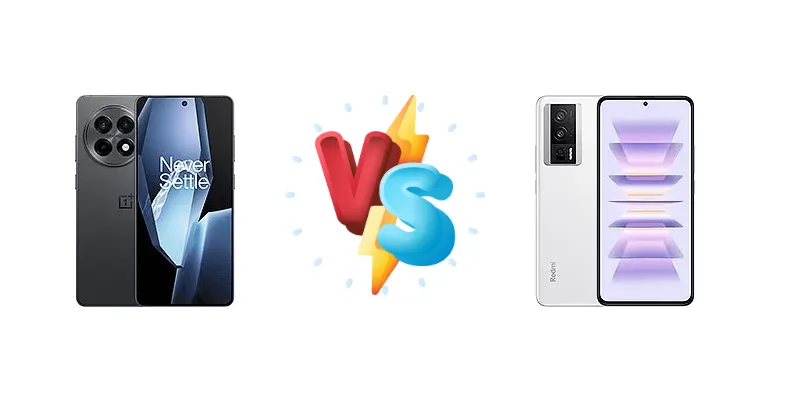
|
🏆 Quick Verdict
For users prioritizing raw processing power and future-proofing, the OnePlus Ace 5 emerges as the winner. Its Snapdragon 8 Gen 3 chipset offers a noticeable performance uplift over the K60 Pro’s Snapdragon 8 Gen 2. However, the Xiaomi Redmi K60 Pro’s significantly faster 120W charging and wireless charging capabilities make it a strong contender for those who value convenience and rapid power-ups.
| PHONES | ||
|---|---|---|
| Phone Names | OnePlus Ace 5 | Xiaomi Redmi K60 Pro |
| Network | ||
|---|---|---|
| 2G bands | GSM 850 / 900 / 1800 / 1900 | GSM 850 / 900 / 1800 / 1900 |
| 3G bands | HSDPA 800 / 850 / 900 / 1700(AWS) / 2100 | HSDPA 800 / 850 / 900 / 1700(AWS) / 2100 |
| 4G bands | 1, 3, 4, 5, 8, 18, 19, 26, 28, 34, 38, 39, 40, 41, 42, 48, 66 | 1, 3, 4, 5, 8, 18, 19, 26, 34, 38, 39, 40, 41, 42 |
| 5G bands | 1, 3, 5, 8, 28, 38, 40, 41, 48, 66, 77, 78 SA/NSA | 1, 3, 5, 8, 28, 38, 41, 77, 78 SA/NSA |
| Speed | HSPA, LTE, 5G | HSPA, LTE, 5G |
| Technology | GSM / CDMA / HSPA / LTE / 5G | GSM / CDMA / HSPA / CDMA2000 / LTE / 5G |
| - | CDMA2000 1x | |
| Launch | ||
|---|---|---|
| Announced | 2024, December 26 | 2022, December 27 |
| Status | Available. Released 2024, December 26 | Available. Released 2023, January 01 |
| Body | ||
|---|---|---|
| Build | Glass front (Crystal Shield Glass), glass back (Crystal Shield Glass), aluminum frame | - |
| Dimensions | 161.7 x 75.8 x 8.1 mm (6.37 x 2.98 x 0.32 in) | 162.8 x 75.4 x 8.6 mm or 8.9 mm |
| SIM | Nano-SIM + Nano-SIM | Nano-SIM + Nano-SIM |
| Weight | 206 g or 223 g (7.27 oz) | 201 g or 205 g (7.09 oz) |
| Display | ||
|---|---|---|
| Protection | Crystal Shield Glass | - |
| Resolution | 1264 x 2780 pixels (~450 ppi density) | 1440 x 3200 pixels, 20:9 ratio (~526 ppi density) |
| Size | 6.78 inches, 111.7 cm2 (~91.2% screen-to-body ratio) | 6.67 inches, 107.4 cm2 (~87.5% screen-to-body ratio) |
| Type | LTPO AMOLED, 1B colors, 120Hz, HDR10+, Dolby Vision, 800 nits (typ), 1600 nits (HBM), 4500 nits (peak) | OLED, 68B colors, 120Hz, Dolby Vision, HDR10+, 1400 nits (peak) |
| Platform | ||
|---|---|---|
| CPU | Octa-core (1x3.3 GHz Cortex-X4 & 3x3.2 GHz Cortex-A720 & 2x3.0 GHz Cortex-A720 & 2x2.3 GHz Cortex-A520) | Octa-core (1x3.2 GHz Cortex-X3 & 2x2.8 GHz Cortex-A715 & 2x2.8 GHz Cortex-A710 & 3x2.0 GHz Cortex-A510) |
| Chipset | Qualcomm SM8650-AB Snapdragon 8 Gen 3 (4 nm) | Qualcomm SM8550-AB Snapdragon 8 Gen 2 (4 nm) |
| GPU | Adreno 750 | Adreno 740 |
| OS | Android 15, ColorOS 15 | Android 13, MIUI 14 |
| Memory | ||
|---|---|---|
| Card slot | No | No |
| Internal | 256GB 12GB RAM, 256GB 16GB RAM, 512GB 12GB RAM, 512GB 16GB RAM, 1TB 16GB RAM | 128GB 8GB RAM, 256GB 8GB RAM, 256GB 12GB RAM, 512GB 12GB RAM, 512GB 16GB RAM |
| - | UFS 4.0 UFS 3.1 - 128GB only | |
| Main Camera | ||
|---|---|---|
| Features | Color spectrum sensor, Dual-LED flash, HDR, panorama | Color spectrum sensor, Dual-LED dual-tone flash, HDR, panorama |
| Triple | 50 MP, f/1.8, 24mm (wide), 1/1.56", 1.0µm, PDAF, OIS 8 MP, f/2.2, 16mm, 112˚ (ultrawide), 1/4.0", 1.12µm 2 MP (macro) | 54 MP, f/1.9, (wide), 1/1.49", 1.0µm, PDAF, OIS 8 MP, 118˚ (ultrawide), 1/4.0", 1.12µm 2 MP (macro) |
| Video | 4K@30/60fps, 1080p@30/60/120/240fps, gyro-EIS, OIS | 8K@24fps, 4K@30/60fps, 1080p@30/60/120/240/960fps, 720p@1920fps, gyro-EIS |
| Selfie camera | ||
|---|---|---|
| Features | HDR, panorama | HDR |
| Single | 16 MP, f/2.4, 24mm (wide), 1/3", 1.0µm | 16 MP, (wide), 1/3.06", 1.0µm |
| Video | 1080p@30fps, gyro-EIS | 1080p@30/60/120fps |
| Sound | ||
|---|---|---|
| 3.5mm jack | - | No |
| 35mm jack | No | No |
| Loudspeaker | Yes, with stereo speakers | Yes, with stereo speakers |
| - | 24-bit/192kHz audio | |
| Comms | ||
|---|---|---|
| Bluetooth | 5.4, A2DP, LE, aptX HD, LHDC 5 | 5.3, A2DP, LE |
| Infrared port | Yes | Yes |
| NFC | Yes | Yes |
| Positioning | GPS (L1+L5), GLONASS (G1), BDS (B1I+B1c+B2a), GALILEO (E1+E5a), QZSS (L1+L5) | GPS (L1+L5), GLONASS (G1), BDS (B1I+B2a+Bc), GALILEO (E1+E5a), QZSS (L1+L5), NavIC |
| Radio | No | Unspecified |
| USB | USB Type-C 2.0 | USB Type-C 2.0, OTG |
| WLAN | Wi-Fi 802.11 a/b/g/n/ac/6/7, dual-band | Wi-Fi 802.11 a/b/g/n/ac/6e, dual-band, Wi-Fi Direct |
| Features | ||
|---|---|---|
| Sensors | Fingerprint (under display, optical), accelerometer, gyro, proximity, compass | Fingerprint (under display, optical), accelerometer, gyro, proximity, compass |
| Battery | ||
|---|---|---|
| Charging | 80W wired, 18W PD, 55% in 15 min, 100% in 35 min | 120W wired, PD3.0, QC3+, 100% in 19 min 30W wireless |
| Type | Si/C Li-Ion 6415 mAh | Li-Po 5000 mAh |
| Misc | ||
|---|---|---|
| Colors | Gray, White, Green | Black, White, Mint, Champion Black |
| Models | PKG110 | 22127RK46C |
| Price | About 300 EUR | About 460 EUR |
OnePlus Ace 5
- Latest Snapdragon 8 Gen 3 chipset for top-tier performance
- More efficient CPU architecture for sustained performance
- Potentially better gaming performance due to improved GPU
- Slower 80W wired charging compared to the K60 Pro
- No wireless charging support
Xiaomi Redmi K60 Pro
- Ultra-fast 120W wired charging for rapid power-ups
- 30W wireless charging for added convenience
- PD3.0 and QC3+ support for wider charger compatibility
- Older Snapdragon 8 Gen 2 chipset
- Potentially more thermal throttling under sustained load
Display Comparison
While display specifications aren't provided, both phones likely feature high refresh rate AMOLED panels, typical of their price segment. The key difference will be in peak brightness and color calibration. Given Xiaomi’s history with display technology, the K60 Pro may offer slightly more accurate color reproduction. However, without specific nit ratings, it’s difficult to definitively declare a winner. Both will likely support HDR10+ for enhanced video playback.
Camera Comparison
Without detailed camera specifications, a direct comparison is challenging. However, both phones likely employ a multi-camera system with a primary sensor. The Redmi K60 Pro, given Xiaomi’s camera focus, may prioritize computational photography and image processing algorithms. The Ace 5, while capable, may lean towards a more natural image profile. The absence of information regarding sensor size and OIS makes it impossible to determine which phone captures superior low-light images or offers better video stabilization.
Performance
The OnePlus Ace 5’s Snapdragon 8 Gen 3 (4nm) represents a significant architectural leap over the Redmi K60 Pro’s Snapdragon 8 Gen 2 (4nm). The Gen 3 features a new Cortex-X4 prime core clocked at 3.3 GHz, compared to the Gen 2’s 3.2 GHz Cortex-X3. This, coupled with improvements in the A720 cores (Ace 5) versus A715/A710 (K60 Pro), translates to a measurable performance advantage in CPU-intensive tasks. The Gen 3 also boasts a more powerful Adreno GPU, offering superior graphics performance. While both utilize LPDDR5x RAM, the Ace 5’s chipset is inherently more efficient, potentially leading to better sustained performance under heavy load and reduced thermal throttling.
Battery Life
The Redmi K60 Pro’s 120W wired charging is a clear advantage, promising a full charge in just 19 minutes. The OnePlus Ace 5’s 80W charging, while still fast, takes 35 minutes to reach 100%. The K60 Pro also adds 30W wireless charging, a feature absent on the Ace 5. While battery capacity isn’t specified, the faster charging speeds of the K60 Pro mitigate any potential disadvantage from a slightly smaller battery. The inclusion of PD3.0 and QC3+ on the K60 Pro also offers broader compatibility with various chargers.
Buying Guide
Buy the OnePlus Ace 5 if you need the absolute best performance for demanding tasks like gaming and video editing, and are willing to trade off slightly slower charging speeds. Buy the Xiaomi Redmi K60 Pro if you prioritize incredibly fast charging – both wired and wireless – and a well-rounded experience without necessarily needing the latest generation chipset. The K60 Pro is ideal for users who frequently top up their phones throughout the day.