
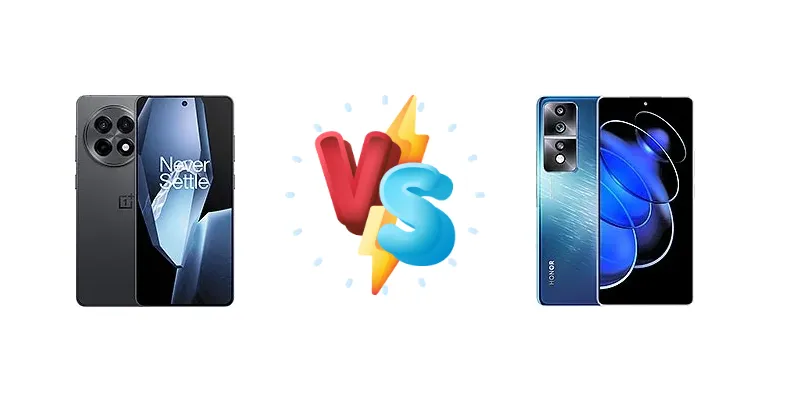
OnePlus Ace 5 vs Honor 80 GT: A Deep Dive into Performance and Value
| Phones Images | |||||
|---|---|---|---|---|---|
|
🏆 Quick Verdict
For users prioritizing raw performance and future-proofing, the OnePlus Ace 5 is the clear winner thanks to its Snapdragon 8 Gen 3. However, the Honor 80 GT offers a strong value proposition, delivering excellent performance at a potentially lower price point, making it ideal for budget-conscious gamers.
| PHONES | ||
|---|---|---|
| Phone Names | OnePlus Ace 5 | Honor 80 GT |
| Network | ||
|---|---|---|
| 2G bands | GSM 850 / 900 / 1800 / 1900 | GSM 850 / 900 / 1800 / 1900 |
| 3G bands | HSDPA 800 / 850 / 900 / 1700(AWS) / 2100 | HSDPA 800 / 850 / 900 / 1700(AWS) / 2100 |
| 4G bands | 1, 3, 4, 5, 8, 18, 19, 26, 28, 34, 38, 39, 40, 41, 42, 48, 66 | 1, 3, 4, 5, 8, 19, 28, 34, 38, 39, 40, 41 |
| 5G bands | 1, 3, 5, 8, 28, 38, 40, 41, 48, 66, 77, 78 SA/NSA | 1, 5, 8, 28, 41, 77, 78 SA/NSA |
| Speed | HSPA, LTE, 5G | HSPA, LTE, 5G |
| Technology | GSM / CDMA / HSPA / LTE / 5G | GSM / CDMA / HSPA / CDMA2000 / LTE / 5G |
| - | CDMA2000 1x | |
| Launch | ||
|---|---|---|
| Announced | 2024, December 26 | 2022, December 26 |
| Status | Available. Released 2024, December 26 | Available. Released 2022, December 26 |
| Body | ||
|---|---|---|
| Build | Glass front (Crystal Shield Glass), glass back (Crystal Shield Glass), aluminum frame | - |
| Dimensions | 161.7 x 75.8 x 8.1 mm (6.37 x 2.98 x 0.32 in) | 162.5 x 75.3 x 7.9 mm (6.40 x 2.96 x 0.31 in) |
| SIM | Nano-SIM + Nano-SIM | Nano-SIM + Nano-SIM |
| Weight | 206 g or 223 g (7.27 oz) | 187 g or 195 g (6.60 oz) |
| Display | ||
|---|---|---|
| Protection | Crystal Shield Glass | - |
| Resolution | 1264 x 2780 pixels (~450 ppi density) | 1080 x 2400 pixels, 20:9 ratio (~395 ppi density) |
| Size | 6.78 inches, 111.7 cm2 (~91.2% screen-to-body ratio) | 6.67 inches, 107.4 cm2 (~87.8% screen-to-body ratio) |
| Type | LTPO AMOLED, 1B colors, 120Hz, HDR10+, Dolby Vision, 800 nits (typ), 1600 nits (HBM), 4500 nits (peak) | AMOLED, 1B colors, 120Hz, HDR10, 1400 nits (peak) |
| Platform | ||
|---|---|---|
| CPU | Octa-core (1x3.3 GHz Cortex-X4 & 3x3.2 GHz Cortex-A720 & 2x3.0 GHz Cortex-A720 & 2x2.3 GHz Cortex-A520) | Octa-core (1x3.0 GHz Cortex-X2 & 3x2.5 GHz Cortex-A710 & 4x1.80 GHz Cortex-A510) |
| Chipset | Qualcomm SM8650-AB Snapdragon 8 Gen 3 (4 nm) | Qualcomm SM8475 Snapdragon 8+ Gen 1 (4 nm) |
| GPU | Adreno 750 | Adreno 730 |
| OS | Android 15, ColorOS 15 | Android 12, MagicOS 7 |
| Memory | ||
|---|---|---|
| Card slot | No | No |
| Internal | 256GB 12GB RAM, 256GB 16GB RAM, 512GB 12GB RAM, 512GB 16GB RAM, 1TB 16GB RAM | 256GB 12GB RAM, 256GB 16GB RAM, 512GB 12GB RAM |
| Main Camera | ||
|---|---|---|
| Features | Color spectrum sensor, Dual-LED flash, HDR, panorama | LED flash, HDR, panorama |
| Single | - | 16 MP, f/2.4, (wide) |
| Triple | 50 MP, f/1.8, 24mm (wide), 1/1.56", 1.0µm, PDAF, OIS 8 MP, f/2.2, 16mm, 112˚ (ultrawide), 1/4.0", 1.12µm 2 MP (macro) | 54 MP, f/1.9, (wide), 1/1.49", PDAF 8 MP, f/2.2, (ultrawide) 2 MP (macro) |
| Video | 4K@30/60fps, 1080p@30/60/120/240fps, gyro-EIS, OIS | 4K@30fps, 1080p@30/60fps, gyro-EIS |
| Selfie camera | ||
|---|---|---|
| Features | HDR, panorama | - |
| Single | 16 MP, f/2.4, 24mm (wide), 1/3", 1.0µm | 16 MP, f/2.4, (wide) |
| Video | 1080p@30fps, gyro-EIS | 1080p@30fps, gyro-EIS |
| Sound | ||
|---|---|---|
| 3.5mm jack | - | No |
| 35mm jack | No | No |
| Loudspeaker | Yes, with stereo speakers | Yes |
| Comms | ||
|---|---|---|
| Bluetooth | 5.4, A2DP, LE, aptX HD, LHDC 5 | 5.2, A2DP, LE, aptX HD |
| Infrared port | Yes | Yes |
| NFC | Yes | Yes |
| Positioning | GPS (L1+L5), GLONASS (G1), BDS (B1I+B1c+B2a), GALILEO (E1+E5a), QZSS (L1+L5) | GPS, GALILEO, GLONASS, BDS, QZSS |
| Radio | No | No |
| USB | USB Type-C 2.0 | USB Type-C 2.0, OTG |
| WLAN | Wi-Fi 802.11 a/b/g/n/ac/6/7, dual-band | Wi-Fi 802.11 a/b/g/n/ac/6, dual-band, Wi-Fi Direct |
| Features | ||
|---|---|---|
| Sensors | Fingerprint (under display, optical), accelerometer, gyro, proximity, compass | Fingerprint (under display, optical), accelerometer, gyro, compass |
| - | Virtual proximity sensing | |
| Battery | ||
|---|---|---|
| Charging | 80W wired, 18W PD, 55% in 15 min, 100% in 35 min | 66W wired, 3-50% in 15 min 5W reverse wired |
| Type | Si/C Li-Ion 6415 mAh | Li-Po 4800 mAh |
| Misc | ||
|---|---|---|
| Colors | Gray, White, Green | Black, Blue, White |
| Models | PKG110 | AGT-AN00 |
| Price | About 300 EUR | About 450 EUR |
OnePlus Ace 5
- Superior performance with Snapdragon 8 Gen 3
- Faster 80W wired charging
- Likely more advanced camera system
- Potentially higher price
- No reverse wireless charging
Honor 80 GT
- Excellent value for money
- Strong performance with Snapdragon 8+ Gen 1
- 66W fast charging and 5W reverse charging
- Older chipset, less future-proof
- Potentially inferior camera performance
Display Comparison
While display specifications are missing, both phones likely feature high refresh rate AMOLED panels, common in this segment. However, the Ace 5, being a newer device, may benefit from advancements in panel technology like higher peak brightness and potentially improved color accuracy. The Snapdragon 8 Gen 3's ISP could also contribute to more vibrant and accurate color reproduction. The Honor 80 GT, given its market positioning, may prioritize cost optimization in this area.
Camera Comparison
Camera details are absent, but we can infer some differences. The Ace 5, being a newer flagship, likely incorporates a more advanced image sensor and processing pipeline. The Snapdragon 8 Gen 3’s ISP offers improved computational photography capabilities, potentially resulting in better dynamic range, low-light performance, and video stabilization. The Honor 80 GT, while capable, will likely rely on software optimizations to compete, and may not match the Ace 5’s raw image quality. The absence of specific sensor details makes a definitive comparison difficult, but the Ace 5’s chipset advantage suggests a superior camera experience.
Performance
The OnePlus Ace 5’s Snapdragon 8 Gen 3 (4nm) represents a significant leap over the Honor 80 GT’s Snapdragon 8+ Gen 1 (4nm). The Gen 3’s Cortex-X4 prime core, clocked at 3.3 GHz, offers substantially improved single-core performance compared to the 8+ Gen 1’s Cortex-X2 at 3.0 GHz. The newer architecture also translates to gains in multi-core performance, with the Ace 5’s CPU configuration (1x3.3GHz, 3x3.2GHz, 2x3.0GHz, 2x2.3GHz) offering a more balanced and efficient workload distribution than the 80 GT’s (1x3.0GHz, 3x2.5GHz, 4x1.80GHz). This difference will be most noticeable in demanding applications and sustained gaming sessions, where the Ace 5 will exhibit less thermal throttling. The Ace 5 also benefits from potentially faster LPDDR5x RAM, further enhancing performance.
Battery Life
The OnePlus Ace 5’s 80W wired charging is significantly faster than the Honor 80 GT’s 66W charging. The Ace 5 claims 55% charge in 15 minutes and 100% in 35 minutes, while the 80 GT reaches 3-50% in 15 minutes. While battery capacity is unknown for both, the faster charging of the Ace 5 provides a more convenient user experience, especially for users who frequently need to top up their battery quickly. The 80 GT does offer 5W reverse wired charging, a feature absent in the Ace 5, which could be useful for charging accessories.
Buying Guide
Buy the OnePlus Ace 5 if you demand the absolute best Android performance for demanding tasks like gaming and video editing, and are willing to pay a premium. Buy the Honor 80 GT if you prioritize a balanced experience with strong gaming capabilities, fast charging, and a potentially more affordable price tag. The 80 GT is the better choice for users who want flagship-level performance without breaking the bank.