
OnePlus Ace 3 vs ZTE nubia Z60 Ultra: A Deep Dive into Snapdragon Generations
| Phones Images | |||||
|---|---|---|---|---|---|
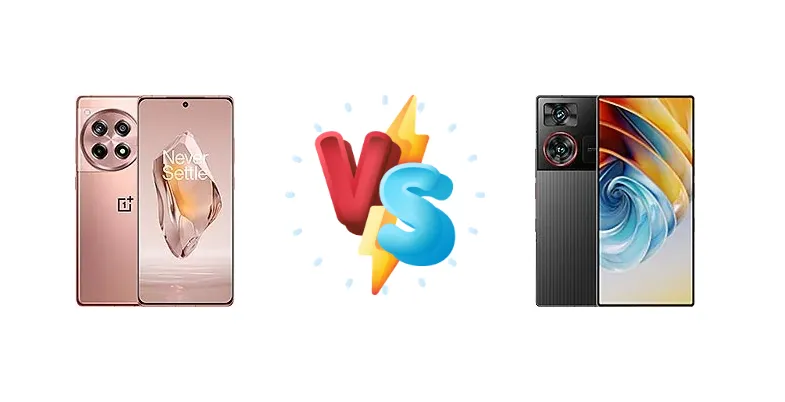
|
🏆 Quick Verdict
For most users, the ZTE nubia Z60 Ultra Leading emerges as the superior choice. The Snapdragon 8 Gen 3 provides a noticeable performance uplift, and the impressive 14:04 hour active use battery life significantly outpaces what the Ace 3 can achieve, despite the latter’s faster 100W charging.
| PHONES | ||
|---|---|---|
| Phone Names | OnePlus Ace 3 | ZTE nubia Z60 Ultra Leading |
| Network | ||
|---|---|---|
| 2G bands | GSM 850 / 900 / 1800 / 1900 | GSM 850 / 900 / 1800 / 1900 |
| 3G bands | HSDPA 850 / 900 / 1700(AWS) / 2100 | HSDPA 850 / 900 / 1700(AWS) / 1900 / 2100 |
| 4G bands | 1, 3, 4, 5, 8, 18, 19, 26, 28, 34, 38, 39, 40, 41 | 1, 2, 3, 4, 5, 7, 8, 12, 17, 18, 19, 20, 26, 28, 34, 38, 39, 40, 41, 66 - International |
| 5G bands | 1, 3, 5, 8, 28, 41, 77, 78 SA/NSA | 1, 2, 3, 5, 7, 8, 28, 38, 40, 41, 66, 77, 78 SA/NSA - International |
| Speed | HSPA, LTE, 5G | HSPA, LTE, 5G |
| Technology | GSM / CDMA / HSPA / LTE / 5G | GSM / CDMA / HSPA / CDMA2000 / LTE / 5G |
| Launch | ||
|---|---|---|
| Announced | 2024, January 04 | 2024, July 23 |
| Status | Available. Released 2024, January 15 | Available. Released 2024, August 12 |
| Body | ||
|---|---|---|
| Build | Glass front (Gorilla Glass Victus 2), glass back, aluminum frame | Glass front, aluminum frame, glass back |
| Dimensions | 163.3 x 75.3 x 8.8 mm (6.43 x 2.96 x 0.35 in) | 164 x 76.4 x 8.8 mm (6.46 x 3.01 x 0.35 in) |
| SIM | Nano-SIM + Nano-SIM | Nano-SIM + Nano-SIM |
| Weight | 207 g (7.30 oz) | 246 g (8.68 oz) |
| Display | ||
|---|---|---|
| Protection | Corning Gorilla Glass Victus 2 | - |
| Resolution | 1264 x 2780 pixels (~450 ppi density) | 1116 x 2480 pixels, 20:9 ratio (~400 ppi density) |
| Size | 6.78 inches, 111.7 cm2 (~90.9% screen-to-body ratio) | 6.8 inches, 111.6 cm2 (~89.1% screen-to-body ratio) |
| Type | LTPO AMOLED, 1B colors, 120Hz, HDR10+, Dolby Vision, 1600 nits (HBM), 4500 nits (peak) | AMOLED, 1B colors, 120Hz, HDR10, 1500 nits (peak) |
| Platform | ||
|---|---|---|
| CPU | Octa-core (1x3.2 GHz Cortex-X3 & 2x2.8 GHz Cortex-A715 & 2x2.8 GHz Cortex-A710 & 3x2.0 GHz Cortex-A510) | Octa-core (1x3.4 GHz Cortex-X4 & 3x3.2 GHz Cortex-A720 & 2x3.0 GHz Cortex-A720 & 2x2.3 GHz Cortex-A520) |
| Chipset | Qualcomm SM8550-AB Snapdragon 8 Gen 2 (4 nm) | Qualcomm SM8650-AC Snapdragon 8 Gen 3 (4 nm) |
| GPU | Adreno 740 | Adreno 750 (1 GHz) |
| OS | Android 14, ColorOS 14 | Android 14, MyOS 14 (International), MyOS 14.5 (China) |
| Memory | ||
|---|---|---|
| Card slot | No | No |
| Internal | 256GB 12GB RAM, 512GB 16GB RAM, 1TB 16GB RAM | 256GB 8GB RAM, 256GB 12GB RAM, 512GB 16GB RAM, 1TB 16GB RAM, 1TB 24GB RAM |
| Main Camera | ||
|---|---|---|
| Features | Color spectrum sensor, LED flash, HDR, panorama | Laser AF, color spectrum sensor, Ring-LED, dual-tone flash, panorama, HDR |
| Triple | 50 MP, f/1.8, 24mm (wide), 1/1.56", 1.0µm, PDAF, OIS 8 MP, f/2.2, 16mm, 112˚ (ultrawide), 1/4.0", 1.12µm 2 MP (macro) | 50 MP, f/1.6, 35mm (standard), 1/1.56", 1.0µm, PDAF, OIS 64 MP, f/3.3, 85mm (periscope telephoto), 1/2.0", PDAF, OIS, 3.3x optical zoom (vs. 26mm cam) 50 MP, f/1.8, 18mm, 100˚ (ultrawide), 1/1.55", 1.0µm, PDAF, OIS |
| Video | 4K@30/60fps, 1080p@30/60/120/240fps, gyro-EIS, OIS | 8K@30fps, 4K@30/60/120fps, 1080p@30/60fps, gyro-EIS, HDR10, 10‑bit video |
| Selfie camera | ||
|---|---|---|
| Features | HDR | HDR |
| Single | 16 MP, f/2.4, 26mm (wide), 1/3", 1.0µm | 12 MP, under display |
| Video | 1080p@30fps | 1080p@30fps |
| Sound | ||
|---|---|---|
| 35mm jack | No | No |
| Loudspeaker | Yes, with stereo speakers | Yes, with stereo speakers |
| Comms | ||
|---|---|---|
| Bluetooth | 5.3, A2DP, LE, aptX HD | 5.4, A2DP, LE, aptX HD, aptX Adaptive, aptX Lossless |
| Infrared port | Yes | Yes |
| NFC | Yes | Yes (market/region dependent) |
| Positioning | GPS (L1+L5), GLONASS (G1), BDS (B1I+B1c+B2a), GALILEO (E1+E5a), QZSS (L1+L5) | GPS (L1+L2+L5), GLONASS (G1+G5), BDS (B1I+B1C+B2a+B2b), GALILEO (E1+E5a), QZSS (L1+L5) |
| Radio | No | No |
| USB | USB Type-C 2.0 | USB Type-C 3.1, OTG |
| WLAN | Wi-Fi 802.11 a/b/g/n/ac/6/7, dual-band | Wi-Fi 802.11 a/b/g/n/ac/6e/7, dual-band, Wi-Fi Direct |
| Features | ||
|---|---|---|
| Sensors | Fingerprint (under display, optical), accelerometer, gyro, proximity, compass | Fingerprint (under display, optical), accelerometer, gyro, proximity, compass |
| Battery | ||
|---|---|---|
| Charging | 100W wired, 100% in 27 min | 80W wired, PD3.0, QC4 |
| Type | 5500 mAh | Li-Po 6000 mAh |
| Misc | ||
|---|---|---|
| Colors | Black, Blue, Rose Gold | Black, Silver |
| Models | PJE110 | - |
| Price | About 340 EUR | About 730 EUR |
OnePlus Ace 3
- Extremely fast 100W charging
- Proven Snapdragon 8 Gen 2 performance
- Potentially more affordable price point
- Shorter battery life compared to the nubia Z60 Ultra
- Older generation chipset
ZTE nubia Z60 Ultra Leading
- Latest Snapdragon 8 Gen 3 chipset
- Exceptional 14:04 hour active use battery life
- Potentially superior camera system
- Slower 80W charging compared to the Ace 3
- Likely higher price tag
Display Comparison
Context data lacks display specifics, but given the flagship positioning, both devices likely feature high-refresh-rate AMOLED panels. The nubia Z60 Ultra Leading, historically, prioritizes flat displays, potentially appealing to users who dislike curved edges. The Ace 3, based on previous models, may offer a slightly more color-accurate display tuned for media consumption. Without detailed specs, it's difficult to definitively declare a winner, but the nubia's flat panel is a differentiating factor.
Camera Comparison
Context data is silent on camera specs. However, ZTE’s nubia line often emphasizes camera capabilities. We can reasonably expect the Z60 Ultra Leading to feature a more advanced camera system, potentially with a larger main sensor and more sophisticated image processing algorithms. OnePlus typically focuses on a balanced camera experience. Without specific sensor details, it’s difficult to make a precise comparison, but the nubia is likely to appeal to photography enthusiasts.
Performance
The ZTE nubia Z60 Ultra Leading’s Snapdragon 8 Gen 3 (4nm) represents a significant architectural upgrade over the OnePlus Ace 3’s Snapdragon 8 Gen 2 (4nm). The Gen 3 features a new Cortex-X4 prime core clocked at 3.4 GHz, compared to the Gen 2’s 3.2 GHz Cortex-X3. This, coupled with the improved Cortex-A720 performance cores, translates to faster application loading, smoother multitasking, and higher sustained frame rates in demanding games. While both chips are built on a 4nm process, the Gen 3’s architectural enhancements offer a clear performance advantage. The nubia Z60 Ultra Leading will benefit users who frequently engage in resource-intensive tasks like video editing or high-end mobile gaming.
Battery Life
The ZTE nubia Z60 Ultra Leading boasts a substantial advantage in battery life, achieving 14:04 hours of active use. This suggests a larger battery capacity and/or more efficient power management. While the OnePlus Ace 3 offers incredibly fast 100W wired charging (100% in 27 minutes), the nubia Z60 Ultra Leading’s 80W charging, while slower, is still respectable and complemented by significantly longer runtimes. Users who prioritize all-day battery life will strongly favor the nubia Z60 Ultra Leading.
Buying Guide
Buy the OnePlus Ace 3 if you prioritize a proven, thermally efficient chipset and extremely fast 100W charging, and are looking for a slightly more affordable flagship experience. Buy the ZTE nubia Z60 Ultra Leading if you demand the absolute latest in processing power, extended battery life for demanding users, and are willing to trade a bit of charging speed for overall endurance.